
Outdoor furniture looks simple when it is photographed on a terrace: a dining set, lounge chair, sofa group, side table, umbrella base, or modular sectional arranged under clean sunlight. In real use, the product has to survive a harsher commercial test. It is exposed to sun, rain, humidity, temperature swings, salt air, pool chemicals, sweat, sunscreen, dust, storage, shipping, and repeated cleaning.
That is why weatherability is becoming a sourcing filter, not only a product feature. For importers, retailers, distributors, and project buyers, outdoor furniture is no longer judged only by style, price, carton size, and container loading. The stronger question is whether the supplier can explain how each material behaves outside, how the product was tested, and what level of use environment the product is actually designed for.
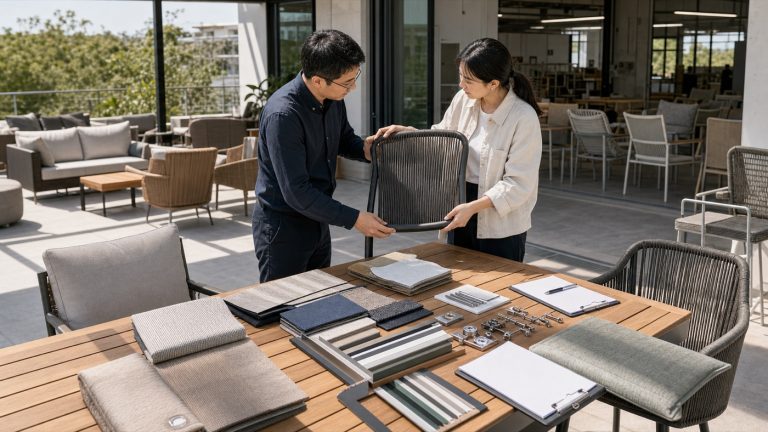
The Home Industry Insights editorial view is that outdoor furniture buyers should treat weatherability as a system. A patio chair is not one material. It is frame, coating, weld, hardware, rope or wicker, cushion fabric, foam, zipper, thread, glide, tabletop, packaging, care instructions, and spare-part logic. If one layer fails, the whole product can become a claim problem.
Why Outdoor Furniture Is Harder Than It Looks
Indoor furniture usually competes inside a relatively stable environment. Outdoor furniture competes against climate. The same product may be sold into a dry inland market, a coastal balcony, a humid garden, a poolside hotel, a shaded restaurant patio, or a sunny rooftop. Each environment creates a different failure pattern.
Coastal use increases corrosion risk, especially for steel frames, screws, welds, exposed cut edges, and cheap plated hardware. Strong sun can fade fabrics, embrittle plastic wicker, change rope color, dry wood, and weaken coatings. Rain and humidity can create mildew, swelling, staining, fastener rust, and water pooling inside poorly drained frames. Hotel and hospitality use adds cleaning chemicals, frequent movement, and heavier daily loading. Ecommerce adds another pressure: the buyer may not understand care limitations until the product has already failed.
This is why a generic claim such as “outdoor use” is not enough. Buyers need to know whether the supplier means covered patio, occasional garden use, poolside commercial use, marine-adjacent use, or full sun and rain exposure. A factory can make products for all of these lanes, but it should not describe them as if they were the same lane.
Frame Material Sets The Risk Baseline
The frame is the first sourcing decision because it defines weight, cost, corrosion risk, structure, and perceived value.
Aluminum is popular for outdoor dining chairs, sofas, loungers, and modular sets because it is light and naturally more corrosion resistant than ordinary steel. But aluminum is not automatically trouble-free. Wall thickness, alloy selection, weld quality, drainage holes, powder coating pretreatment, surface preparation, and hardware compatibility still matter. A thin aluminum frame may look attractive in a sample, but it can feel unstable, dent easily, or fail under repeated commercial handling.
Steel offers strength and lower cost, but corrosion control must be taken seriously. The buyer should ask whether the product uses powder-coated steel, galvanized steel, stainless steel, or a mixed construction. If a frame is steel but the sample room conversation only says “metal,” that is a warning sign. Steel products for humid or coastal markets need a much clearer coating and hardware plan.
Stainless steel can be appropriate for premium or commercial outdoor furniture, but even stainless grades and surface finishes need to match the environment. A buyer should not assume that every stainless claim means the same corrosion performance. Screws, brackets, weld areas, and hidden connectors may become the real weak point.
Wood frames and tabletops bring a different set of questions. Teak, acacia, eucalyptus, and other outdoor woods can all be used in furniture, but they differ in oil content, dimensional stability, appearance change, maintenance needs, and sourcing cost. The issue is not only whether a species is “outdoor wood.” It is whether the buyer understands expected color change, cracking, oiling requirements, end-grain sealing, hardware interaction, and origin documentation. This also connects with our earlier article on wood-origin traceability in furniture sourcing, because outdoor wood furniture often combines appearance, legality, and performance questions in one SKU.
Coating Is A Process, Not A Color
Outdoor furniture buyers often discuss powder coating by color and texture: matte black, warm white, bronze, sand, green, or stone gray. In practice, coating performance depends on the process behind the color.
A coating system can fail through peeling, blistering, chalking, fading, scratching, rust creep from damaged points, or poor adhesion around welds and corners. These failures often appear after the product has already shipped and reached the customer. That makes coating control a buyer-level issue.
At minimum, buyers should ask about pretreatment, powder type, coating thickness, curing control, adhesion checks, and corrosion screening. The ISO page for ISO 9227 salt spray tests describes methods for assessing corrosion resistance of metallic materials and coatings, while also noting that salt spray methods are not intended to predict long-term real-life corrosion resistance or rank different materials as a direct long-term forecast. That caveat is important. Salt spray can help reveal coating discontinuities or process problems, but it is not a magic warranty number.
For sourcing teams, the practical question is not “How many hours can you pass?” The better question is: which parts are tested, under what method, after what pretreatment, with what acceptance criteria, and for which end-use environment? A 500-hour or 1,000-hour claim without sample details, photos, failure criteria, and production linkage is weak evidence.
Rope, Wicker, And Plastic Materials Need Their Own Brief
The fastest-growing outdoor furniture looks often include rope, synthetic wicker, webbing, sling fabric, and mixed woven surfaces. These materials create the relaxed lifestyle look that sells well online and in showrooms. They also introduce UV, abrasion, tension, cleaning, and replacement questions.
Rope chairs and woven backs can look strong in a showroom, but buyers should ask about fiber type, UV stabilizer, colorfastness, stretch, abrasion, water absorption, drying behavior, and how the rope is attached to the frame. If the rope is wrapped around a metal tube, the contact area can become a wear point. If the product is used in hospitality, repeated movement and cleaning can expose weaknesses faster than residential use.
Synthetic wicker has similar issues. Low-grade PE wicker may become brittle, fade unevenly, crack at bends, or loosen from the frame. Better wicker systems control material compound, strand thickness, UV resistance, weave tension, color consistency, and repairability. A buyer should also ask whether the same wicker used in the sample will be used in mass production. Color changes between sample and production can be obvious on a large patio set.
For nonmetallic outdoor materials, accelerated UV exposure is often part of the sourcing conversation. ASTM’s page for ASTM G154 describes fluorescent UV lamp weathering devices that can use a range of exposure conditions. The sourcing lesson is simple: do not accept “UV tested” without knowing the test condition, duration, material tested, and pass/fail definition.
Cushion Fabric Is A Return Driver
Cushions often create the first visible customer complaint even when the frame is structurally fine. Outdoor cushions can fade, stain, absorb water, mildew, deform, leak dye, lose loft, or fail at seams and zippers. A beautiful frame can still become a bad review if the cushion looks tired after one season.
Buyers should separate outdoor fabric questions into several layers. The top fabric needs lightfastness, water repellency, abrasion resistance, cleaning compatibility, and color consistency. The filling needs drainage, recovery, thickness stability, and comfort. The thread, zipper, piping, and hook-and-loop details need their own material choices. A cushion that uses outdoor fabric but indoor-grade thread or zipper is not a complete outdoor cushion.
Textile lightfastness should also be discussed with real test references, not vague claims. AATCC’s TM16.3 Colorfastness to Light: Xenon-Arc page describes a test method for determining colorfastness to light of textile materials. In sourcing terms, the exact standard, test option, color, fabric type, and buyer acceptance level all matter. Dark navy, black, red, and certain greens may behave differently from beige or gray, so buyers should not approve a fabric family based only on one easy color.
This also links to our article on home textile labeling and sourcing control. Outdoor cushions are not just soft accessories. They are textile products with material, care, claim, and documentation implications.
Hardware And Small Parts Decide The After-Sales Cost
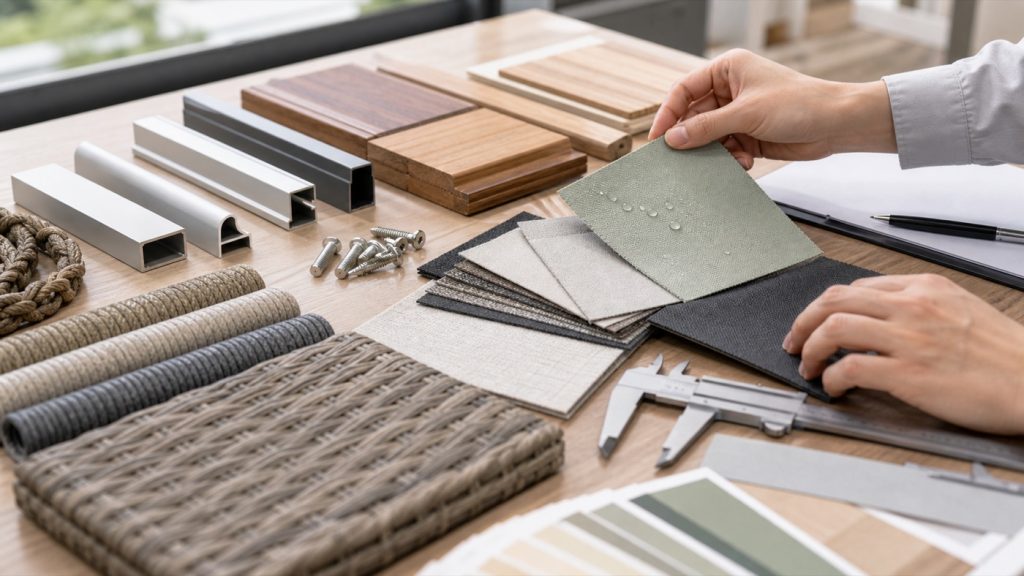
Outdoor furniture claims often start with small parts: rusting screws, loose feet, missing caps, cracked glides, bent brackets, failed leveling feet, poor clips, weak connectors, or mismatched bolts. These parts may be cheap individually, but they create expensive customer service cases when the product is bulky.
Buyers should ask suppliers to specify hardware material and finish, not only hardware quantity. Stainless screws, coated screws, zinc-plated steel screws, and mixed hardware packs do not carry the same risk. If a product has an aluminum frame but uses low-grade steel fasteners, the visible frame may survive while the fasteners become the failure point.
Hardware packs also matter for ecommerce and flat-pack outdoor furniture. Screws should be counted reliably, bagged by product or assembly step, protected from moisture, and matched to the instruction revision. If a chair arrives with the wrong screw length, the buyer may face both assembly complaints and structural risk.
For replacement strategy, outdoor furniture should be designed with predictable service parts: feet, glides, cushion covers, hardware packs, plastic caps, and sometimes rope or wicker repair kits. A supplier that can support spare parts reduces the buyer’s refund pressure.
Testing Should Match The Sales Channel
Outdoor furniture testing should not be copied blindly from one product to another. A balcony bistro set, a resort lounger, a steel garden bench, a rope dining chair, a wooden table, and a modular sectional do not fail in the same way.
For metal frames, useful checks may include coating adhesion, salt spray screening, weld quality, drainage, load stability, and assembly repeatability. For woven products, buyers should add UV behavior, tension retention, abrasion points, and attachment security. For cushions, testing may include lightfastness, water repellency, seam strength, zipper durability, foam recovery, and mildew-related care evaluation. For wood, buyers should discuss moisture content, finishing, cracking expectations, hardware interaction, and maintenance instructions.
The channel also changes the risk. Retail showroom furniture may be assembled by trained teams and delivered through controlled routes. Ecommerce furniture may be assembled by consumers, returned through parcel or LTL networks, and judged through photos in reviews. Hospitality furniture may be moved every day and cleaned aggressively. Project furniture may need replacement-part continuity across multiple phases.
This is why outdoor furniture belongs inside a broader sourcing system, not only a design file. The same logic appeared in our article on furniture packaging and transit damage: the product should be evaluated against the route it will actually travel. For outdoor furniture, the same principle applies to the climate and use environment it will actually face.
What Buyers Should Put Into The Supplier Brief
A strong outdoor furniture brief should be specific enough to prevent optimistic assumptions. It should define the intended market, use environment, channel, warranty expectation, and care position.
For example, the brief should say whether the product is for covered patio, full outdoor exposure, coastal market, poolside use, restaurant use, hotel use, balcony use, or seasonal residential use. It should identify whether the buyer expects year-round outdoor placement or seasonal storage. It should state whether cushions are intended to resist light rain, dry quickly after rain, or be stored when not in use.
The material section should list frame material, coating system, hardware material, tabletop material, rope or wicker material, fabric construction, foam type, zipper and thread requirements, and any restricted substitutions. The test section should identify which tests are required, which samples will be tested, what acceptance level is expected, and whether production lots need random verification.
The packaging section should reflect the fact that outdoor products often combine hard frames, soft cushions, glass or ceramic tops, visible coatings, and many small parts. Cushion compression, frame scratching, wet-container risk, and hardware bag control all need attention.
The care section should be honest. If a product needs cover storage, cushion storage, periodic wood oiling, freshwater rinsing in coastal areas, or avoidance of harsh chemicals, the buyer should know before launch. Care limitations are not a weakness if they are communicated clearly. They become a weakness when the product is marketed beyond its real use environment.
What Factories Can Do To Win Better Accounts
For factories, outdoor furniture weatherability can become a selling advantage. Many suppliers can make a good-looking sample. Fewer can explain why the material choices fit the target market and how production will keep those choices consistent.
Factories can start by building material libraries with approved frame profiles, coatings, wicker compounds, rope specifications, fabric options, foam options, hardware types, and test histories. The library should not be only a showroom display. It should connect to supplier records, purchase specs, inspection criteria, and approved substitution rules.
Factories should also separate residential, ecommerce, hospitality, and coastal product lines when the risk profile is different. A low-cost residential set should not be presented as if it were suitable for hotel poolside use. A hospitality-grade product should not be priced against a casual seasonal set without explaining the difference in frame, coating, fabric, hardware, and spare-parts support.
Finally, factories should keep claim feedback in a structured format. If a buyer reports faded cushions, rusted screws, cracked wicker, loose rope, water pooling, or damaged coating, the factory should connect that claim to material batch, product line, channel, packaging, and use environment. Over time, this feedback becomes product development data.
The 2026 Sourcing Takeaway
Outdoor furniture is becoming a more technical category because buyers are selling products into environments they cannot control. A terrace set may be photographed in perfect sunlight, but it may be used in humidity, salt air, intense UV, rain, heavy cleaning, or year-round exposure.
For buyers, the practical response is to stop treating “outdoor” as one product label. Ask what environment the product is built for, what materials carry the main risk, how those materials were tested, and what care expectations must be communicated to the final user.
For factories, the opportunity is to make weatherability visible. Clear material specs, realistic test records, honest use classifications, and spare-part support can separate a serious outdoor furniture supplier from a sample-only supplier.
The outdoor furniture market will still reward design, comfort, color, and room-scene presentation. But in sourcing, the products that last will increasingly be the products whose material story is understood before the order is placed.