
Home textiles often look simple at the point of sale. A towel, sheet set, curtain panel, cushion cover, throw blanket, table linen, or bedding accessory is easy for a consumer to judge by color, handfeel, size, and price. For buyers and suppliers, however, the product is also a labeling and claims system.
That system includes fiber content, country of origin, manufacturer or marketer identification, care information, packaging language, retailer-specific claims, and production records. If these details are treated as a late-stage packaging task, they can create shipment delays, relabeling costs, marketplace disputes, customer complaints, and compliance risk.
This is why home textile labeling is becoming a sourcing control point. The issue is not only whether a label is physically sewn into a product. The real question is whether the buyer, factory, fabric mill, packaging supplier, and inspection team are working from the same product data.

Labels Are Product Data, Not Decoration
In many home textile programs, labels are still managed too late. The fabric is selected, the color is approved, the sample is photographed, the carton is designed, and only then does the team ask what needs to be printed on the label. That sequence creates avoidable risk.
Fiber content needs to match the real material. Country of origin needs to reflect where the product was made or processed under the applicable rule. The responsible company name or RN needs to be correct. Care language should match the product construction, finishing, dyeing, trim, and expected use. Packaging claims need to be supported by records.
A label error can be more than a cosmetic issue. If a towel is labeled as cotton but contains a blended fiber, if a curtain is marketed with an unsupported recycled claim, if a bedding set mixes components with different fiber content, or if packaging and sewn-in labels conflict, the buyer may face a costly relabeling problem. The product may be physically good, but commercially incomplete.
For sourcing teams, the label should be treated like a bill of materials field, not like a graphic-design afterthought.
The U.S. Framework Starts With Identity, Fiber, And Origin
The U.S. Federal Trade Commission’s guidance, Threading Your Way Through the Labeling Requirements Under the Textile and Wool Acts, explains that textile and wool products covered by the rules generally need labels disclosing fiber content, country of origin, and the identity of the manufacturer or another business responsible for marketing or handling the item. NIST’s Guide to United States Apparel and Household Textiles Compliance Requirements also addresses household textiles and points to labeling areas such as fiber content, country of origin, care labeling, environmental labeling, and other category requirements.
The practical takeaway is that home textile buyers cannot rely only on supplier descriptions such as “cotton-like,” “linen feel,” “microfiber,” “bamboo style,” or “eco fabric.” Marketing language and legal fiber disclosure are different. A product team needs the actual fiber composition and the correct generic fiber names, not only the sales name used in a catalog.
This is especially important for blended products. A towel, duvet cover, curtain, cushion cover, or throw may combine cotton, polyester, viscose, linen, acrylic, wool, recycled fibers, elastane, or specialty yarns. The label should be based on the real composition of the finished product, and the factory should be able to trace that composition back to fabric supplier records.
Care Information Is A Commercial Promise
Care labeling can be misunderstood because different rules apply to different product types. The FTC’s Care Labeling Rule focuses on textile wearing apparel and certain piece goods. Home textile products are not all governed in the same way as apparel. Even so, care information is still commercially important for many household textile categories.
Retailers and consumers expect to know whether an item can be machine washed, tumble dried, ironed, bleached, dry cleaned, or washed separately. A printed care instruction that does not match the product can create shrinkage, color bleeding, fabric distortion, pilling, coating damage, or return claims.
For buyers, the safest approach is to treat care language as a tested product statement. If a curtain panel has a blackout coating, if a towel has a specialty finish, if a quilted bedding item combines shell fabric and filling, or if a decorative throw uses delicate yarns, the care statement should be reviewed against real washing and drying behavior. It should not be copied from last season’s label.
This is not only a customer-service issue. Care information affects returns, reviews, retailer scorecards, and repeat orders. A product that fails after the first wash can damage a brand even when the original label looked professional.
Claims Need Their Own Evidence
The home textile category is full of attractive claims: organic, recycled, natural, bamboo, linen-like, hypoallergenic, antimicrobial, cooling, moisture-wicking, wrinkle-resistant, stain-resistant, eco-friendly, low-impact, and chemical-conscious. Some of these claims may be useful. Some can become risky if the buyer cannot support them.
The problem often starts with loose supplier language. A fabric may be described as “bamboo” when the finished fiber is actually rayon or viscose. A product may be called “recycled” because one component contains recycled polyester, while the full set includes other materials. A towel may be marketed as “organic cotton” even though certification and chain-of-custody records are incomplete.
Buyers should separate the base label from marketing claims. The base label answers what the product is: fiber content, origin, and responsible party. Marketing claims answer how the product is being positioned. Each claim needs its own support, whether that comes from fabric mill documentation, certification, testing, supplier declarations, or chain-of-custody records.
If the evidence is not available before production, the claim should not be printed on packaging, marketplace content, hangtags, or product pages.
Multi-Component Sets Create Extra Risk
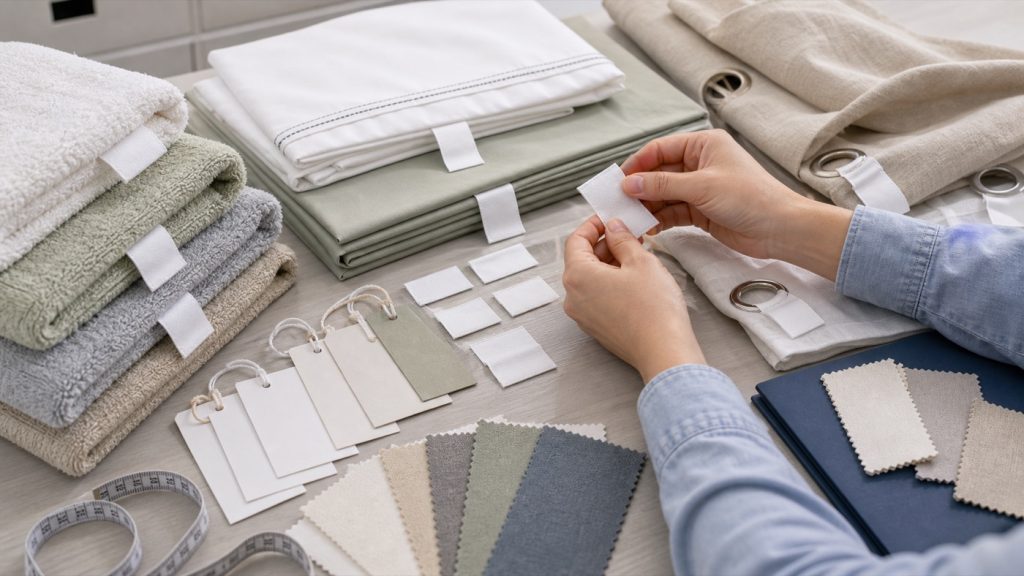
Home textiles often sell as sets. A bedding set may include a flat sheet, fitted sheet, duvet cover, pillowcases, shams, and decorative cushions. A bathroom set may include towels of different weights or trims. A curtain set may include panels, tiebacks, hooks, linings, or blackout layers. A table linen set may combine napkins, runners, placemats, and packaging inserts.
Sets can create labeling complexity because not every component is identical. The main fabric may be cotton, the filling may be polyester, the lining may be a coated fabric, and the decorative trim may use another fiber. If the label or package describes the entire set too broadly, the buyer may create a mismatch between product reality and consumer-facing information.
This is why the product data sheet should list each component. The buyer should know whether the same label covers all pieces, whether separate labels are required, whether the package description is accurate, and whether the care instruction applies to every component. A label that is correct for a plain sheet may not be correct for a quilted duvet cover or lined curtain.
For factories, the important discipline is version control. If a trim, lining, filling, yarn, coating, or supplier changes, the label and package data may also need to change.
Country Of Origin Should Not Be Left To The Shipping Team
Country-of-origin marking is often treated as a customs or logistics task. In home textiles, it should be considered earlier because production can involve multiple steps across different locations: yarn sourcing, fabric weaving or knitting, dyeing, printing, finishing, cutting, sewing, embroidery, quilting, packaging, and kitting.
The sourcing team should know how the origin statement is determined for the finished product and whether packaging, sewn labels, invoices, and shipping documents are aligned. If a buyer sources fabric from one country and sewing from another, it should not wait until the carton is ready to decide what the label says.
This is especially important for private-label programs. The brand may be responsible for the consumer-facing claim, but the factory and suppliers control much of the production evidence. A strong sourcing process brings those records together before the purchase order is released.
What Buyers Should Ask Before Approving A Home Textile SKU
A practical label review begins with product structure. What is the finished product? Is it a single item or a set? Which components are textile products? Which components have different fiber content, filling, coating, lining, or trim?
The next layer is label data. What is the exact fiber content by component? Which generic fiber names are used? What is the country of origin? Which company name or RN appears on the label? Does the package language match the sewn label? Is the label durable, visible, and attached in a way that remains through normal merchandising and delivery?
The third layer is care and claim support. Has the care instruction been reviewed against wash testing, shrinkage, colorfastness, coating behavior, and trim performance? Are claims such as recycled, organic, bamboo, antimicrobial, cooling, or stain-resistant supported by supplier documents or test records? Are unsupported claims removed from packaging and product pages?
The final layer is production control. Who approves label artwork? Who checks the label before bulk printing? Who verifies label placement during production? How are label rolls, hangtags, packaging sleeves, and cartons matched to the correct SKU and market? What happens if the fabric supplier changes?
These questions are basic, but they prevent many expensive mistakes.
What Factories Should Build Into Their Workflow
Factories that want to serve serious home textile buyers should build label control into sampling and production. The factory should maintain a product data sheet by SKU, fabric supplier records, fiber composition documents, origin information, approved label artwork, approved package copy, care instruction records, and a change-control process.
The sales team should avoid using vague phrases that the label cannot support. The purchasing team should not substitute fabric or trim without checking whether label data changes. The packaging team should not print cartons or inserts before the buyer confirms final wording. The inspection team should verify not only stitching, color, size, and packing, but also label presence, label placement, and package consistency.
This discipline connects to other sourcing controls we have discussed. Like composite wood documentation, textile labeling depends on material traceability. Like furniture packaging control, it depends on matching the right physical product to the right information before shipment.
The Home Industry Insights View
Home textile labeling is becoming more important because the market is becoming more claims-driven, more cross-border, and more private-label oriented. A label is not only a small piece of fabric. It is a public statement about the product.
For buyers, the lesson is to review labels as product data. For factories, the opportunity is to make label accuracy part of supplier capability. A factory that can control fiber records, origin information, care language, claim support, label placement, and packaging consistency is easier to trust with repeat programs.
In home textiles, the product may be soft, but the data behind it needs to be disciplined. That is what turns a good-looking sample into a scalable product line.