
Power recliners and lift chairs have moved well beyond a manual lounge mechanism with an added motor. A current model can combine a linear actuator, control box, hand control or switch, reclining and headrest functions, USB charging, battery backup, heat or massage options, and sometimes Bluetooth or app control. That makes the category relevant to furniture retailers, mobility-focused dealers, ecommerce brands, hospitality buyers, and sourcing teams that want a higher-value upholstered seating offer.
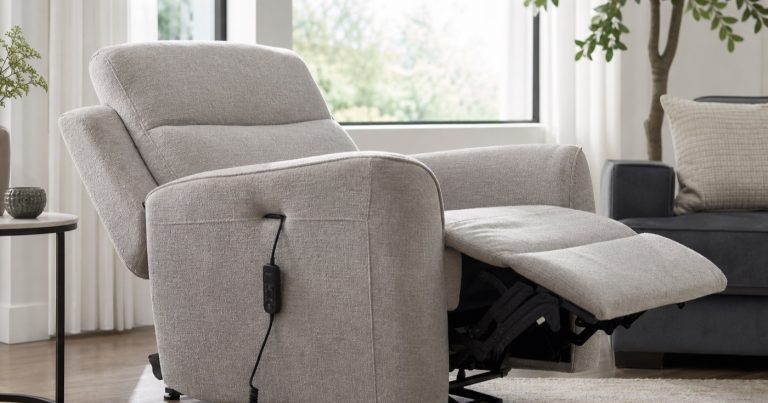
The Home Industry Insights view is that a smart power recliner should be sourced as a moving furniture system with an after-sales plan. Comfort and styling still sell the chair, but the commercial result is decided by quiet, stable motion; safe moving zones; dependable controls; practical service access; recoverable packaging; and the ability to replace a single failed component without replacing the whole chair.
Why Power Recliners Need A Different Buying Lens
A standard upholstered chair already asks buyers to review the frame, foam, suspension, cover, stitching, dimensions, comfort, carton, and container loading. A power recliner adds a mechanical and electrical layer beneath the seat. One weak part can change the customer experience completely: a noisy actuator, a cable that pulls loose, a control switch that feels cheap, a footrest that stops out of alignment, or a power supply that cannot be replaced quickly.
The category also serves several distinct use cases. A compact apartment recliner may need wall-hugger geometry and easy plug access. A retail chain may need an easy-to-explain remote and low return risk. A lift chair aimed at mobility support may need a slower, stable rise function, clear hand-control layout, backup power logic, and a stronger service network. A premium cinema-style recliner may add powered headrest, lumbar adjustment, cupholder lighting, or modular sectional connections.
Those are not interchangeable specifications. Buyers should start with the user journey and channel position, then choose a mechanism and feature package that matches it. The best product is rarely the chair with the longest feature list. It is the chair whose moving parts, control method, upholstery construction, packaging, and warranty model make sense together.
The Mechanism Is The Product Core
The most important invisible decision is the motion architecture. A power recliner can use one motor for a linked back-and-footrest movement, separate motors for backrest and footrest adjustment, or additional actuators for headrest, lumbar, or lift functions. Each architecture changes the bill of materials, control logic, motion path, trouble-shooting process, and service stock.
Buyers should ask the supplier to demonstrate the exact production mechanism under load, not a loose mechanism sample or a chair from another collection. The test review should include full extension, return, repeated intermediate stops, one-sided user loading, normal seated weight, footrest movement, backrest alignment, end-stop consistency, and sound. Listen for clicking, rubbing, metal contact, gear chatter, or a motor that changes speed as the chair moves.
A mechanism also needs a realistic load definition. The supplier should state the rated user load, the intended duty cycle, any paired-seat or console limitations, and the test configuration. A wide power recliner may look like a single chair but behave differently from a narrow recliner when a user sits near one arm. Modular systems need particular attention at connecting points, where a small difference in frame height, cable route, or mechanism alignment can turn into a visible gap or uneven motion.
This is related to our earlier article on sofa cushion durability. Comfort cannot be evaluated only on day one. The foam, suspension, and seat deck need to retain their support while the mechanism continues to move underneath them.
Controls Should Be Simple Before They Are Smart
There are several common control choices: a two-button arm switch, a multi-button wired hand control, a wireless remote, a touch strip, a hidden control panel, or an app-linked system. The interface can support product differentiation, but it also creates one of the most visible failure points.
A basic chair should be operable by a first-time user without reading a long manual. Button symbols need to be clear, positions should be reachable when the chair is partly reclined, and a wired hand control should have a deliberate storage position so it does not fall behind the seat. A hand control that is too small or tightly attached can be difficult for older users or users with limited grip strength. A side switch that looks elegant but sits behind a thick arm cushion can be equally frustrating.
For lift chairs, the control should make the direction of movement obvious. The chair must not surprise the user by moving quickly or continuing when the intended motion has stopped. Buyers should ask for failure-mode behavior: what happens if the handset cable disconnects, a button sticks, the controller loses power, or the chair reaches an end stop? The answer should exist in a wiring diagram and service guide, not only in a salesperson’s explanation.
App and wireless options should only be added where they solve a real problem. If a chair includes Bluetooth, Wi-Fi, or a radio remote, the buyer should lock the exact module and firmware version. In the United States, the FCC’s rules on marketing radio frequency devices are a useful official reference. For Europe, the European Commission’s Radio Equipment Directive page is the official starting point for radio equipment. The exact compliance route depends on the product configuration and sales market, so it should be confirmed for the finished chair rather than assumed from a component brochure.
Moving Gaps And Pinch Points Need Early Review
Smart furniture is often discussed as a controls or connectivity topic. In a recliner, the immediate safety question can be mechanical. Footrest linkages, seat-to-leg-rest gaps, scissor mechanisms, pivot arms, and base clearances can create access points while the chair is moving.
Historic CPSC recalls are a useful reminder of why this matters. The agency’s recall notice for glider recliners with ottomans described exposed gaps and moving parts that could create entrapment, pinching, and crushing hazards. A separate CPSC notice for power reclining furniture documented an overheating switch hazard. These are recall examples, not a substitute for product-specific testing, but they make the sourcing lesson clear: moving geometry and electrical parts need to be reviewed as finished-furniture risks.
During sample approval, inspect the underside and rear of the chair in every motion state. Check whether small hands can access moving parts, whether fabric or a throw blanket can snag, whether cables can rub on sharp metal edges, and whether a loose object under the chair can interfere with travel. Where guards, fabric flaps, cable sleeves, strain relief, or limit logic are used, they should be inspected in the production configuration rather than added cosmetically to a pre-production sample.
Power Supply, Battery Backup, And Cable Routing Are Warranty Decisions
Most field failures are not glamorous. A damaged adapter, loose connector, pinched cable, failing transformer, or handset lead can disable an otherwise good chair. The electrical path should therefore be documented from wall plug to power supply, control box, actuator, switch, and any USB or wireless modules.
Buyers should request the component list with model numbers, voltage and current ratings, connector types, fuse or protection details where applicable, cable lengths, and approved substitution rules. If a supplier changes a power supply or control box, the buyer should know whether the new part changes output, noise, heat, connector fit, certification coverage, or service compatibility.
Battery backup is another feature that needs plain-language definition. Some systems only support a limited return movement during a power outage. Others require separate batteries, have replacement intervals, or are not intended for repeated operation. A product page should not imply continuous use during an outage when the actual design is only meant to return the chair to a safe seated position. The user manual and retailer training material should say exactly what the backup does.
Furniture with embedded electrical functions should also be assessed as finished furniture, not merely as a collection of bought-in parts. UL 962 covers household and commercial furnishings and lists related furniture power distribution material. It is a useful reference point for buyers who need to discuss electrical furnishing requirements with a qualified test laboratory or market-compliance specialist. It does not eliminate the need to confirm the appropriate route for the exact chair, power supply, and destination market.
Lift Functions Need Stable Motion And Clear Positioning
Lift chairs deserve a separate product brief because they are not simply recliners with a higher price. The lift action changes the frame geometry, actuator loading, center of gravity, and user expectation. A chair that feels stable in a reclined position may behave differently while raising a person forward toward standing.
Buyers should observe the entire rise sequence with realistic user weight, not only an empty chair. Check the first movement from the seated position, side-to-side stability, arm support, foot position, motion speed, noise, and the final angle. The chair should also be evaluated on normal flooring, not only a perfectly level factory floor. Thick carpet, uneven floorboards, and a rug edge can change the real experience.
For a mobility-oriented retail channel, service instructions matter as much as marketing copy. Retail staff need to know the chair’s intended use, user-load limit, wall-clearance requirement, battery-backup behavior, and what to do when the chair does not return. The manufacturer should be able to supply a parts diagram, fault guide, and replacement process that a trained service partner can follow.
Upholstery And Frame Engineering Cannot Be Separated From Motion
Power recliners are still upholstered furniture. The mechanism creates more pressure points and movement zones than a fixed chair, which makes fabric choice, seam placement, foam geometry, and frame clearance more important. A cover that looks clean on a static sample may pull tight at the footrest, wrinkle badly at the lumbar area, or rub against metal during repeated cycles.
Buyers should ask to see the chair fully upright, partially reclined, and fully extended in every selected cover. Inspect seam tension, cushion recovery, visible fabric stress, clearance around the mechanism, and whether the cable or control panel affects the arm upholstery. For leather and coated fabrics, look at flex points around the footrest and headrest. For loose fiber-fill back cushions, check whether motion shifts the filling away from the visible support zones.
Frame and mechanism integration matter too. Screw pull-out strength, reinforcement at the actuator mounts, metal-to-wood connection points, weld consistency, and transverse rails should be assessed with the product’s actual upholstery and seating system in place. A robust-looking metal mechanism cannot compensate for a weak frame interface.
Packaging Must Protect A More Complicated Chair
A power recliner travels with parts that a conventional chair does not have: actuator, control box, power supply, remote, cable harnesses, switches, and sometimes detachable backs or modular connectors. The carton must protect the upholstery and the mechanism at the same time.
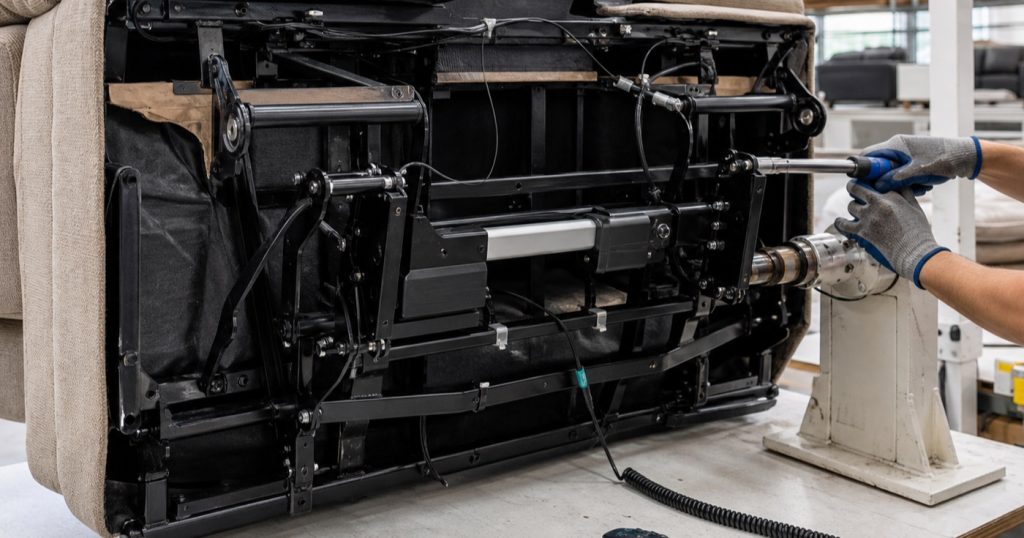
The packaging review should include protection for the arm switch, remote storage, plug and power supply, footrest edge, mechanism protrusions, and any detachable-back latch. If the chair ships in two pieces, the assembly instructions must match the real carton layout and cable routing. A customer should not have to pull a cable through a tight gap or guess which connector belongs to which motor.
Our earlier article on furniture packaging and transit damage is especially relevant here. A small impact that bends a linkage, damages an actuator connector, or pulls a cable clamp loose may remain hidden until the customer tries to recline. Buyers should ask for drop-test logic, carton orientation, corner protection, hardware retention, power-supply protection, and a clear method for identifying hidden transit damage before final installation.
Service Parts Are The Commercial Difference
A smart power recliner has a longer after-sales tail than a manual chair. The supplier should be able to identify and stock the actuator, control box, power supply, hand control, arm switch, cable harness, battery pack, transformer, bracket, mechanism section, remote, and relevant hardware. Each part needs a stable code, photo, compatibility note, and replacement method.
The buyer should not accept a vague promise that spare parts are available. Ask which parts are replaceable in a customer’s home, which require a technician, which require partial upholstery removal, and which require the chair to be returned. A low-cost actuator is not a useful spare part if accessing it takes two hours and damages the cover.
Service planning should also cover substitutions. A factory may be able to source several similar actuators or controllers, but a replacement must match stroke, force, connector, mounting, motion logic, and controller firmware. A supplier’s change-control process should require buyer approval before a different electronic or mechanical component is used in production.
What To Request Before A Power Recliner Launch
Before approving a smart power recliner or lift chair, buyers should build a finished-product file. It should include the upholstered specification, frame drawing, mechanism drawing, actuator and control-box details, motion sequence, control layout, wiring diagram, power-supply details, user-load limit, assembly instructions, warning labels, packaging drawing, test plan, service-parts list, and change-control rules.
The sample review should cover comfort, motion quality, noise, stability, pinch-point visibility, cable routing, endpoint behavior, upholstery tension, USB or wireless features if selected, wall clearance, carton recovery, and repair access. The commercial review should cover parts stock, lead time, service labor assumptions, warranty process, destination-market documentation, and whether the supplier can hold the same configuration over repeat orders.
2026 Takeaway
Power recliners and lift chairs are a strong example of where smart furniture becomes operational rather than decorative. The chair may win attention through a smooth recline, powered headrest, lift function, or neat control panel. It earns repeat business when the mechanism stays quiet, the cables stay protected, the motion remains stable, the customer understands the controls, and the retailer can repair a failed part without a costly return.
For buyers and distributors, the most useful question is not simply whether a supplier can add motors to an upholstered chair. It is whether that supplier can deliver a stable motion system, safe moving geometry, documented electrical components, realistic packaging, and a service-parts program that still works after the container has been sold through.