
A sofa is often sold through shape, fabric, color, room styling, and the first few seconds of sitting comfort. But for importers, retailers, distributors, and sourcing teams, the real commercial test starts later. Does the seat keep its support after months of use? Does the cushion recover after compression? Does the fabric resist abrasion and pilling? Does the customer still believe the sofa is worth the price after the showroom feeling has disappeared?
This is why sofa cushion durability is becoming a sourcing filter. It is not only a product-development detail for the factory. It affects returns, reviews, warranty cost, replacement-part planning, retail trust, and brand positioning. A sofa with a strong frame but weak seat construction can still become an after-sales problem.
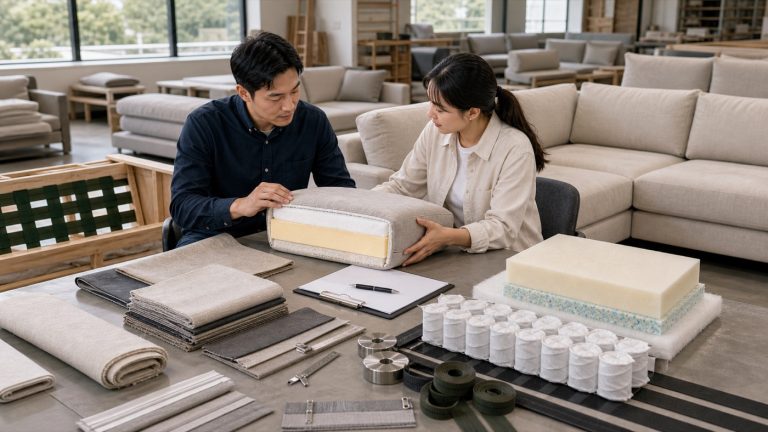
The Home Industry Insights editorial view is that sofa sourcing teams should treat cushion durability as a system. Foam, fiber wrap, pocket springs, webbing, fabric, seam construction, zipper quality, cushion shape, packaging compression, and user expectations all work together. If the buyer evaluates only appearance and sample comfort, the real risk is left inside the cushion.
Why First-Sit Comfort Can Mislead Buyers
Showroom comfort is important, but it can be deceptive. A very soft seat may feel attractive in the first minute, especially for lifestyle photography and retail display. That same softness may turn into early sagging, poor recovery, or uneven seating after normal use. A very firm seat may feel durable, but it can perform badly in markets where consumers expect a relaxed lounge experience.
The sourcing problem is that “comfortable” is not a technical specification. It is a result created by cushion thickness, foam type, foam density, indentation force, support layers, spring or webbing system, upholstery tension, seat depth, back cushion angle, and user body weight. If a buyer simply approves a sample by sitting on it, the final order may still vary because one hidden layer changed.
This matters more for sofas than for many other furniture categories. A cabinet may be judged by storage, finish, hardware, and dimensions. A dining table may be judged by stability, surface, and packaging. A sofa is judged through repeated body contact. The user may sit, lie down, lean, shift weight, and use the same seat position every day. Small differences in cushion construction can become visible quickly.
Foam Density Is Not The Whole Story
Foam density is one of the first numbers buyers ask about, and it does matter. Higher-density polyurethane foam often has better long-term support potential than low-density foam. But density alone does not tell the full story.
Two foam samples with similar density can feel different and age differently because of foam chemistry, cell structure, firmness, resilience, compression set, air permeability, production consistency, and whether the foam is used as a core layer or comfort layer. A supplier may quote “high density foam” without explaining whether it is the main support core, a thin topper, a mixed recycled layer, or a marketing description.
ASTM’s page for ASTM D3574 describes test methods for flexible cellular materials such as slab, bonded, and molded urethane foams. For furniture buyers, the practical lesson is not that one standard number will solve the entire sourcing problem. The lesson is that foam should be discussed through measurable properties: density, firmness, compression behavior, tensile and tear properties where relevant, and recovery after repeated use.
Buyers should also ask whether the quoted foam is local-market foam, export-order foam, or production foam from the same batch family as the approved sample. In some factories, sample-room foam can be better than mass-production foam. In other cases, a factory may change foam supplier due to price or availability without making the change visible to the buyer. This is where a material approval sheet becomes more useful than a verbal promise.
Seat Construction Is More Than One Cushion
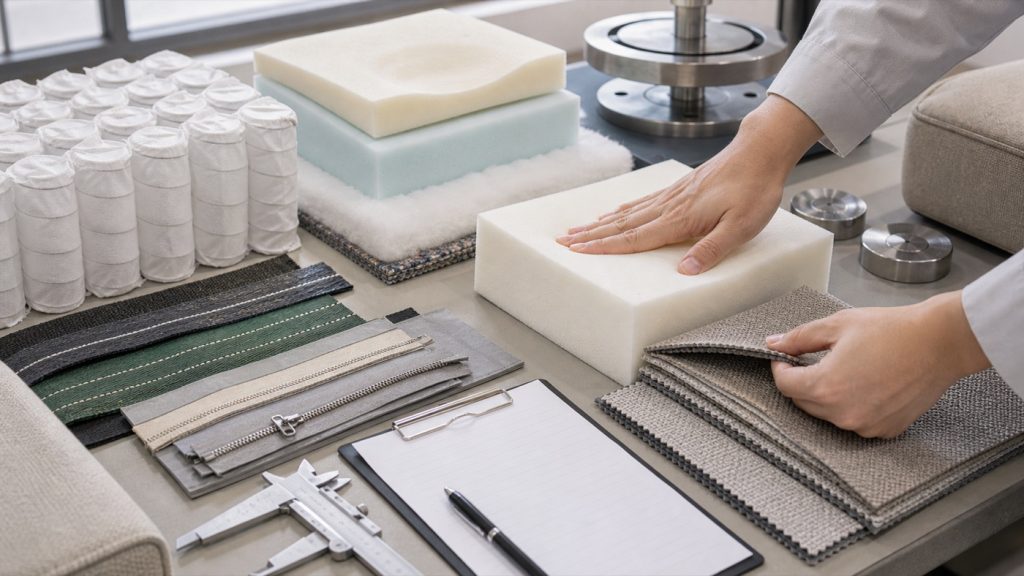
A sofa seat is not only a foam block. Many products combine several layers:
High-resilience foam or conventional polyurethane foam as the support core.
Softer foam, memory foam, or latex-like comfort layers for the top feel.
Fiber wrap or batting to create a fuller, softer look.
Pocket springs, sinuous springs, elastic webbing, or plywood decking as the support base.
Fabric, leather, faux leather, or performance textile as the outer surface.
Zippers, inner liners, thread, seam allowances, and cushion-box construction.
The buyer should know which layer is creating the comfort and which layer is carrying the load. If the top layer is soft but the base support is weak, the cushion may feel good in the showroom but collapse quickly. If the support base is strong but the fiber wrap shifts, the cushion may look wrinkled or uneven even when the foam core is still acceptable.
Pocket springs can improve bounce and support, but they need correct placement, covering, and edge control. Sinuous springs can work well, but wire gauge, spacing, fastening, and frame attachment matter. Elastic webbing can create a clean contemporary feel, but weak webbing or poor tension can lead to hammocking. A buyer should not approve these structures only by category name.
Fabric Wear Changes The Customer's View Of Quality
Even when the cushion core performs well, upholstery fabric can change the perceived quality of the sofa. Pilling, abrasion, color change, seam stress, loose threads, fabric stretching, and local shine can all make a sofa look older than it is.
Abrasion testing is common in upholstery sourcing conversations, but buyers should be careful with simple cycle-count claims. ASTM’s page for ASTM D4966 describes the Martindale abrasion tester method and also notes important limitations: abrasion results can vary with testing conditions, abradant, pressure, evaluation method, and laboratory practice, and abrasion resistance should not be treated as a direct prediction of actual wear life in every end use.
That caveat is useful for sourcing. A fabric that performs well in one lab condition may still disappoint if the yarn pills, the surface attracts lint, the color shows wear, or the customer uses the sofa heavily. A buyer should ask what test method was used, which fabric color was tested, what result was achieved, what failure criterion was applied, and whether the tested fabric is exactly the fabric used in production.
Fabric selection also interacts with channel. A sofa sold online may rely heavily on product photos and review images. If the fabric pills quickly, negative reviews may appear before the frame has any issue. A sofa sold through a showroom may face more trial sitting before purchase. A sofa used in apartments, rental properties, lounges, or hospitality settings may need a more conservative fabric specification than a low-frequency residential sofa.
Sample Approval Should Lock The Hidden Layers
Sofa samples can be dangerous when the approval process focuses only on appearance. A sample may look right, photograph well, and feel comfortable, while the internal material structure remains loosely documented.
A strong sample approval should lock these details:
Foam density, firmness range, layer thickness, supplier, and approved alternatives.
Spring or webbing system, spacing, attachment method, and support board specification.
Fiber wrap weight, liner material, cushion casing construction, and zipper quality.
Fabric supplier, fabric code, color, backing, abrasion result, pilling expectation, and cleaning guidance.
Seat depth, cushion crown, seam position, stitch density, and tolerance range.
Packaging method, cushion compression limit, and recovery time after unpacking.
If these details are not locked, the buyer is approving a look rather than a product. The factory may still produce acceptable goods, but the risk is higher. If any layer changes after approval, the buyer should receive a change notice with reason, performance impact, cost impact, and new test or material evidence.
This principle is similar to broader material control in furniture sourcing. In our article on composite wood compliance in furniture sourcing, we noted that hidden panels can carry documentation risk even when the finished product looks normal. Sofa cushions create a parallel issue: the hidden construction defines long-term performance even when the outside appearance is unchanged.
Packaging Can Damage The Cushion Story
Sofa cushion durability is not only about the material itself. Packaging and logistics can change the customer’s first experience.
Many sofas are shipped with compressed cushions to reduce carton volume. Compression can be practical, but it should be controlled. If a cushion is compressed too tightly, stored too long, exposed to heat, or packed before the foam has stabilized, the seat may arrive with poor recovery, wrinkles, uneven loft, or a permanent impression. The customer may interpret this as low quality even if the factory used acceptable materials.
Buyers should ask how long cushions can remain compressed, what recovery time is expected, whether the product needs unpacking instructions, and whether the test shipment used the same compression method as mass production. A sample hand-delivered from the factory is not enough evidence for ecommerce shipment.
This also connects with our earlier analysis of furniture packaging and transit damage. For sofas, packaging quality is not limited to broken frames or crushed cartons. It also includes cushion recovery, fabric abrasion inside the carton, moisture risk, hardware protection, and customer assembly sequence.
Returns Often Start With Expectation Gaps
Some sofa complaints are real product failures. Others are expectation gaps created by unclear positioning.
If a sofa is marketed as deep, plush, and cloud-like, customers may expect visible softness and accept more cushion maintenance. If it is marketed as structured and supportive, early sagging will feel like a defect. If the product is sold as family-room furniture, the buyer should assume frequent sitting, children, food spills, and repeat use. If it is sold as occasional accent seating, the durability expectation may be different.
Sourcing teams should therefore connect the product brief with the sales promise. A low-cost sofa cannot carry the same performance claim as a premium performance-fabric sectional unless the material system supports it. A thick cushion is not automatically durable. A hard cushion is not automatically high quality. A premium fabric name does not guarantee seam strength, zipper durability, or cushion recovery.
The best buyer briefs define the intended price band, channel, use frequency, target feel, expected recovery, warranty tolerance, and care language. That makes it easier for the factory to choose the right construction and for the buyer to judge whether the sample is truly aligned with the commercial plan.
What Buyers Should Ask Suppliers
For a new sofa program, buyers should ask for a cushion bill of materials, not only a product photo and price sheet. The cushion BOM should list foam type, density, firmness range, thickness, layer structure, fiber wrap, spring or webbing support, fabric code, zipper, thread, liner, and any approved substitutes.
Buyers should request test evidence that matches the claims being made. If the supplier claims high-resilience foam, ask what property supports that claim. If the supplier claims high abrasion fabric, ask which test method and failure criterion were used. If the supplier claims anti-pilling performance, ask whether the exact color and fabric backing were tested.
Buyers should compare sample and production materials. A simple destructive check can be useful: open one pre-production cushion and confirm layer structure, thickness, and material labels against the approved spec. For large orders, random production checks can prevent quiet substitution.
Buyers should also ask about warranty history. Which complaints occur most often: sagging, foam collapse, fabric pilling, seam opening, zipper failure, uneven cushions, loose webbing, frame noise, or packaging deformation? A serious factory should be able to discuss claim patterns by SKU and material type, not only say that complaints are rare.
What Factories Can Do Better
For factories, cushion durability can become a competitive advantage. Many suppliers can copy a sofa outline. Fewer can explain why a cushion construction fits a specific market, price band, channel, and warranty expectation.
Factories should build a material library that connects foam, fabric, support systems, and test records. Each approved foam should have density, firmness range, supplier, intended use, and cost position. Each fabric should have abrasion, pilling, color, backing, cleaning, and channel notes. Each support system should have a known feel and durability profile.
Factories should also keep sample, pre-production, and mass-production materials aligned. If a buyer approves a cushion made with one foam supplier and the factory later changes supplier, the change should not be hidden. If production needs a substitute fabric, the substitute should be tested and approved before shipment.
Claim feedback should feed back into design. If one sofa line receives repeated sagging complaints, the factory should check foam density, cushion size, webbing tension, use environment, packaging compression, and customer expectations. If one fabric receives pilling complaints, the factory should check yarn, finishing, backing, and whether the fabric was appropriate for the channel.
The 2026 Sourcing Takeaway
Sofa cushion durability is becoming more important because customers judge sofas over time, not only at purchase. A beautiful product photo can win attention, but daily sitting determines reviews, repeat orders, and warranty cost.
For buyers, the practical step is to move from visual approval to construction approval. Ask what is inside the cushion, how the material was tested, what can change during production, and how the product is expected to recover after shipping and use.
For factories, the opportunity is to make comfort measurable and repeatable. Clear cushion specifications, controlled material substitution, realistic testing, and claim feedback can help a supplier move from sample-making to long-term account support.
The sofa market will always reward design and comfort. But in sourcing, the next filter is durability that can be explained before the order is placed and defended after the product reaches the customer’s home.