
Smart bathroom mirror cabinets are moving beyond a simple mirror above a sink. In many product lines, the cabinet now combines mirror glass, LED lighting, demister heating, touch control, internal storage, outlet or USB modules, Bluetooth audio, ventilation details, and a matching bathroom vanity.
That makes the category useful for retailers, project suppliers, hotel bathroom programs, apartment fit-out teams, and online home brands. It also makes the product harder to source than it first appears. A smart mirror cabinet sits in a humid room, is installed on a wall, is touched with wet hands, may include live electrical parts, and still has to behave like furniture: doors must align, hinges must hold, shelves must be practical, packaging must protect glass, and service parts must be available after shipment.
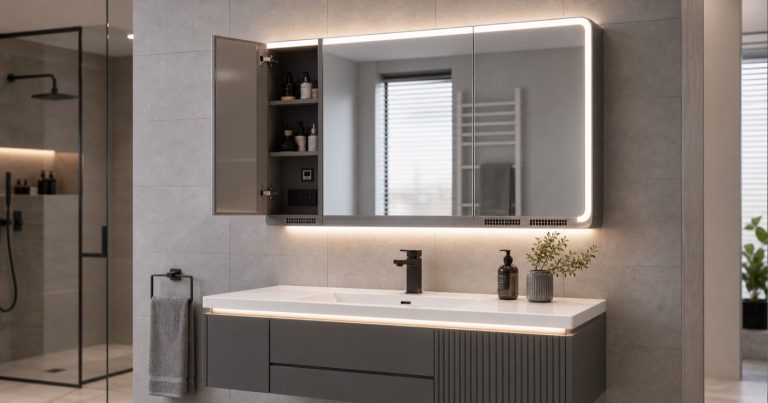
The Home Industry Insights view is that smart bathroom mirror cabinets should be sourced as wet-room furniture systems, not as decorative mirrors with extra electronics. Buyers who treat the category as a combined furniture, glass, lighting, electrical, installation, and after-sales product will have fewer surprises when the first container reaches the market.
Why This Is A Different Smart Furniture Category
Many smart furniture products are used in relatively dry rooms. A charging nightstand, height-adjustable desk, smart wardrobe, or TV lift cabinet usually faces dust, heat, wiring, customer assembly, and mechanical durability. A bathroom mirror cabinet adds another layer: moisture exposure.
The product may be installed close to a shower, above a basin, inside a compact apartment bathroom, or in a hotel room where ventilation is inconsistent. Steam, condensation, cleaning chemicals, toothpaste residue, and repeated wet-hand operation all affect the product. The cabinet body must resist swelling and corrosion. The mirror must remain clean and stable. The electrical modules must be protected and documented. The lighting must be comfortable enough for daily use. The cabinet door must keep working even when the mirror panel is heavy.
This is why smart bathroom mirror cabinets are not only a bathroom accessory. For buyers, they are a small system product with several failure points.
LED Lighting Is A Product Decision, Not Decoration
LED lighting is often the most visible selling point. Buyers may request front lighting, back lighting, under-cabinet lighting, color-temperature adjustment, dimming, motion activation, or memory settings. The showroom effect can be strong, but the sourcing question is practical: does the lighting work for a real bathroom routine?
For daily use, mirror lighting must reduce face shadows, avoid harsh glare, and maintain consistent color across the mirror. A weak strip behind frosted glass may look good in photos but fail in actual grooming or makeup use. A bright strip without diffusion can create glare, hot spots, and customer complaints. The light color should also match the market position. A hotel program, apartment project, and ecommerce vanity line may not want the same color temperature or control logic.
Buyers should ask for LED module specifications, power rating, driver details, replacement method, color-temperature tolerance, dimming behavior, heat data, and lifetime assumptions. If the same cabinet is sold in different markets, electrical documentation should follow the destination market rather than the factory’s default domestic configuration.
Demister Heating Needs Thermal Discipline
Defogging is another feature that looks simple but deserves careful review. A demister pad or heating film behind the mirror can clear a central area after shower steam, but the buyer should understand its size, location, operating temperature, power draw, switch logic, and shutoff behavior.
Poorly specified demister systems can create uneven clearing, excessive local heat, customer confusion, or unnecessary energy use. The cleared area may also be smaller than the mirror photo suggests. If the demister zone is only a small rectangle, the product page and instruction sheet should not imply the whole mirror clears instantly.
Thermal behavior matters because the demister sits behind glass and near cabinet materials. Buyers should ask whether the supplier has tested the mirror surface temperature, backing material compatibility, adhesive performance, wiring route, switch life, and long-duration operation. For hotel and rental projects, automatic timeout can reduce misuse and reduce after-sales risk.
Wet-Room Wiring Is Not Ordinary Cabinet Wiring
A bathroom cabinet with lighting, demister, outlet, USB module, speaker, or sensor needs more than tidy cable routing. It needs a wiring plan that respects bathroom use.
Important questions include where the power enters the cabinet, whether cables are protected from sharp metal edges, how connectors are fixed, how the low-voltage and mains-voltage areas are separated, whether service access is possible after wall installation, and whether the design relies on installers making undocumented decisions on site.
The source of compliance expectations depends on the destination market and the exact product configuration. UL’s product page for UL 962 frames the standard around household and commercial furnishings. For smart bathroom cabinets, the lesson is practical even when the final applicable route needs professional confirmation: once furniture contains electrical functions, the finished furniture configuration matters.
Buyers should not approve a smart mirror cabinet from a beauty photo alone. They should review the wiring diagram, component list, installation method, labels, instruction sheets, and the supplier’s change-control process for power supplies, LED drivers, switches, connectors, and outlet modules.
Outlets And USB Ports Need Use-Case Control
Internal outlets and USB ports are attractive because bathrooms need charging and grooming support. But placement is critical. A socket hidden too deep inside a narrow cabinet may be inconvenient. A module too close to wet storage areas may create risk. A USB port without output labeling may create customer complaints when devices charge slowly.
The product brief should define the use case. Is the outlet for an electric toothbrush, shaver, hair trimmer, rechargeable beauty device, small speaker, or phone? Does the customer need one AC outlet, two outlets, USB-A, USB-C, or a replaceable module? Does the cabinet need a cable pass-through? Is the outlet accessible when shelves are loaded with bottles?
This connects with our earlier article on charging furniture and USB-C strategy. Embedded power features should not be treated as generic add-ons. Buyers need output specifications, labeling, supplier traceability, heat control, and replacement logic.
Wireless Features Bring Documentation Work
Some smart mirror cabinets include Bluetooth speakers, app-linked lighting, touch panels with memory functions, voice control, Wi-Fi modules, or other radio features. Those options can support a premium story, but they also change the documentation package.
In the United States, the FCC’s eCFR rules on marketing radio frequency devices and import conditions are relevant references when a product includes radio equipment. For Europe, the European Commission’s Radio Equipment Directive page is the official starting point for radio equipment placed on the EU market.
The practical sourcing rule is simple: if the cabinet includes Bluetooth, Wi-Fi, remote control, or app connectivity, the buyer should know the exact module, authorization status, labeling, firmware version, test report coverage, user manual language, and substitution rules. A supplier should not quietly replace a wireless module because another module is cheaper or easier to buy.
Ventilation And Heat Are Furniture Issues
Smart mirror cabinets can trap heat. LED drivers, demister pads, outlet modules, speakers, and power supplies all need space, airflow, and suitable material selection. A cabinet installed tight against a tiled wall may have less ventilation than the factory sample table suggests.
Ventilation slots are therefore not decorative. Their location, size, and blockage risk should be checked against shelf layout, packaging inserts, user storage behavior, and cleaning routines. If a customer fills the cabinet with bottles and towels, the heat path may change.
This is where furniture engineering and electronics engineering overlap. Panel thickness, door gap, shelf position, hinge cup location, and back-panel design can influence heat and service access. Buyers should request heat-run data for the actual cabinet configuration, not only for a loose LED strip or power supply.
Mirror Doors Need Real Hardware Review
The mirror door is often heavy. It may be a large glass panel bonded to a door frame, with soft-close hinges, a wide opening angle, and frequent daily use. If the hinge specification is weak or the drilling tolerance is poor, the cabinet can look premium in a photo but feel unstable in a home.
Our earlier analysis of cabinet hardware durability applies strongly here. Buyers should check hinge load rating, cycle testing, screw pull-out resistance, door alignment after transport, soft-close consistency, corrosion resistance, and replacement availability.
Mirror edge protection also matters. Chipped glass, sharp corners, poor backing, and weak adhesive can turn a return problem into a safety complaint. For project buyers, sample approval should include repeated opening, steam exposure review, shelf loading, and installer feedback.
Cabinet Materials Must Match Bathroom Reality
Bathroom cabinets are exposed to humidity, splashes, cleaning agents, and temperature swings. The material choice must match the market price point and installation environment. MDF, plywood, aluminum, stainless steel, coated steel, mirrored glass, PVC edge banding, and lacquer finishes each have different behavior.
For wooden or wood-based bathroom furniture, buyers should review edge sealing, panel swelling resistance, back-panel protection, screw-holding strength, coating adhesion, and odor control. For aluminum or metal cabinet structures, corrosion resistance, surface finish, corner quality, and galvanic interaction with hardware deserve attention.
A supplier’s general furniture quality system is not enough. Bathroom furniture needs wet-room assumptions built into the product brief.
Packaging Must Protect Glass And Electronics
Smart bathroom mirror cabinets are vulnerable in transit. The product can fail because of cracked mirror glass, bent cabinet corners, loose hinges, crushed outlet modules, broken LED diffusers, damaged wiring, missing hardware packs, or hidden impact damage that appears only after installation.
This links directly to our article on furniture packaging and transit damage. For mirror cabinets, packaging must protect both visible surfaces and hidden functional parts. A mirror that arrives intact but has a damaged connector is still a failed product.
Buyers should check corner protection, glass-face protection, hinge-area reinforcement, power-module protection, accessory pack position, drop-test logic, carton moisture resistance, pallet plan, and whether installers can identify parts quickly after unpacking.
Service Parts Decide Warranty Cost
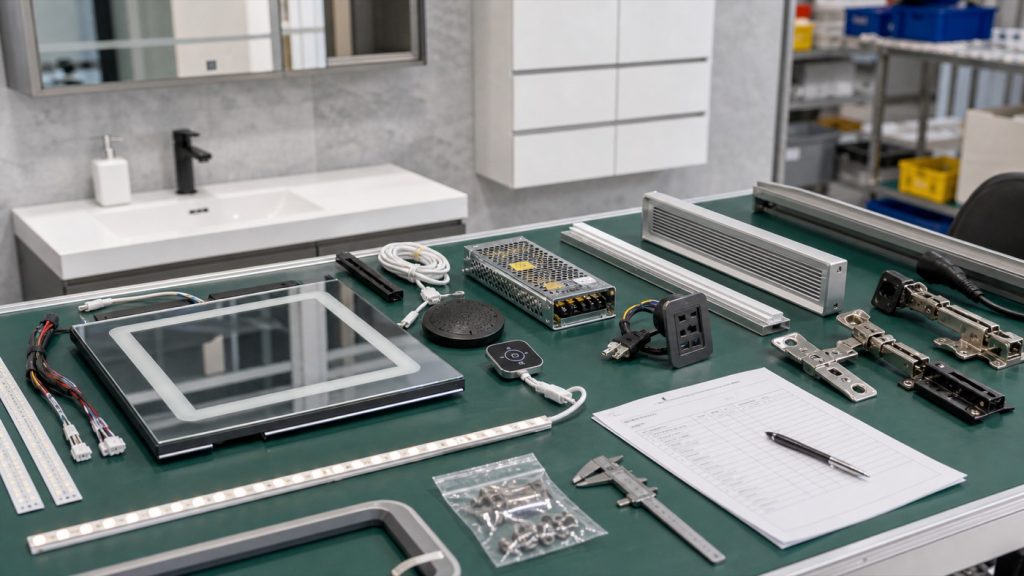
Smart bathroom mirror cabinets need service planning before launch. The supplier should identify replaceable parts: LED strip, driver, demister pad, touch sensor, outlet module, USB module, speaker, hinge, shelf support, mirror door, transformer, and wiring harness.
If a replacement requires removing the entire cabinet from the wall, the warranty cost will be high. If the factory cannot supply the same module six months later, the buyer may face inconsistent repair results. If the instruction sheet does not explain access points, installers and service teams will improvise.
For distributors and project teams, a service-parts list is not optional. It should include part codes, photos, wiring positions, expected lead time, minimum order quantity, compatibility rules, and whether parts can be replaced by a trained installer without destroying the cabinet.
What Buyers Should Ask Before Approval
Before approving a smart bathroom mirror cabinet program, buyers should ask for a complete product file, not only a quotation and photo set.
The file should include a finished-product specification, electrical component list, wiring diagram, LED and demister data, outlet or USB module specifications, wireless documentation if applicable, installation instructions, user manual, labels, packaging drawing, hardware list, service-parts list, and change-control rules.
The sample review should include mirror clarity, lighting quality, demister coverage, touch response, outlet access, shelf usefulness, door alignment, hinge feel, ventilation clearance, heat behavior, wall mounting, packaging recovery, and service access.
The commercial review should include warranty terms, spare-parts support, supplier substitution rules, destination-market documentation, carton dimensions, loading efficiency, and whether the supplier can keep the same configuration stable across repeat orders.
2026 Takeaway
Smart bathroom mirror cabinets are attractive because they combine visible lifestyle value with practical daily use. They also show where home furniture is heading: more products are becoming integrated systems that combine materials, hardware, electronics, installation, compliance, and service.
For buyers, the winning approach is not to chase the most dramatic light effect or the longest feature list. It is to define the real use case, control the wet-room risks, document the electrical and wireless layer, protect the glass in transit, and make service parts available.
For factories, the opportunity is to move beyond basic mirror cabinet assembly into finished wet-room furniture systems. Suppliers that can control mirror glass, cabinet materials, lighting, demister heat, wiring, outlet placement, ventilation, packaging, and service support will be better positioned as smart bathroom furniture becomes a larger part of the home industry.