
Charging furniture has become one of the most visible smart-furniture features. Nightstands with wireless charging pads, sofa side tables with USB-C ports, desks with embedded power modules, hotel headboards with outlets, and storage furniture with integrated lighting all promise a cleaner way to live with devices.
But the category is easy to underestimate. A charging table may look like ordinary furniture with a power module installed. In practice, it combines furniture construction, electrical safety, cable routing, heat management, wireless interoperability, documentation, packaging, and after-sales service. If one layer is weak, the product can create returns even when the woodwork looks excellent.
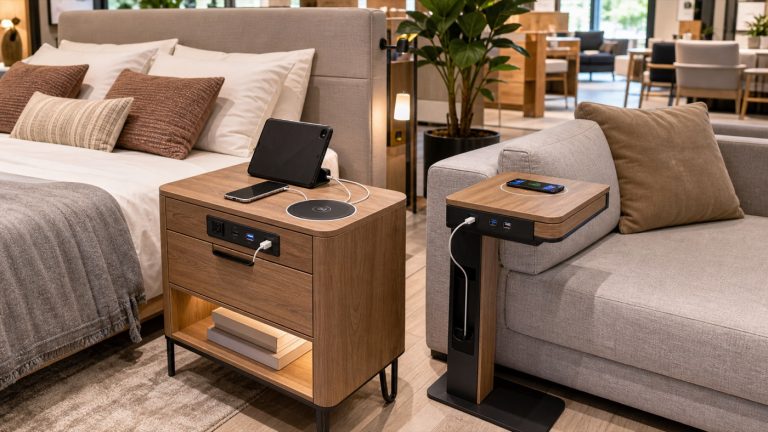
The Home Industry Insights editorial view is that charging furniture should be treated as a power product inside a furniture product. That distinction matters for overseas buyers, retailers, importers, hotel project teams, online furniture brands, and factories trying to make smart furniture scalable rather than fragile.
The Feature Is Simple, The System Is Not
Consumers understand the promise immediately: place a phone on the nightstand, plug a laptop into the desk, charge earbuds on a side table, or reduce visible cables around the sofa. This makes charging furniture attractive for bedrooms, living rooms, home offices, student housing, hotels, serviced apartments, co-living spaces, and compact urban homes.
For the sourcing team, however, the product is not just a feature upgrade. The factory must decide where power enters the product, where heat can escape, how cables are protected, how the user accesses ports, whether modules can be replaced, how the carton protects the module, what certifications apply, and what documentation follows the shipment.
That makes charging furniture different from decorative smart-home add-ons. A USB-C port, wireless charging coil, AC outlet, adapter, extension lead, switch, LED, and control board all affect the furniture design. If the electronics are selected after the cabinet, table, or headboard has already been designed, the product can become hard to certify and hard to service.
USB-C Has Raised Customer Expectations
USB-C is now widely understood by consumers as the modern charging connector, but the label alone does not define the customer experience. A port may support only basic low-power charging, or it may support higher output through USB Power Delivery. A desk that claims USB-C charging but cannot power a laptop may disappoint a buyer even if the port technically works.
The USB Implementers Forum explains that USB Power Delivery increases USB power levels up to 240W and enables new fixed voltage levels for 140W, 180W, and 240W power. This does not mean every furniture product should offer high power. It does mean that buyers need to specify the expected output instead of treating “USB-C” as a complete specification.
For a furniture brief, the useful questions are practical:
What wattage does each USB-C port support?
Is the port intended for phones, tablets, lamps, monitors, or laptops?
Is the adapter internal or external?
Can multiple ports deliver useful power at the same time?
What happens if a user plugs in a high-power laptop?
Is the module labeled clearly enough for the market?
This is where many attractive samples become weak products. A sample room may show a phone charging on a nightstand, but the production product may be sold into a market where users expect laptop charging, hotel guest charging, or shared-space durability.
Wireless Charging Adds Alignment And Heat Questions
Wireless charging is visually cleaner than a cable, but it is less forgiving. A charging coil must be positioned correctly under the surface. The surface material and thickness matter. The user needs to understand where to place the phone. Heat needs to be managed. Cases, rings, metal accessories, and device position can affect performance.
The Wireless Power Consortium says Qi2 introduced magnetic attachment technology to help align devices and chargers for better efficiency, faster charging, and easier usability, while Qi2 25W increases charging power. For furniture makers, the key point is not to chase the highest number first. The key is to design the user interface and integration around alignment, safety, and repeatable performance.
Buyers should ask whether the wireless module is Qi-certified, whether it appears in the WPC certified product database, what power profile it supports, what surface thickness is allowed, how heat was evaluated in the finished furniture, and how the customer knows the correct charging position.
The WPC certified product database says certified products receive a certified ID and are included in the database. For overseas buyers, this is a useful verification habit. A claimed “Qi-compatible” module is not the same thing as documented certification.
Furniture Materials Change Charging Behavior
Charging modules do not live in open air. They are embedded in MDF, particleboard, plywood, veneer, solid wood, laminate, metal frames, upholstery, stone-look panels, or plastic inserts. Each material creates different design constraints.
A thick tabletop may reduce wireless charging performance. A metal accent ring may interfere with charging. A fabric-covered headboard may hide heat and make cleaning difficult. A drawer box may pinch a cable. A sofa side table may be exposed to spilled drinks. A hotel nightstand may face constant abuse from guests.
This is why the finished furniture must be evaluated, not only the loose module. A module that works on an engineering bench may perform differently when installed under a surface, routed through a cabinet, packed for shipping, and used every day by customers who do not read manuals carefully.
Our earlier article on smart furniture integration argued that the whole product should be approved as a system. Charging furniture is a direct example. The electronics, panel thickness, cable path, surface finish, user label, and replacement method all belong in the same design conversation.
Safety Standards Are Part Of Product Design
Charging furniture can involve AC outlets, USB modules, adapters, low-voltage wiring, wireless charging transmitters, switches, and sometimes lighting. That means safety cannot be handled as a final document request after mass production starts.
UL’s page for UL 962 describes requirements covering motor-operated furniture, electrified and non-electrified furniture, electrical decorations, and home office furnishings such as consoles, tables, and desks. UL also has UL 962A for furniture power distribution units, describing indoor-use cord-and-plug connected or permanently connected furniture power distribution units rated 250 V AC or less and 20 amperes or less.
These references matter because charging furniture is often sold as furniture first. A retailer may describe it as a nightstand, desk, or side table, but the product includes electrical functionality. The factory and buyer need to understand which standards, test scope, labels, instructions, and component certifications apply in the destination market.
The practical sourcing question is simple: was the finished furniture configuration reviewed, or was only the purchased module certified? If the certified module is installed in a way that traps heat, damages insulation, exposes connectors, or allows poor strain relief, the furniture can still become risky.
RF And Import Rules Can Apply To Wireless Modules
Wireless charging and connected charging furniture can also raise radio-frequency questions. Some wireless charging systems, Bluetooth controls, Wi-Fi power modules, occupancy sensors, and app-connected modules may fall under radio-frequency device rules depending on design and market.
For the United States, 47 CFR § 2.803 says no person may market a radio frequency device unless it is authorized under a valid FCC equipment authorization, with the regulation defining marketing broadly to include sale, lease, advertising, importation, shipment, or distribution for selling or leasing. For import conditions, 47 CFR § 2.1204 states that radio-frequency devices may be imported only if one or more listed conditions are met, including valid equipment authorization where required.
For furniture buyers, the lesson is not to turn every sourcing manager into a radio engineer. The lesson is to ask for clear documentation. Which module is used? Is it authorized or exempt? Is the model number stable? Does the label match the production unit? Does the finished furniture change the module’s use conditions?
Thermal Design Is A Furniture Issue
Charging creates heat. The amount depends on power level, charging efficiency, device position, ambient temperature, material, ventilation, and user behavior. A bedside table used under blankets, near curtains, or in a small hotel room may experience different conditions from a laboratory bench.
Thermal design should be considered in the furniture itself. Is there airflow around the adapter? Does the wireless charging area have enough thermal path? Is the module installed close to foam, fabric, paper inserts, or dust-collecting areas? Does the user have any warning if charging stops or overheats? Can the surface finish tolerate long-term warmth without discoloration?
These questions are especially important for products that combine multiple functions: AC outlet, USB-C PD, USB-A, wireless charging, LED lighting, and hidden cable storage. The more functions are concentrated into a small furniture part, the more important the heat path becomes.
Cable Routing Is Where Many Failures Start
The best module can still fail if the cable path is poor. A sharp wooden edge can abrade insulation. A drawer can pinch a harness. A rotating side table can twist a cable. A consumer assembly step can pull a connector loose. A carton compression point can damage a power inlet before the product reaches the customer.
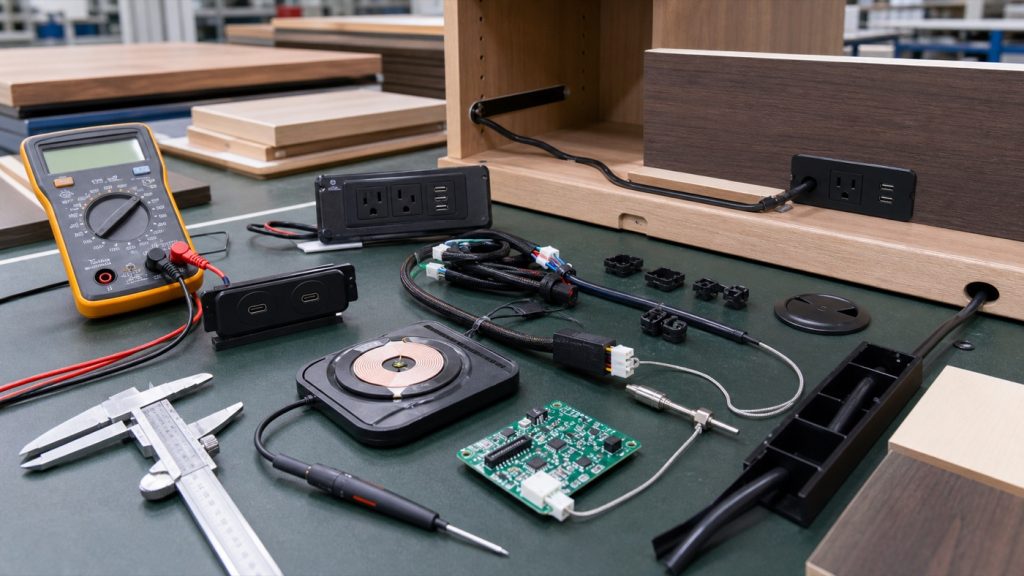
Charging furniture should therefore have a cable-routing drawing, not just a product render. The drawing should define holes, grommets, bend radius, clips, strain relief, connector orientation, wire length, moving-part clearance, and inspection points. If the product is consumer-assembled, the instruction design should make cable damage unlikely.
Packaging should also be part of the test. A module that passes before packing but fails after drop, vibration, compression, humidity, or unpacking is not ready for online furniture channels.
Replaceable Modules Reduce After-Sales Cost
Charging furniture after-sales can be expensive because the furniture is bulky and the failed part may be small. A defective adapter, USB-C module, wireless charging pad, cable harness, PCB, or outlet can make a nightstand feel broken even if the frame is fine.
Buyers should prefer designs where key modules can be replaced without destroying the furniture. The product should have stable part numbers, accessible fasteners, clear labels, spare-part photos, troubleshooting steps, and a realistic service path.
This matters for online furniture brands and retailers. Sending a replacement module may be economical. Replacing an entire nightstand, side table, desk, or headboard because of a small power-board issue is not.
Factories that can support module replacement, failure analysis, and version records will have an advantage over suppliers that treat electronics as hidden accessories.
Hotels And Projects Need A Different Standard
Charging furniture for hotels, apartments, dormitories, and offices faces heavier use than home furniture. Ports are used by many people. Cables are pulled at bad angles. Guests may plug in unknown chargers and devices. Cleaning staff may expose surfaces to moisture. Products must survive repeated contact without looking damaged or becoming loose.
Project buyers should therefore specify use environment, duty cycle, module access, replacement process, surface durability, cleaning expectations, and documentation. A consumer-grade charging module may be acceptable for some home products but weak for hospitality furniture.
The same applies to built-in furniture and contract installations. Once furniture is installed across rooms or projects, replacing a weak module becomes a labor issue, not just a parts issue.
What A Better Product Brief Should Include
A charging furniture brief should define the charging use case first. Is the product meant for phones only, phones and tablets, laptop charging, hotel guest charging, or multi-device home-office use?
It should then define the power layer: plug type, voltage range, adapter, AC outlets, USB-C output, USB-A output, simultaneous output behavior, cable length, strain relief, labels, and certification assumptions.
It should define the wireless layer: Qi or Qi2 status, certified module ID where available, power level, coil position, surface thickness, alignment method, heat behavior, device-case assumptions, and user feedback.
It should define the furniture layer: material, panel thickness, ventilation, spill exposure, cleaning, assembly process, cable path, packaging protection, and how the customer reaches the module.
Finally, it should define the service layer: spare parts, version records, troubleshooting, replacement steps, supplier response time, and how claims will be classified.
This level of detail does not make the product less marketable. It makes the feature dependable enough to scale.
The 2026 Takeaway
Charging furniture is a strong smart-furniture lane because it solves a visible daily problem. Consumers want fewer cables, better bedside charging, cleaner work surfaces, and furniture that supports connected living.
But the winning products will not be defined by the presence of a USB-C port alone. They will be defined by the quality of the power module, the clarity of the output specification, the reliability of wireless alignment, the safety of the finished furniture, the protection of cable routing, and the practicality of after-sales service.
For buyers, the core question is no longer “does it charge?” The better question is “will it charge safely, repeatedly, clearly, and economically after the product is shipped, assembled, used, cleaned, and serviced?”
For factories, charging furniture is an opportunity to show real integration capability. The supplier that can combine furniture design, electrical knowledge, module documentation, packaging, and service planning will be easier to trust as smart furniture becomes a normal part of the home industry.