
Smart furniture is often discussed through beds, desks, wardrobes, and charging tables. But media furniture is becoming another important category. TV lift cabinets, motorized media consoles, hidden-screen cabinets, pop-up monitor furniture, and AV storage units are turning a simple living-room cabinet into a mechanical and electrical system.
A TV lift cabinet is not only a wood case with a motor inside. It has to support a display, move it smoothly, hide cables, manage heat, protect the screen during transport, prevent tipping, preserve the cabinet finish, and let the user recover from faults. It may also include wireless remotes, RF receivers, limit switches, anti-pinch features, ventilation fans, soundbar space, cable chains, and service access panels.
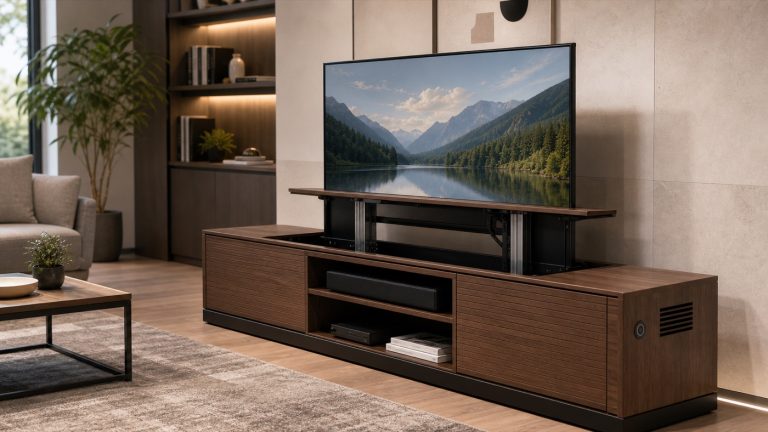
The Home Industry Insights editorial view is that smart TV lift cabinets should be sourced as media furniture systems, not only as decorative cabinets. The product sits between furniture, AV hardware, motorized motion, electrical safety, installation, and after-sales service.
Why TV Lift Cabinets Are A Distinct Smart Furniture Category
Unlike a normal media console, a TV lift cabinet has to move a valuable object. The lift must carry the screen safely, stop at the right height, avoid shaking, protect cables, and fit inside a furniture structure that still looks attractive in a living room.
The category has real appeal. Designers want clean rooms without a visible screen all day. Apartment owners want flexible living spaces. Hotels, serviced apartments, yachts, senior-living rooms, and premium homes may use hidden-screen furniture to make a room feel less dominated by electronics. Retailers can present it as a higher-value media furniture product.
But the product is also easy to underestimate. A showroom sample may raise a TV smoothly for a few demonstrations. Mass production has to work after shipping, assembly, uneven floors, different TV weights, different cable setups, and repeated daily use.
The Lift Mechanism Defines The Product
The heart of the product is the lift mechanism. It may use motorized columns, rails, telescoping arms, belts, threaded rods, control boxes, limit switches, brackets, and a VESA mounting plate. The furniture around it must support the mechanism without warping or loosening.
Buyers should define the screen size and weight range early. A mechanism that works with a light 43-inch display may not be suitable for a heavier 65-inch screen. A cabinet designed around one TV thickness may not allow enough clearance for another model. If the TV is customer-supplied, the product needs a clear compatibility range.
Motion stability matters. The display should not wobble noticeably when rising or stopping. The lift should not scrape the cabinet opening. The mechanism should not twist the back panel. The top lid or opening should not trap cables or damage the screen.
This is where the buyer has to treat the product as a system. The cabinet dimensions, lift stroke, bracket geometry, TV clearance, cable path, ventilation, and mounting plate all need to be approved together.
Electrical Safety Cannot Be Added At The End
A motorized TV lift cabinet includes electrical components even when the visible product looks like furniture. It may contain a lift motor, low-voltage power supply, controller, receiver, remote, switch, fan, LED indicator, and cable management hardware.
UL’s page for UL 962 describes the standard as covering household and commercial furnishings and includes motor-operated furniture. For TV lift cabinets, the practical point is that the finished furniture configuration should be reviewed as electrified furniture, not treated as a normal cabinet after a purchased lift is installed.
The buyer should know which lift, power supply, controller, wiring harness, switch, and receiver are used. The factory should define approved substitutions. If a supplier changes the lift mechanism or control box after sample approval, the change can affect safety, compatibility, service parts, and warranty handling.
The electrical design should also consider strain relief, user access, labels, instructions, cable protection, and heat. A neat-looking cabinet can still be risky if power cables are pinched, the controller is loose, or the cabinet traps heat around electronics.
Wireless Remotes Need Documentation
TV lift cabinets often use RF remotes or wireless receivers. Some may include Bluetooth, app control, smart-home triggers, or integration with AV systems. These features create convenience, but they also create documentation requirements.
For the United States, 47 CFR § 2.803 says a radio-frequency device may not be marketed unless it is authorized under a valid FCC equipment authorization, with marketing defined broadly to include sale, lease, advertising, importation, shipment, or distribution for sale or lease. For imported products, 47 CFR § 2.1204 states that radio-frequency devices may be imported only if one or more listed conditions are met, including valid equipment authorization where required.
For the European Union, the European Commission’s Radio Equipment Directive page explains that Directive 2014/53/EU sets a framework for radio equipment and includes essential requirements covering safety and health, electromagnetic compatibility, and efficient use of radio spectrum.
The sourcing lesson is straightforward. If the cabinet includes a wireless remote or receiver, the buyer should ask for module identity, authorization records, labeling requirements, firmware or protocol version, and substitution rules. A remote control should not be treated as a disposable accessory when it controls a moving display.
Tip-Over Risk Is Central To Media Furniture
Media furniture carries a screen, and the screen may move upward. That changes the center of gravity. A cabinet that is stable when the TV is hidden may behave differently when the TV is raised. A narrow cabinet, heavy screen, uneven floor, pulled cable, or child interaction can increase risk.
The U.S. Consumer Product Safety Commission’s tip-over information center focuses on the hazard of furniture and TV tip-overs and encourages anchoring furniture and televisions. For TV lift cabinets, this is directly relevant because the product combines both furniture and a moving screen.
Buyers should ask how the cabinet is stabilized. Does it require wall anchoring? Are anti-tip restraints included? Is the base wide enough for the intended TV size? Are instructions clear? Does the product warn users not to climb, pull, or operate the lift with objects in the path?
This connects with our earlier article on furniture tip-over safety. Smart media furniture should not treat anchoring as an afterthought. Stability should be part of product development.
Cable Management Is A Moving Design Problem
TV lift cabinets have more cable complexity than many other furniture products. A TV may require power, HDMI, antenna, audio, Ethernet, USB, speaker, and smart-home cables. Those cables must move with the screen or be routed safely around the lift path.
A poor cable path can create real failures. Cables can snag, pull out, rub against rails, block the lift, or become pinched by the cabinet lid. A stiff cable bundle can make the TV lean. A connector can hit the cabinet opening. A cable that is too short can fail after repeated movement.
The product should therefore include a cable-routing plan, not only a cabinet drawing. The plan should define cable-chain position, service loop length, grommet placement, strain relief, no-pinch zones, and user instructions for connecting external devices.
This also affects after-sales. If the customer installs a new soundbar, game console, or streaming device, the cable system should still be understandable. A smart cabinet that works only with one factory demo setup will create support problems.
Ventilation And Heat Need Attention
Media cabinets already have heat questions because AV receivers, set-top boxes, game consoles, routers, and amplifiers can run warm. A TV lift cabinet adds a motor, control box, power supply, and sometimes a fan inside the same cabinet.
Heat can affect electronics, wood panels, adhesives, and user perception. A cabinet that feels too warm can generate complaints even before a component fails. A closed cabinet with no airflow can shorten the life of AV equipment or make the lift controller operate in poor conditions.
Buyers should ask where ventilation grilles are located, whether airflow is blocked by the TV lift, whether a fan is included, how dust is handled, and whether the customer can access components for cleaning or service.
The cabinet should be tested with a realistic AV setup, not an empty cabinet. If the product is marketed for soundbars, receivers, consoles, or routers, those use cases should be considered during design.
Noise And Motion Quality Affect Perceived Value
A TV lift cabinet is often sold as premium furniture. That means the lift motion should feel refined. Slow, jerky, noisy, or unstable motion makes the product feel cheap even if the cabinet finish is attractive.
Noise can come from motors, rails, loose fasteners, rubbing panels, cable chains, or cabinet vibration. Motion quality can be affected by screen weight, rail alignment, bracket tolerance, and cabinet stiffness.
Factories should test the product with realistic screen weights and repeated cycles. They should test after packaging simulation, not only after fresh assembly. If a bracket loosens during transport, the customer may experience noise or misalignment immediately.
This is similar to the issue we discussed in smart adjustable bed bases: motion furniture has to be evaluated after real shipping and assembly conditions, because movement quality is part of the product promise.
Packaging Has To Protect The Mechanism And Finish
TV lift cabinets are vulnerable in transport. They combine finished panels, long openings, lift rails, brackets, control boxes, cables, ventilation grilles, and sometimes glass or delicate decorative surfaces.
Packaging must protect both appearance and function. A dented panel is a visible defect. A bent rail, crushed connector, loose bracket, or damaged cable can make the lift fail. The mechanism may also need shipping locks or protective inserts so that it does not move inside the carton.
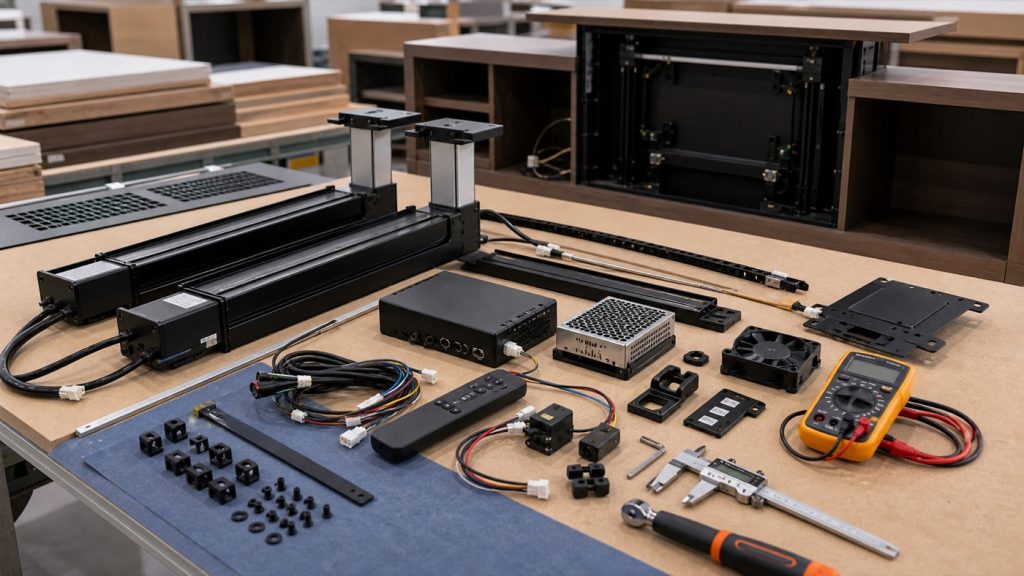
The packaging plan should specify how the lift is secured, where the remote and power supply are packed, how the VESA plate is protected, and how installers identify each component. Missing small parts can stop the entire installation.
Service Access Decides The Real Cost
The expensive part of a smart TV lift cabinet may not be the failed component. It may be the labor required to reach it. If the control box is buried behind fixed panels, a simple failure can become a full cabinet repair.
Buyers should ask whether the lift, controller, power supply, remote receiver, fan, and cable harness are accessible. Can a service technician replace them without damaging the cabinet? Are replacement parts stable across batches? Does the factory provide a wiring diagram and troubleshooting flow?
Spare parts need clear identifiers. A TV lift column, remote, receiver, power adapter, limit switch, and VESA bracket should not be described only as “the black part” or “the motor.” If the product is sold through retailers or project channels, part identification becomes essential.
Version control matters as well. A later batch may use a different lift supplier or remote protocol. The buyer needs to know this before spare parts become incompatible.
What Buyers Should Ask Before Approval
A strong TV lift cabinet brief should define the media use case first. Is the product for living rooms, bedrooms, hospitality rooms, yachts, apartments, or project installations? Will the TV be factory-supplied or customer-supplied? What screen sizes, weights, and VESA patterns are supported?
It should define the lift system: stroke length, load capacity, speed, noise, cycle testing, anti-pinch behavior, limit switches, emergency stop, service access, and compatibility with the cabinet structure.
It should define the electrical and wireless layer: lift motor, control box, power supply, remote receiver, cable harness, labels, instructions, and authorization documents where needed.
It should define the furniture layer: panel material, cabinet stiffness, top opening, ventilation, anti-tip anchoring, cable routing, AV storage, packaging, and installation sequence.
Finally, it should define the service layer: spare parts, diagnostic process, replacement steps, batch records, and support responsibilities between the cabinet factory, lift supplier, and retailer.
The 2026 Takeaway
Smart TV lift cabinets show how media furniture is becoming a system product. The cabinet still needs good proportions, finish, storage, and room presence. But it also needs motion hardware, electrical safety, wireless documentation, cable management, ventilation, stability, packaging, and service access.
For buyers, the opportunity is a premium living-room product that makes screens more flexible and less visually dominant. The risk is hidden complexity inside a beautiful cabinet.
For factories, the opportunity is to move beyond ordinary media console production into integrated smart furniture. The suppliers that can manage cabinet construction, lift mechanisms, AV cable needs, safety documentation, packaging, and after-sales parts will be better positioned as smart media furniture grows.