
Smart furniture is not only about charging ports, connected cabinets, or showroom lighting. Adjustable bed bases are becoming one of the clearest examples of how furniture categories are turning into engineered systems. A modern adjustable bed may combine a steel or wood platform, upholstered frame, electric actuators, lift hinges, control box, remote, under-bed lighting, USB accessories, massage function, anti-snore preset, mattress-retention hardware, packaging protection, and after-sales parts.
That makes the product more complex than a bed frame and more furniture-sensitive than a loose motor device. The buyer is not only approving a shape, color, and carton. The buyer is approving motion, load, noise, stability, cable protection, electrical safety, wireless control, mattress compatibility, user instructions, and serviceability.
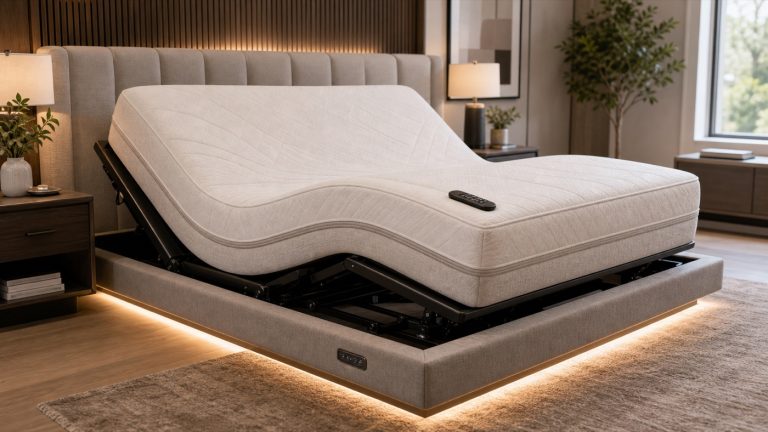
The Home Industry Insights editorial view is that smart adjustable bed bases should be sourced as sleep-furniture systems. They sit between furniture, bedding, electrical products, and wellness positioning. Buyers who treat them as ordinary beds with motors added later may underestimate the real risk.
Why Adjustable Beds Are Different From Ordinary Bed Frames
A standard bed frame must support a mattress and the user. An adjustable base must do that while moving, stopping, holding position, returning to flat, and surviving repeated mechanical cycles. It also needs to remain quiet enough for a bedroom, stable enough for daily use, and simple enough for consumers or installers to set up correctly.
The category has several demand drivers. Aging households want easier sitting and getting out of bed. Apartment residents want a bed that can support reading, working, and watching content. Mattress brands want a higher-value sleep system. Hotels and serviced apartments want differentiated room experiences. Ecommerce brands want a product with a clear premium story.
But every driver adds expectations. A user who buys an adjustable base expects the motion to be smooth, the remote to be intuitive, the mattress not to slide, the frame not to creak, and the electronics not to fail after shipping. These expectations are not solved by appearance alone.
Motion Is The Center Of The Product
The core system is mechanical motion. The head section, leg section, lumbar area, neck tilt, or split zones may be controlled by linear actuators, lift arms, hinge brackets, pivots, control boxes, and limit logic. Each moving part creates a quality question.
The load assumptions must be realistic. A sample that lifts an empty mattress may behave differently with a heavy hybrid mattress, two users, bedding, and repeated movement. A base designed for a thin foam mattress may not work well with a thick spring mattress or a mattress with stiff edge reinforcement.
Buyers should define the motion specification early: maximum user and mattress load, lift angle, number of zones, cycle testing, noise target, speed, emergency flat function, power-loss behavior, and expected mattress type. If these details are not in the brief, the supplier may optimize for sample-room appearance rather than long-term use.
Our earlier analysis of smart furniture integration made the same point at a broader level: the product should be approved as a system, not as separate furniture and electronics packages. Adjustable beds make that lesson concrete because mechanical motion affects almost every part of the product.
Electrical Safety Needs To Be Designed In
An adjustable base can include motors, low-voltage wiring, power supplies, control boxes, illuminated elements, and sometimes outlets or USB accessories. That means electrical safety needs to be part of the product design, not a document collected at the end.
UL’s page for UL 962 describes the standard as covering household and commercial furnishings and includes motor-operated furniture. This is directly relevant for buyers evaluating powered beds, lift furniture, desks, tables, cabinets, and other electrified home products.
For buyers, the practical question is whether the finished adjustable bed configuration was considered. A certified component does not automatically mean the whole product is low risk if wiring is routed poorly, a connector is exposed, the control box overheats under the mattress platform, or a cable can be crushed by the moving frame.
The electrical file should identify the motor supplier, control box, adapter, wire harness, connector type, power rating, labels, instructions, and authorized substitutions. If a factory changes an actuator or control box after sample approval, the buyer should know.
Wireless Remotes And App Control Add Compliance Work
Many adjustable bases use wireless remotes. Some add Bluetooth, Wi-Fi, voice integration, app presets, sleep-position memory, or connected controls. These features are convenient, but they also bring radio-frequency documentation and service responsibilities.
For the United States, 47 CFR § 2.803 says a radio-frequency device may not be marketed unless it is authorized under a valid FCC equipment authorization, with marketing defined broadly to include sale, lease, advertising, importation, shipment, or distribution for sale or lease. For imported products, 47 CFR § 2.1204 states that radio-frequency devices may be imported only if one or more listed conditions are met, including valid equipment authorization where required.
For the European Union, the European Commission’s Radio Equipment Directive page explains that Directive 2014/53/EU sets a framework for radio equipment and includes essential requirements covering safety and health, electromagnetic compatibility, and efficient use of radio spectrum.
The sourcing implication is straightforward. If the remote or app module is wireless, the buyer needs model numbers, authorization records, labeling, firmware version control, and a process for module substitutions. A supplier should not quietly replace a remote-control board with a different radio module before mass production.
Mattress Compatibility Can Make Or Break The Experience
An adjustable base is only experienced together with a mattress. If the mattress is too stiff, too thick, too heavy, or poorly matched to the bend zones, the user may blame the base. If the mattress slides during motion, the user may blame the whole product. If the edge construction fights the lift angle, the motor may work harder and noise may increase.
This is why mattress compatibility should be part of the sourcing brief. Buyers should specify mattress type, thickness range, weight range, retainer design, upholstery friction, corner behavior, and whether the base will be sold alone or bundled with a mattress.
For mattress brands, the question becomes even more important. A mattress promoted as adjustable-base compatible should be tested with the base that will actually be sold. For furniture retailers, the product page and instructions should make compatibility clear enough to reduce returns.
Noise And Vibration Are Quality Signals
Consumers may accept some mechanical sound from a moving base, but bedroom furniture has a low tolerance for noise. A clicking bracket, vibrating motor, rattling slat, loose retainer bar, or squeaking upholstered panel can make the product feel cheap even if it still functions.
Noise control needs both mechanical and packaging thinking. Brackets need stable tolerances. Fasteners need torque discipline. Foam and fabric should not rub against moving metal. Actuator mounting points should be protected from looseness. Control boxes and cables should not vibrate against the frame.
Factories should test noise after shipping simulation and assembly, not only when the sample is fresh from the bench. A base that is quiet before packaging but noisy after transport may have a bracket, bolt, or harness issue.
Pinch Points And User Instructions Matter
Moving furniture creates pinch-point and entrapment considerations. The user may reach under the bed, children may play near the mechanism, bedding may hang into moving parts, and installers may test motion before all covers or retainers are in place.
This does not mean every adjustable base is a medical device or a hospital bed. It does mean that motion safety must be treated seriously in consumer furniture. Guards, clearances, labels, instructions, emergency stop behavior, and installation sequence should be reviewed before launch.
The U.S. Consumer Product Safety Commission’s adult portable bed rails safety page warns about entrapment and asphyxiation hazards, especially when users become trapped between the rail and mattress or within parts of the rail. Adjustable bases are a different product category, but the broader lesson is relevant: anything added around a bed must be evaluated for gaps, user movement, and foreseeable misuse.
If a buyer offers optional rails, side supports, massage accessories, under-bed storage, or project-specific add-ons, those elements should be tested with the moving base, not treated as isolated accessories.
Packaging Must Protect Mechanical Alignment
Adjustable bases are difficult to ship because they combine heavy frames, moving joints, motors, cables, control boxes, upholstery, and sometimes long metal parts. A carton that protects a normal bed frame may not protect an actuator mount or connector.
Packaging should protect the product from bending, compression, connector damage, fabric abrasion, missing hardware, and impact to the mechanism. Foam placement matters. Hardware pack location matters. Cable protection matters. The remote and power supply should not be loose in a carton where they can damage fabric or disappear during unpacking.
This connects with our earlier article on furniture packaging and transit damage. For smart adjustable beds, packaging is not only a cosmetic issue. It can change whether the product works after delivery.
Service Parts Decide The Real Cost
The real cost of an adjustable base is often revealed after the sale. If a remote fails, a cable disconnects, an actuator becomes noisy, a control box stops responding, or a power supply is lost, the retailer does not want to replace the entire bed. The supplier needs a service model.
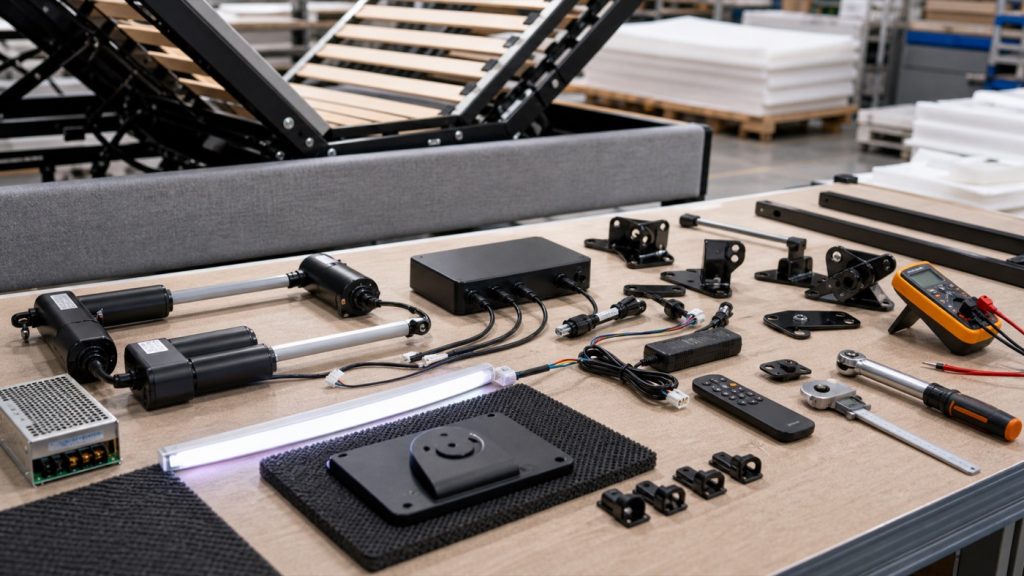
A good service plan includes stable part numbers, replaceable motors, accessible control boxes, clear wiring diagrams, remote pairing instructions, diagnostic steps, and spare-part packaging. The factory should be able to tell the buyer which component failed, not simply classify every claim as “motor problem.”
Version control is critical. If the supplier changes the actuator supplier, remote protocol, connector, control board, or power adapter, the buyer needs records. Otherwise, warranty support becomes guesswork.
Project And Retail Channels Need Different Thinking
An adjustable base sold through ecommerce has different risks from one installed in a hotel or senior-living project. Ecommerce products need consumer-friendly assembly, clear troubleshooting, compact packaging, and easy part replacement. Project products need installer documentation, room-to-room consistency, maintenance access, and spare parts available for years.
Retailers also need careful claim language. Terms such as anti-snore, zero gravity, massage, sleep tracking, pain relief, or wellness support can be attractive, but they should be used responsibly. The more a product sounds like it treats a health condition, the more carefully the claim should be reviewed.
For many furniture brands, the safer path is to describe functions clearly: head lift, leg lift, memory positions, massage vibration, under-bed light, wireless remote, emergency flat, and mattress compatibility. Let the product experience carry the value instead of overstating medical benefit.
What Buyers Should Ask Before Approval
A strong adjustable-bed brief should define the motion system first. Which zones move? What is the lift angle? What load is assumed? What mattress types are compatible? What cycle testing is required? How noisy is the product after transport?
It should define the electrical and wireless system. Which motors, control boxes, remotes, adapters, and modules are used? Which authorizations or certifications apply? What labels and instructions are required? Can the product function without an app?
It should define the furniture system. What frame materials are used? How is upholstery protected? How are brackets mounted? How are cables routed? How is the product packaged? How is the bed assembled and anchored if needed?
Finally, it should define the service system. Which parts are replaceable? Who can replace them? How are claims diagnosed? How many years will spare parts be available? How are hardware and firmware versions tracked?
These questions are not excessive. They are what separate a showroom sample from a scalable smart furniture program.
The 2026 Takeaway
Smart adjustable bed bases show how furniture categories are becoming more technical without becoming less furniture-like. The product still needs good upholstery, stable structure, comfortable proportions, quiet operation, and attractive room presence. But it also needs motors, control logic, electrical safety, wireless documentation, packaging control, and service support.
For buyers, the opportunity is a higher-value sleep product with a clear consumer benefit. The risk is hidden complexity behind the mattress. For factories, the opportunity is to move beyond bed-frame production into system integration for sleep furniture.
The winning adjustable bed suppliers will not be the ones that simply add more buttons to a remote. They will be the ones that make motion, safety, comfort, delivery, and service work together after the product leaves the showroom.