
Height-adjustable desks have moved from corporate offices into homes, apartments, creator studios, student rooms, and hybrid-work spaces. The category is no longer only an office furniture product. It is becoming a smart furniture system that combines a desktop, lift columns, motors, control box, keypad, anti-collision logic, cable management, monitor support, packaging, and after-sales parts.
That shift matters for buyers and factories. A smart sit-stand desk may look simple in a showroom, but the real product has to lift smoothly, remain stable at height, support real work equipment, avoid cable damage, survive parcel delivery, and be serviceable when a control box, handset, or lift column fails.
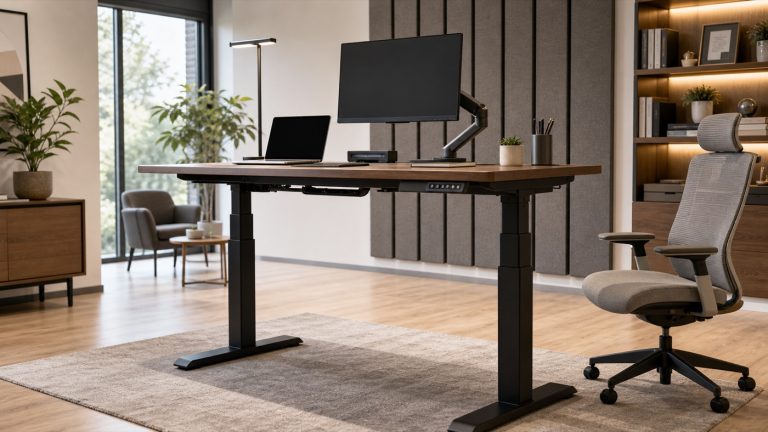
The Home Industry Insights editorial view is that smart height-adjustable desks should be sourced as work systems, not only as furniture frames with motors. The buyer is approving structure, electronics, ergonomics, packaging, assembly, and support at the same time.
Why Sit-Stand Desks Are A Different Smart Furniture Lane
Charging furniture is built around power access. Smart wardrobes are built around storage experience. Adjustable bed bases are built around sleep motion. Height-adjustable desks are built around work behavior.
The desk must support monitors, laptop docks, lamps, speakers, cables, chargers, keyboard trays, monitor arms, and sometimes heavy desktop surfaces. It must operate while those items remain on the surface. It must stay stable when raised, not only when lowered. It must also work in homes where floors may be uneven and assembly may be done by the customer.
This makes the product more demanding than a fixed desk. A fixed desk can be judged by surface, frame, storage, finish, and packaging. A height-adjustable desk adds motion, load, noise, speed, synchronization, anti-collision behavior, electronics, cable routing, and replacement parts.
The Lift System Is The Product Core
The lift system usually includes two or three telescoping columns, motors, gearboxes, a control box, a keypad, cables, brackets, crossbars, feet, and sometimes memory presets or Bluetooth control. The visible desk may be a wood-look top and metal legs, but the hidden lift system defines much of the customer experience.
Buyers should define the load expectation clearly. Is the desk for a laptop only, or for dual monitors and a desktop computer? Will users install heavy monitor arms? Is the desktop solid wood, MDF, bamboo, laminate, or stone-look composite? Does the desk need to move smoothly at maximum height with the real load?
A supplier can make a desk look stable at showroom height and still deliver poor performance at the top of travel. Wobble at height, uneven leg movement, motor strain, control-box errors, and cable pull are all common risks when the lift system is not matched to the intended use.
BIFMA Makes Performance More Concrete
Smart desks should not be evaluated only by marketing claims. Buyers need performance language that is easier to test and compare.
ANSI/BIFMA X5.5-2021 Desk and Table Products is widely used in the office furniture industry for desks and tables, including height-adjustable tables, benching, tilt-top tables, monitor arms, and related desk/table products. The value for buyers is that it frames desks and tables as products that need safety, durability, stability, and structural-performance evaluation rather than only visual approval.
For furniture buyers, the point is not that one standard answers every market question. The point is that height-adjustable desks need defined tests for stability, load, adjustment, durability, and structural performance. A supplier that only provides a static product photo and motor wattage is not giving enough evidence.
In a procurement brief, BIFMA language can help structure the conversation: vertical adjustment, worksurface load, stability, durability, monitor-arm impact, benching configuration, and user safety. It gives the buyer a way to move beyond “it looks solid” toward measurable furniture performance.
Electrical Safety Still Applies
A height-adjustable desk is still furniture, but it is also electrified furniture. The system may include AC input, power supply, low-voltage wiring, motors, controller, keypad, USB accessories, cable tray, and sometimes integrated outlets or wireless modules.
UL’s page for UL 962 describes the standard as covering household and commercial furnishings and includes categories such as home office furnishings and motor-operated furniture. This is directly relevant for powered desks, tables, beds, cabinets, and other electrified home products.
For buyers, the practical question is whether the finished desk configuration was considered. A listed power supply or motor is useful, but the finished product still needs safe wire routing, strain relief, accessible instructions, stable control-box mounting, and protection from moving parts.
If a factory changes the control box, keypad, power adapter, motor supplier, or cable harness after sample approval, that should be treated as a controlled change, not a routine substitution.
Wireless And App Features Need Documentation
Many sit-stand desks work with a wired keypad. Others add Bluetooth, wireless remotes, app control, sitting-time reminders, usage tracking, or integration with office-management systems. These features can be useful, but they also add documentation and compliance responsibilities.
For the United States, 47 CFR § 2.803 says a radio-frequency device may not be marketed unless it is authorized under a valid FCC equipment authorization, with marketing defined broadly to include sale, lease, advertising, importation, shipment, or distribution for sale or lease. For imported products, 47 CFR § 2.1204 states that radio-frequency devices may be imported only if one or more listed conditions are met, including valid equipment authorization where required.
For the European Union, the European Commission’s Radio Equipment Directive page explains that Directive 2014/53/EU sets a framework for radio equipment and includes essential requirements covering safety and health, electromagnetic compatibility, and efficient use of radio spectrum.
The lesson is simple: if the desk includes a wireless module, the buyer should know the module identity, authorization status, firmware version, labeling requirements, and substitution rules. A smart keypad is not just a small accessory.
Anti-Collision Is Not A Marketing Checkbox
Anti-collision is often promoted as a smart feature. It can reduce damage when the desk moves into a chair arm, shelf, drawer, cable bundle, window ledge, or object under the desk. But the quality of the feature depends on sensor design, motor-control logic, sensitivity, load, and installation.
Buyers should ask how the feature is tested. Does it work while lowering and raising? Does it respond to soft objects and hard objects? Does it behave differently at maximum load? Can false triggers frustrate users? Does the desk stop, reverse, or show an error? How does the user reset the desk?
Anti-collision should be evaluated with realistic home-office setups: monitor arms, cable trays, under-desk storage, chair arms, wall proximity, and power cables. It should not be tested only on an empty factory bench.
Cable Management Is A Moving-System Issue
Cable management is not a cosmetic accessory on a sit-stand desk. It is part of the motion system. Every cable must survive the full height range without pulling, pinching, tangling, or becoming a trip risk.
The desk may include a laptop charger, monitor power cable, display cable, dock cable, speaker cable, desk lamp, motor cable, keypad cable, and power cord. If the cable tray is too shallow, the clips are weak, or the grommet location is wrong, users may create unsafe or messy setups.
Our previous article on charging furniture and USB-C power strategy covered how power modules can become engineering issues inside furniture. Height-adjustable desks add a further challenge: the cables must move with the furniture.
This is why a desk brief should include cable-tray design, grommet location, wire length, strain relief, controller placement, power-cord length, and instructions for monitor-arm setups. Without that, the desk may function electrically but fail as a real work surface.
Stability At Height Is The Buyer Test
Many sit-stand desks feel solid at sitting height and less solid at standing height. This is not only a comfort issue. It affects perceived quality, monitor stability, writing, video calls, and long-term confidence in the product.
Stability depends on column quality, foot design, crossbar structure, desktop size, frame width, load position, floor contact, fastener torque, and assembly accuracy. It can also be affected by monitor arms, heavy desktops, casters, and uneven flooring.
For buyers, the desk should be evaluated at maximum height, with realistic work equipment installed. A stable showroom sample at mid-height is not enough. The product should be tested with the actual desktop size, frame configuration, monitor-arm option, and packaging recovery process.
Assembly Is Part Of Quality
Height-adjustable desks are often shipped flat-packed. That means the customer’s assembly experience is part of the product quality. A desk may be well engineered but still fail in the field if the instructions are confusing, holes do not align, wires are easy to pinch, or the control box can be mounted in the wrong position.
Assembly design should reduce error. The hardware pack should be clear. Connectors should be difficult to mix up. The keypad position should match the handedness or market expectation. The frame should align with the desktop without forcing. The reset procedure should be printed clearly.
For ecommerce channels, assembly problems become support tickets and returns. For project channels, assembly problems become installer time and site delays. In both cases, the factory’s job is not finished when the desk passes a bench test.
Packaging Must Protect Columns And Electronics
Sit-stand desks combine heavy metal parts, finished desktops, electronics, and small hardware. A carton that protects a normal desk may not be enough for telescoping columns, motors, keypads, and control boxes.
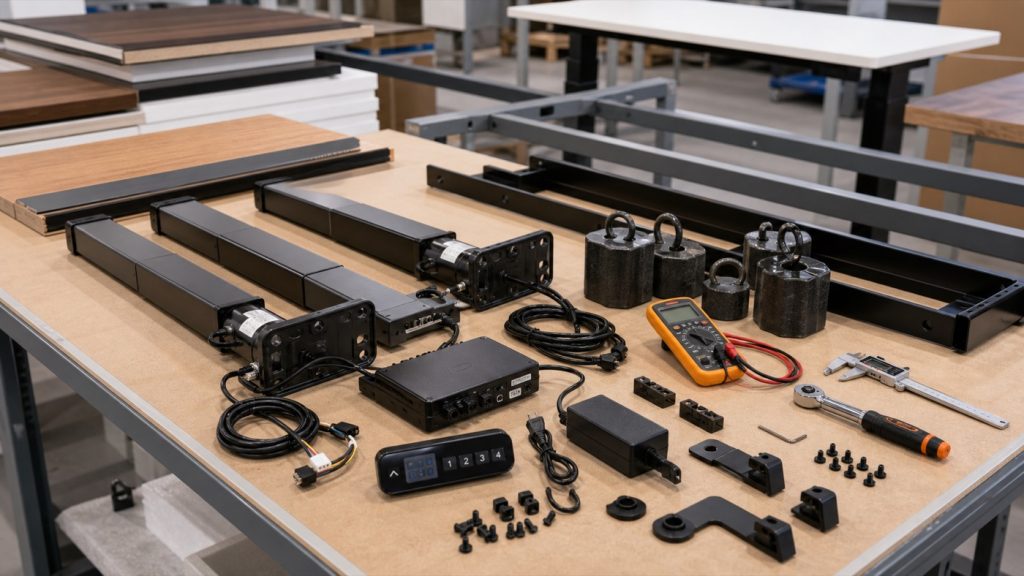
Packaging should protect column straightness, desktop corners, cable connectors, controller housings, keypad faces, and hardware bags. It should also prevent heavy metal components from rubbing against the desktop surface.
This connects with our earlier analysis of furniture packaging and transit damage. For smart desks, packaging damage can be functional, not only cosmetic. A bent bracket, crushed cable, or missing connector can make the product unusable after delivery.
Service Parts Make The Program Scalable
A sit-stand desk program needs spare parts. Motors, control boxes, keypads, cables, power adapters, glide pads, feet, and fastener packs should have stable identifiers. The supplier should know which parts are compatible across batches.
If a desk stops moving, the support team needs diagnostic steps. Is the problem a power supply, control box, handset, motor, cable, overload, memory reset, or column synchronization error? If the answer is always “replace the whole desk,” the product is not ready for scale.
Version control matters. If the supplier changes a control box or keypad firmware, the buyer needs records. Otherwise, spare parts may not pair correctly, and after-sales support becomes guesswork.
What Buyers Should Ask Before Approval
A strong smart desk brief should define the use case first. Is the desk for home office, corporate office, student housing, gaming, creator studios, small apartments, or project installation? Each use case changes load, desktop size, cable expectations, packaging, and support.
It should then define the lift system: number of columns, motor type, load rating, height range, speed, noise target, stability requirement, cycle testing, anti-collision behavior, reset procedure, and maximum desktop size.
It should define the electrical and smart layer: keypad, control box, power adapter, wiring harness, wireless module if any, authorizations, labels, instructions, and substitution rules.
It should define the furniture layer: desktop material, edge durability, frame finish, foot design, cable tray, grommets, monitor-arm compatibility, packaging, and assembly sequence.
Finally, it should define the service layer: spare parts, diagnostic flow, warranty handling, version records, and how claims will be categorized.
These details make the difference between a desk that looks modern and a desk that works reliably in real homes.
The 2026 Takeaway
Smart height-adjustable desks are becoming a serious work-from-home furniture category because they combine office performance, home aesthetics, electronics, motion control, and user assembly. The desk must look like furniture, behave like equipment, and support the daily work habits of real users.
For buyers, the opportunity is a higher-value product with clear consumer demand. The risk is hidden system complexity: unstable lift columns, weak anti-collision logic, poor cable management, missing spare parts, or packaging damage that turns into functional failure.
For factories, the opportunity is to move beyond frame assembly into integrated desk-system supply. The suppliers that can control mechanics, electronics, desktop quality, packaging, documentation, and service parts will be better positioned as smart office furniture becomes part of the home industry.