
For many furniture orders, packaging used to be treated as a late-stage cost item: confirm the carton, add corner protection, load the container, and move on. That view is becoming harder to defend. In bulky home categories, packaging now sits directly between factory margin, buyer trust, return cost, last-mile delivery performance, and the final customer experience.
The shift matters because furniture is not a small parcel category. A sofa, cabinet, dining table, mattress-in-a-box, or flat-pack storage unit may move through factory handling, export loading, ocean freight, destination warehousing, parcel networks, retail DCs, delivery trucks, staircases, elevators, and consumer assembly. Every transfer creates another chance for finish damage, crushed corners, torn upholstery, missing hardware, moisture exposure, or customer complaints.
That is why packaging should no longer be reviewed only by the packing room. It should be discussed by product development, quality, logistics, ecommerce, sales, and sourcing teams before the order is released. For importers and distributors, packaging is part of supplier capability. For factories, it is part of product competitiveness.
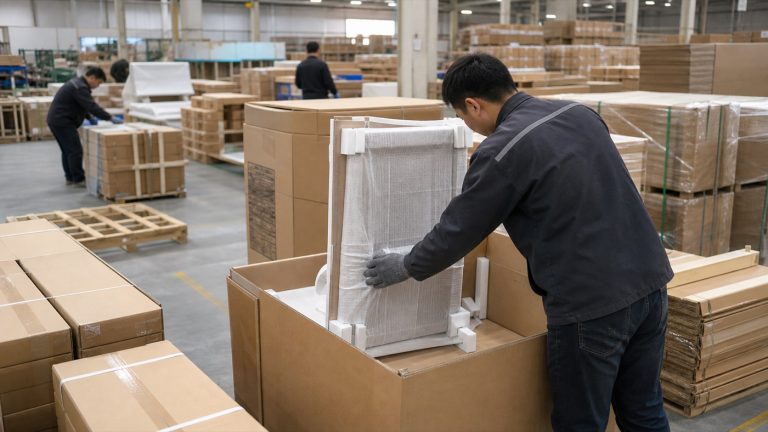
Packaging Is Now Part Of The Product Promise
Furniture buyers increasingly sell across mixed channels: wholesale, marketplace, independent ecommerce, retail stores, project orders, and direct-to-consumer delivery. These channels do not stress packaging in the same way.
A carton built for containerized wholesale movement may survive when it is palletized and handled by experienced warehouse teams. The same product may fail when it enters parcel delivery, is handled as an individual box, or reaches a consumer who expects showroom-level condition at the front door. A flat-pack desk that looks acceptable in a factory sample room can become a margin problem if panels arrive with chipped veneer or if one small hardware bag goes missing.
The buyer’s visible issue is often “damage rate.” The real issue is usually a system: carton strength, internal fit, protection at corners and edges, compression resistance, product orientation, moisture control, hardware control, instruction clarity, pallet pattern, container loading, and channel-specific handling assumptions.
This is also why packaging decisions connect to export strategy. A factory choosing its first serious overseas market cannot look only at demand and price band. It also needs to understand how the product will be distributed after arrival, what claims process the buyer expects, and whether packaging cost is being judged against container efficiency, retail handling, or home delivery reliability. That logic links directly with our earlier analysis of market-first furniture export strategy.
The Carton Is Only One Layer
A common mistake is to reduce packaging review to the outer carton. The carton matters, but it is only one layer of the packaging system.
For furniture, the system usually includes the outer carton, inner corrugated structure, foam or paper-based protection, molded pulp corners, honeycomb board, edge guards, anti-scratch wrapping, fabric protection, silica gel or moisture-control materials, hardware bags, spare parts, assembly manuals, warning labels, pallet configuration, and sometimes drop-test or vibration-test records.
The best packaging is not always the heaviest packaging. Extra material can raise freight cost, reduce container loading efficiency, create sustainability pressure, and still fail if the product moves inside the carton. The better question is whether the packaging protects the most vulnerable points in the actual distribution path.
For case goods, that often means corners, edges, drawer slides, thin panels, legs, hardware, and finished surfaces. For sofas and upholstered chairs, it may mean fabric abrasion, frame corners, leg pockets, moisture, compression marks, and deformation during loading. For flat-pack items, the weak points are often panel separation, carton burst, missing hardware, unclear instructions, and damage caused by movement inside the box. For outdoor furniture, corrosion risk, water exposure, woven material deformation, and coating scratches may matter as much as impact protection.
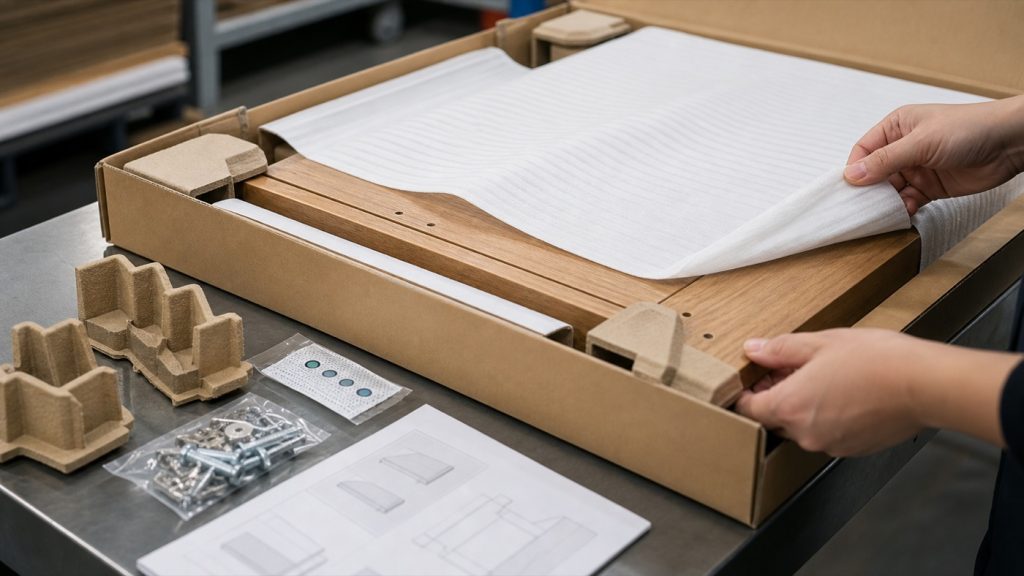
Testing Should Match The Distribution Reality
Packaging tests are useful only when they reflect the way the product will move. The International Safe Transit Association publishes a range of packaged-product test procedures and projects, including approaches for different product weights and distribution systems. ISTA’s public procedure list includes integrity testing, random vibration, unitized load testing, parcel distribution testing, and temperature exposure profiles.
For furniture teams, the practical takeaway is not that every SKU needs the same test. The takeaway is that packaging review should be structured. A buyer and supplier should know whether the product is being prepared for palletized truckload shipment, retail distribution center handling, parcel delivery, cross-border ecommerce, or a mixed route. The packaging spec should then be judged against that route, not against a generic carton drawing.
Useful test and review questions include:
Does the product move inside the carton during vibration? Are corners protected against realistic drops and side impacts? Can cartons tolerate stacking pressure in warehousing and container loading? Does the package handle humidity and temperature exposure without weakening? Are heavy components separated from fragile panels? Does the package survive being opened and reclosed during inspection? Are pallets built so cartons do not overhang or collapse?
These questions are not only laboratory questions. They should inform factory floor packaging trials, pre-shipment inspection photos, carton-marking review, container loading plans, and post-delivery claim analysis.
Damage Data Is A Buyer-Side Asset
Many factories can show a packaging photo. Fewer can show packaging performance data. That gap is important.
A serious buyer should ask suppliers to separate damage by SKU, channel, carton size, destination warehouse, delivery method, and claim type. “The damage rate is low” is less useful than knowing whether the issue is corner crush on a cabinet, fabric stain on a sofa, broken legs on dining chairs, missing screws in a flat-pack item, or crushed cartons caused by pallet overhang.
Factories should also treat claim photos as product development data. If the same table corner is repeatedly damaged, the solution may be an internal protector, better leg separation, a stronger carton grade, a different product orientation, or a changed pallet pattern. If customers complain about assembly, the packaging issue may be instruction design, hardware labeling, or sequencing rather than physical protection.
This is especially important for ecommerce and independent-site sales. Scene-led merchandising can win attention, as we discussed in our analysis of home commerce presentation, but the customer’s final judgment comes when the package arrives and the product can be assembled without damage or confusion.
Category Risk Should Shape The Spec
Packaging standards should not be copied blindly across the whole furniture line. A dining chair, a six-drawer dresser, a glass coffee table, a recliner, a modular sofa, and a collapsible outdoor table do not fail in the same way.
For upholstery, buyers should pay close attention to fabric protection, rubbing points, carton ventilation, moisture control, leg pockets, and compression marks. Upholstered products can arrive structurally intact but visually unacceptable if fabric is stained, creased, abraded, or pressed by hard internal parts.
For case goods, finished edges and corners often carry the highest visible risk. Drawer systems, hinges, handles, and removable shelves need stable positioning. For bedroom storage furniture sold into the United States, buyers also need to understand whether the product falls under clothing storage unit requirements. The U.S. Consumer Product Safety Commission states that the STURDY law led to requirements codified at 16 CFR part 1261 for certain clothing storage units manufactured after September 1, 2023. That is not a packaging rule, but it shows why case-goods documentation, hardware, anti-tip devices, warnings, and assembly materials cannot be treated casually.
For flat-pack products, packaging and assembly experience are inseparable. Panels need separation, corners need protection, hardware needs reliable counting and bagging, and instructions need to match the exact revision of the product. A small mismatch between hardware pack and instruction sheet can create returns even when the product itself is well made.
For outdoor furniture, packaging should reflect corrosion, moisture, surface finish, and long-distance storage risk. If metal frames, screws, or connectors are exposed to humidity before arrival, the buyer may face complaints before the customer has even used the product.
What Buyers Should Ask Before Approving An Order
The packaging discussion should start before mass production, not after the first damage claim. A practical review can be simple, but it needs to be specific.
Buyers should request the packaging bill of materials, carton dimensions, gross weight, pallet pattern, container loading plan, photos of inner protection, photos of the packed product before carton closure, and any available drop, vibration, compression, or channel-specific test records. For new SKUs, buyers should ask for packaging trial photos and confirm whether the trial used the same carton, protection materials, hardware pack, and instruction sheet intended for production.
It is also worth asking how the supplier handles replacements. Can the factory supply spare parts for common damage points? Are cartons marked so warehouses can identify orientation and handling requirements? Are hardware bags labeled by step or component? Can the buyer receive claim photos in a format that can be analyzed by SKU and damage type?
For larger programs, packaging should be part of the supplier scorecard. A supplier with slightly higher unit cost but lower damage claims, better documentation, and faster spare-part response may be more competitive than a supplier that wins only on first-cost quotation.
What Factories Should Build Into Their Capability
Factories that want stronger export accounts should treat packaging as an engineering discipline. That does not require a large laboratory in every plant, but it does require repeatable control.
A capable factory should maintain packaging drawings, material specifications, carton strength requirements, product-to-carton fit records, photo standards, packing SOPs, hardware-control procedures, and a feedback loop from buyer claims. It should also know which products need outside lab testing and which products can be validated through structured internal trials plus buyer-approved inspection.
Packaging improvement should not be framed only as cost increase. Sometimes the best improvement is simplification: fewer component movements inside the carton, clearer hardware bags, better internal sequencing, tighter carton sizing, stronger corner logic, or a loading plan that avoids overhang and compression failure. In other cases, the right answer is a more expensive material because the product’s claim risk justifies it.
The commercial point is straightforward: a buyer does not experience the factory’s production quality directly. The buyer experiences production quality after transit. Packaging is the bridge.
The Home Industry Insights View
Furniture packaging is moving from a back-office purchasing decision to a strategic operating issue. It affects cost, sustainability, delivery reliability, buyer confidence, online reviews, and repeat orders.
For buyers, packaging capability should be part of supplier evaluation, especially for bulky, fragile, assembled, upholstered, or flat-pack products. For factories, packaging should be part of export readiness, not a last-minute carton quote. The companies that understand this earlier will have a practical advantage: fewer claims, smoother launches, better data, and stronger buyer relationships.
In a market where many suppliers can copy a product look, the quieter advantage may be the ability to deliver that product intact, clearly documented, and ready for the customer to use.