
For most home-furniture ranges, a shoe cabinet is a storage item: shelves, doors, hinges, and a finish that works with the entryway. A smart shoe-care cabinet changes the product brief. It may add air circulation, moisture monitoring, replaceable filters, timed drying modes, lighting, sensors, and optional connected controls. The cabinet is still expected to look like furniture, but it also becomes a small managed environment for footwear and the space around it.
That makes it a useful category for buyers, retailers, distributors, and home-product brands looking beyond generic storage. The commercial opportunity is not to place electronics inside a tall cabinet. It is to build a product whose airflow, materials, doors, shelves, controls, maintenance routine, and customer expectations work together after installation.
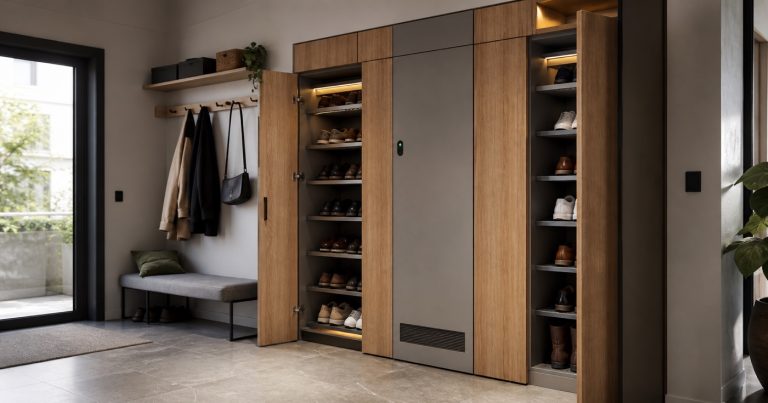
Start With The Actual Use Case
The entryway is a demanding part of the home. It concentrates outdoor shoes, bags, coats, floor dust, changes in temperature and humidity, and sometimes limited floor area. A buyer should decide whether the product is intended for everyday family footwear, seasonal storage, apartment entryways, premium renovation projects, or compact hospitality rooms. Each use case changes capacity, ventilation time, shelf geometry, door opening, noise expectations, and the value of a connected feature.
The brief should identify the footwear mix instead of assuming that every shelf serves every shoe. Boots, running shoes, formal shoes, slippers, and children’s footwear create different heights, widths, soles, and airflow paths. Adjustable shelves may help, but their load rating, supports, tolerance, and removal sequence need to remain practical. A visually attractive sample that only fits a narrow set of shoes will create avoidable returns.
It is also important to define what the product does not claim. Airflow, a replaceable filter, or a timed dry cycle may improve the cabinet environment, but they should not be presented as a health, sterilization, or material-restoration promise without product-specific evidence and legally suitable claim language. Retail copy needs the same discipline as the technical specification.
Airflow Is A Product Architecture Decision
Many smart shoe-care concepts depend on drawing air through the cabinet, circulating it around stored footwear, and exhausting or treating that air in a controlled way. That apparent simplicity hides several furniture decisions: where the air enters, how it reaches each shelf zone, whether doors can close without blocking the path, where a filter sits, how sound travels through panels, and how dust is prevented from becoming a maintenance burden.
Product teams should ask for an air-path diagram and then check it against the physical cabinet. The diagram should identify intake, fan, ducting where used, shelf perforation, filter position, exhaust path, service panel, sensor location, and the condition of the doors during operation. It should also show whether the cabinet requires a clearance from a wall or adjacent fitted cabinetry.
The most relevant test is not simply whether a fan runs. It is whether the completed cabinet moves air through the intended zones without unacceptable sound, rattling, concentrated drafts, or a filter that becomes inaccessible after the cabinet is installed. Fan speed, operating duration, automatic shutoff, control logic after a power interruption, and user feedback should be defined as a finished-product behavior, not an assembly-line assumption.
Moisture Management Needs Measurable Boundaries
Moisture is an understandable consumer concern, especially in humid climates or after wet-weather use. Yet a credible product brief needs specific boundaries. Is the cabinet only monitoring ambient conditions? Is it circulating room air? Does it include a dehumidifying component, and if so, where does collected moisture go? Can the cabinet operate with wet footwear inside, or does the instruction require shoes to be surface-dried first?
Those decisions affect the furniture construction. Edges, shelf panels, fasteners, rear panels, cable cut-outs, and the base need a defined approach to repeated humidity rather than a finish-only solution. If a condensate collection point or removable tray exists, it needs safe removal clearance and a clear cleaning routine. If there is no collection system, the product manual should not imply one.
Buyers should require a test protocol that reflects the intended market and usage. The protocol can specify load configuration, cabinet condition, test duration, fan or dehumidification mode, temperature and humidity measurement points, noise observations, post-test inspection, and acceptance criteria. Avoid headline performance claims that cannot be tied to a repeatable finished-product test.
Furniture Details Still Decide The Experience
Electronic functions do not excuse weak cabinetry. Door alignment, hinges, soft-close behavior, shelf deflection, edge integrity, anti-tip strategy where needed, ventilation-grille finish, level adjustment, and the usability of handles all affect whether the customer sees the cabinet as a reliable piece of furniture.
This is where our review of cabinet hardware durability is directly relevant. Door weight can increase when a product includes an insulated access panel, filter module, or vent detail. The project team should specify the door mass, hinge opening cycle, alignment tolerance, cable clearance, and any limit switches or door sensors as a single interface rather than sourcing them in isolation.
Material selection also needs to consider the visible entryway context. Buyers may want a wood-look panel, lacquered surface, metal frame, or mirror detail, while the internal surfaces need to withstand routine cleaning and occasional dirt transfer from footwear. The bill of materials should make visible panels, internal liners, shelf coatings, edge treatments, grilles, hardware, and electronic enclosures traceable by version.
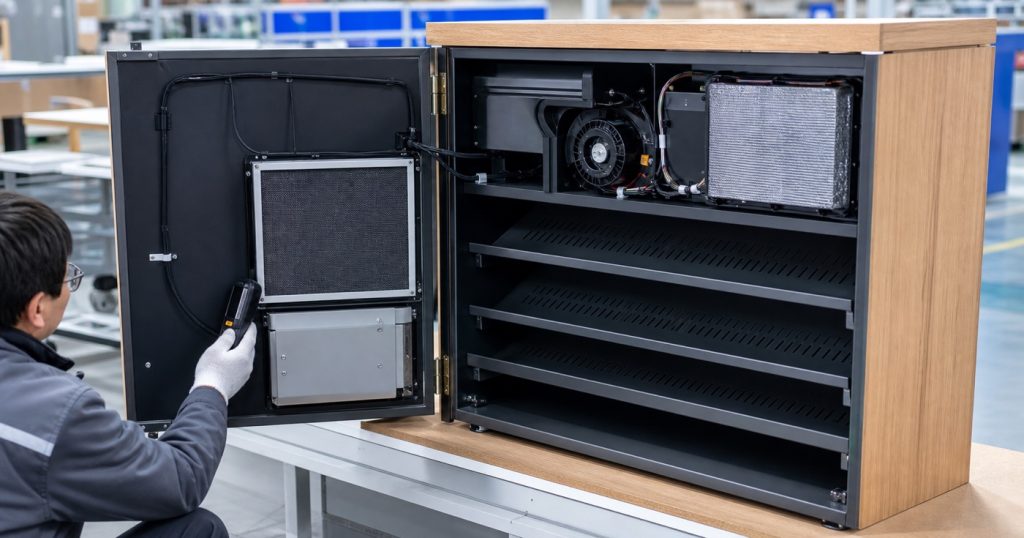
Make Filter And Component Service Simple
Filters, fan modules, sensors, power supplies, and controllers turn a one-time furniture purchase into a product with a service cycle. If the customer cannot reach the filter without unloading the cabinet, the advertised function will be difficult to maintain. If a fan or controller has no defined replacement route, a small component failure may turn into a bulky-furniture warranty claim.
The service design should show how a user or technician opens the access panel, removes and reinstalls a filter, reaches the relevant components, identifies a replacement part, and restores the cabinet to normal operation. The parts plan should distinguish consumer-serviceable items from technician-only work. It should define replacement filter dimensions, packaging, recommended replacement logic, warranty responsibility, and the product version each spare part fits.
For connected versions, product teams also need a controlled approach to pairing, resets, app support, software updates, data handling, and the behavior when a connection is unavailable. A cabinet should remain understandable and usable through local controls; the app should not become the only route to basic operation.
Quality Control Has To Combine Furniture And Appliance Checks
Smart shoe-care cabinets benefit from a combined final inspection. A normal furniture inspection might check dimensions, finish, doors, gaps, hardware, and carton condition. A finished system check should add fan operation, sensor response where specified, control-panel function, cable routing, filter seating, noise observation, heat management, door-sensor behavior where used, and recovery after a controlled power interruption.
The key is to test the final build. Electronics that worked before installation do not prove that the cabinet performs properly after its panels, shelves, doors, ventilation paths, and packing restraints are in place. The factory should document the firmware or controller version where relevant, component lot or serial logic where required, and the change-control process if a fan, filter, power supply, or sensor becomes unavailable.
Our earlier coverage of smart furniture integration explains why this shared ownership matters. The furniture factory, component supplier, and final assembler have to agree on specifications, failures, test records, and responsibility for future substitutions.
Packaging And Retail Setup Need Their Own Plan
The cabinet may ship as a finished appliance-furniture unit, a partly assembled cabinet, or a furniture carcass with modules installed later. The chosen model affects carton strength, protection of doors and grilles, securing of internal shelves, restraint of fan or filter assemblies, cable protection, and the receiving process. Large, tall cabinets also need a clearly defined delivery and installation sequence.
Our guide to furniture packaging and transit damage applies here, with a further requirement: inspection must include function. Retail teams and installers should be able to confirm cabinet level, door alignment, shelf fit, grille condition, cable condition, filter presence, fan operation, and the availability of instructions before a customer begins using the product.
Merchandising should show the category as entryway furniture first, then make the functional value understandable. Demonstration pieces need practical maintenance access, clear but disciplined feature language, and a way for store staff to explain routine care without turning a cabinet sale into a vague technology promise.
What Buyers Should Approve Before Launch
A launch-ready brief should define the entryway use case, footwear capacity, shelf sizes, cabinet materials, air path, filter and moisture-management approach, operating modes, noise target, controls, service access, replacement parts, packaging, installation conditions, and destination-market responsibilities for electrical or connected versions.
It should also identify the evidence behind each claim. The supplier should be able to connect product-page language to a real finished-product specification and test method. That is especially important for statements about moisture, odor, cleaning, air treatment, connected functions, or the lifespan of a component.
2026 Takeaway
Smart shoe-care cabinets illustrate a broader direction in home furniture: small everyday routines are becoming system products. The commercial value comes from combining an attractive entryway cabinet with sensible airflow, moisture boundaries, maintainable components, disciplined claims, and reliable furniture construction.
For buyers and brands, the strongest suppliers will be the ones that can make the cabinet feel simple to own while controlling the details behind it: air paths, filters, panels, hardware, controls, parts, packing, installation, and service.