
An indoor garden cabinet can make fresh herbs and leafy plants part of a kitchen or dining-room setting rather than a collection of pots on a windowsill. The visible product may look like a glazed oak cabinet with shelves of greens. The finished product is more demanding: it combines lighting, water storage, irrigation, drainage, ventilation, humidity, electrical controls, cabinet materials, cleaning access, and routine maintenance.
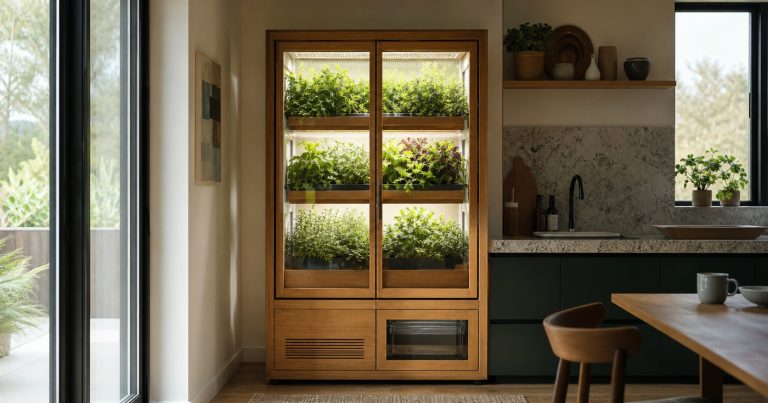
For furniture brands, kitchen retailers, project buyers, and distributors, this is an appliance-integrated furniture category. A unit that grows well in a factory demonstration can still create claims, odor, leakage, mold, noise, service, and cabinet-finish problems after it enters a real apartment. The product has to be designed as a controlled growing environment and a credible piece of home furniture at the same time.
Start With The Household Use Case
The product brief should define what the cabinet is for: decorative greenery, culinary herbs, salad greens, seedling support, or a mixed display. Each use changes shelf spacing, lighting profile, reservoir size, access frequency, cleaning needs, and the degree of consumer guidance required. Buyers should avoid claims about yield, harvest timing, or nutrition unless they can be supported for the exact product and operating conditions.
Cabinet size also matters. A countertop model, freestanding cabinet, and built-in kitchen unit have very different loading, ventilation, plumbing, and service requirements. A project cabinet may have a dedicated power point and planned floor protection. An ecommerce unit may need a simple refill path, spill-resistant packing, and instructions that work for a first-time user.
The best product brief states what plants, growing media, seed pods, nutrients, water treatment, and cleaning products are allowed. It should also identify the user tasks: filling the reservoir, adding nutrients, removing plants, wiping trays, checking a filter, emptying a drain, and responding to an alarm. A smart cabinet is not complete if daily care is more complex than the sales story suggests.
Water Management Is A Furniture Design Problem
Water is the most obvious difference between an indoor garden cabinet and a normal display cabinet. The product may include a reservoir, pump, tubes, trays, drip channels, valves, level sensor, drain tray, overflow path, and removable growing modules. Each connection is a potential leak path, and every leak path is close to furniture panels and electrical components.
Buyers should ask for a water-path drawing that shows the reservoir, pump, feed lines, return lines, trays, overflow route, drain access, and separation from electrical components. The drawing should show how a user reaches the reservoir and how the unit is emptied before moving or servicing it. A hidden tank can look clean, but it becomes a problem if it cannot be cleaned or if an unnoticed leak reaches the cabinet base.
The cabinet material needs an honest wet-environment brief. Veneer, MDF, particleboard, plywood, solid wood, laminate, metal, glass, sealants, and edge treatments react differently to repeated humidity and small spills. Buyers should test the finished cabinet after realistic refill, cleaning, and leak scenarios, not only inspect a dry sample.
Lighting And Ventilation Must Work Together
Growing lights create heat. Plants and wet media create humidity. A closed glass cabinet needs controlled air movement without becoming noisy, drying plants unevenly, or blowing humid air into vulnerable furniture joints. The lighting, fan, vent position, cabinet seal, shelf spacing, and plant layout are one system.
The buyer should request the light specification, heat-management approach, fan location, ventilation path, timer behavior, and expected noise profile. The cabinet should be tested in a real room condition with doors closed, lights operating, water present, and representative plant trays installed. A bright cabinet with poor airflow may create condensation on glass or interior surfaces, while excessive airflow may create a different plant-care burden.
Lighting should be evaluated as a user-facing feature as well. It needs a sensible schedule, a clear on/off or maintenance mode, safe access for cleaning, and a replacement plan. The finished product should not require users to dismantle a wet growing shelf to reach a failed driver or fan.
Controls Should Simplify Maintenance
Useful controls include light scheduling, water-level alert, pump-cycle control, fan setting, door-open alert, cleaning reminder, leak or overflow alert, and diagnostic information. The strongest smart layer reduces uncertainty for the user. It should not create an app requirement for a simple refill or add wireless complexity without a clear benefit.
If the cabinet includes Wi-Fi, Bluetooth, or app control, buyers should lock the module and firmware in the bill of materials. In the United States, 47 CFR 2.803 is relevant to marketing radio-frequency devices. In the European Union, the European Commission’s Radio Equipment Directive overview describes the framework for radio equipment. The finished configuration and destination market determine the actual route.
The product must also behave predictably after a power interruption. Buyers should ask whether the light schedule, pump cycle, alarms, and user settings recover automatically, and whether the cabinet gives a clear indication that a restart or refill is required.
Service Access Separates A Product From A Demonstration
An indoor garden cabinet can contain a pump, water-level sensor, tubing, fan, light driver, controller, power supply, filter, tray, and drain components. The cost of a failed part depends on whether it can be reached. If servicing a pump requires destroying a cabinet panel or if a driver sits below a leaking tray, the product is poorly integrated.
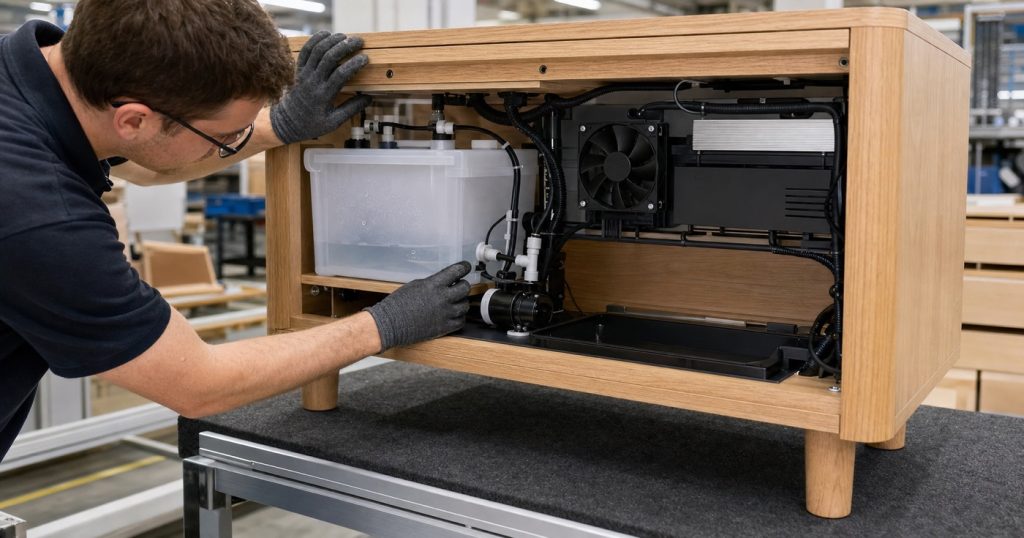
The service drawing should show access to the reservoir, pump, filters, fans, light driver, controller, electrical connections, and drain tray. Buyers should require a spare-parts matrix with stable identifiers, compatibility rules, images, expected replacement steps, and approved substitutions.
This is consistent with our earlier analysis of smart furniture integration. The visible feature is only as durable as the hidden parts, technical file, and after-sales process behind it.
Factory Quality Control Needs A Wet And Dry Test Plan
Normal cabinet inspection checks finish, dimensions, doors, glass, edge quality, and packing. An indoor garden cabinet needs all of those checks plus water-path inspection, pump operation, tubing connections, leak control, light operation, fan behavior, electrical routing, sensor behavior, tray fit, and service-panel access.
The most useful check is a finished-unit test with water in the intended system. Inspect for leaks at fittings, return paths, reservoir seams, trays, and drain points. Verify that electrical parts stay protected from normal water paths and that the cabinet can be cleaned without damaging its finish. The factory should record critical component batches so a warranty claim can be traced to a pump, driver, sensor, or controller version.
Packaging And Installation Need To Protect Both Cabinet And System
The product combines glass, cabinet panels, lighting, water components, trays, and electronics. The carton must prevent breakage and hold removable parts in place. It should specify whether the reservoir ships empty, how the pump and trays are restrained, what is packed separately, and how the customer performs the first water test.
Our earlier coverage of furniture packaging and transit damage applies directly. Receiving inspection should include more than scratches. Before placing the cabinet in a finished kitchen niche, the installer or customer should check level, door alignment, lights, fan, reservoir, pump cycle, drain tray, and any alarms.
What Buyers Should Approve Before Launch
A strong brief should define the household use case, plant and media assumptions, cabinet size, shelf layout, reservoir capacity, water path, drainage, light schedule, ventilation, noise expectation, materials, cleaning routine, service access, and installation conditions.
It should define the electronics and controls: light, driver, fan, pump, sensor, power supply, controller, alerts, wireless module where used, recovery after power interruption, and destination-market documentation. Finally, it should define the commercial system: wet test, carton plan, first-use check, replacement parts, warranty responsibility, and supplier change control.
2026 Takeaway
Smart indoor garden cabinets are a useful example of furniture becoming a controlled home system. The commercial opportunity is not simply to add lights to a shelf. It is to create a product that fits the home, manages water and humidity responsibly, is understandable to a first-time user, and can be repaired after installation.
For buyers, the winning suppliers will be the ones that control cabinet quality, water management, ventilation, lighting, electrical safety, packaging, installation, and service as one finished product.