
An aquarium cabinet used to be treated as a stand: a piece of furniture expected to hold a tank and look acceptable in a room. A smart aquarium cabinet is a more demanding product. It has to present a finished living-room surface while carrying a changing water load, housing filtration equipment, managing heat and humidity, routing tubes and cables, and giving an owner enough access to clean and service the system.
That changes the sourcing conversation. Buyers, retailers, distributors, and home-product brands should not assess the cabinet, aquarium, and equipment as loosely related items. They need a product brief that makes the structural, water-management, electrical, packaging, installation, and after-sales responsibilities visible.
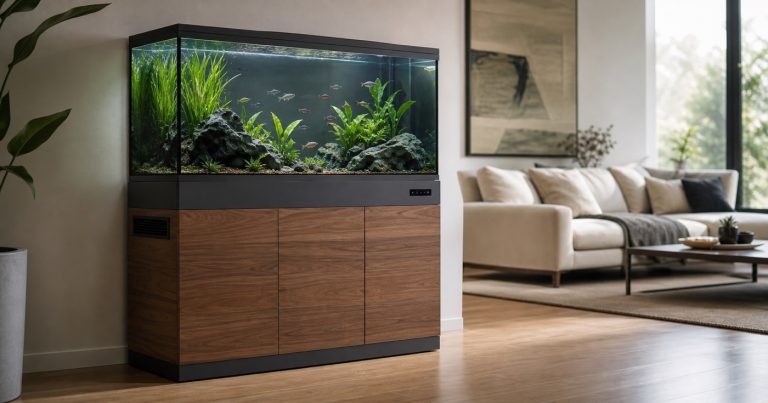
The Product Is Not Just A Cabinet With A Tank On Top
The finished aquarium assembly carries more than water. Its total mass can include the glass or acrylic tank, substrate, rocks, decoration, filtration media, equipment, and the cabinet itself. The actual load depends on the selected tank and configuration, so a supplier should not substitute a generic weight claim for an engineering-defined load case.
For the furniture team, the key question is the complete load path: tank base to top panel, top panel to vertical structure, structure to plinth or feet, and finally to the installation floor. A visually flat top is not enough. The support surface must be specified for flatness and level, and the interface between tank and cabinet must follow the tank maker’s documented requirements. Small deviations can become a service issue when a large, water-filled display is installed in a finished home.
This is one reason smart aquarium cabinets should be treated as a system SKU. The design brief should identify the compatible tank envelope, finished assembly mass, structural reinforcement, anti-racking method, base construction, adjustable-leveling approach where applicable, and the floor or wall-clearance conditions that must appear in the installation instructions.
Water Paths Need A Failure Plan, Not Just Neat Tubing
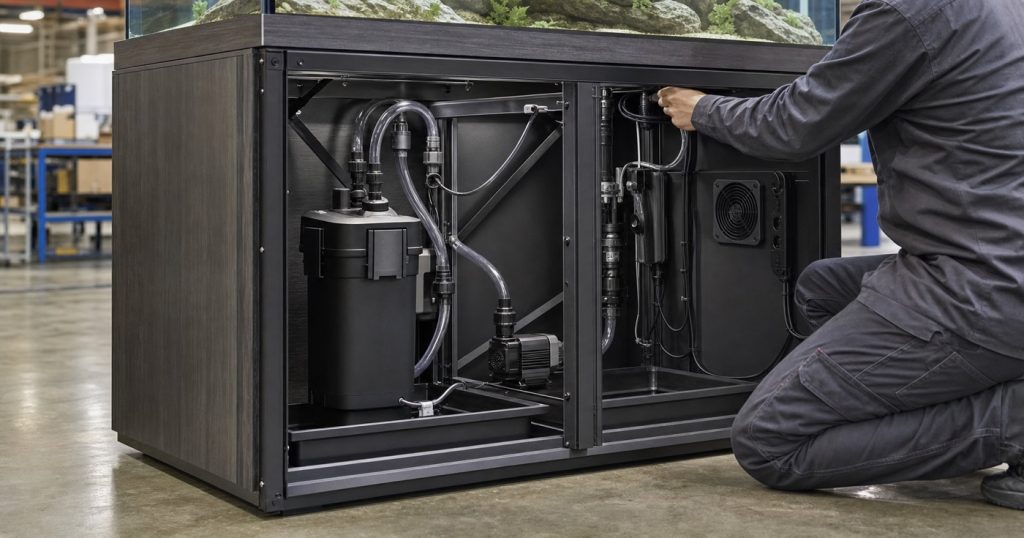
Filtration, return lines, drains, top-off reservoirs, and pump connections turn the cabinet interior into a water-management zone. The commercial question is not whether the tubing looks tidy at a sample review. It is where water can go during normal operation, maintenance, a loose fitting, a blocked return, or a small leak.
A useful supplier review maps every water path and identifies the containment strategy: a water-resistant service tray, raised edges, protected cable and hose pass-throughs, visible inspection points, and a route that does not send a small spill directly into an unprotected panel joint. Materials at the cabinet base, rear panel, door edges, and cut-outs need to be chosen for humidity and occasional water exposure rather than only showroom appearance.
Leak sensing can be a valuable feature, but it is not a substitute for physical containment or clear service access. If a leak sensor, shutoff function, alert, or connected monitoring feature is offered, the product team should define what it detects, what it does after detection, how it is tested, and what the owner is expected to do. Do not market a notification as complete water-loss protection.
Service Access Is A Furniture Design Requirement
The most attractive cabinet can become a poor consumer product when a filter lid, pump, hose connection, power module, or drain point cannot be reached without moving the aquarium. The service bay needs practical door opening, component removal clearance, cable slack, hose bend radius, and enough lighting for routine work.
Buyers should ask for a maintenance sequence, not only a service-bay rendering. It should show how an owner reaches the filter, isolates or disconnects components where the design permits, removes consumables, checks the containment tray, cleans the cabinet interior, and reinstalls doors without pinching lines. The sequence should be reviewed with a real filled system, not only a dry cabinet prototype.
The same principle applies to sound. Pumps, fans, water flow, and cabinet panels can create vibrations that a household finds more noticeable at night than a factory test suggests. A useful sampling plan includes the intended cabinet construction, pump and filter configuration, door panels, feet, and a realistic operating period. It should capture practical noise and resonance observations alongside normal function checks.
Smart Features Need Clear Boundaries
The word “smart” can mean a timer, a lighting controller, a temperature display, leak alert, remote status view, or a connected app. Those functions should be specified separately. A retailer needs a simple customer-facing feature list, while the product team needs a deeper component schedule: controller, sensors, power supply, pumps, fans, lights, cable harnesses, connectors, firmware version where relevant, and replacement part numbers.
Wireless features add market-specific work. In the European Union, radio equipment is subject to the Radio Equipment Directive framework for safety, electromagnetic compatibility, and radio-spectrum use. The European Commission’s RED overview is a useful starting point, but it is not a substitute for a destination-market compliance plan. The responsible business needs to identify the exact finished configuration, radio module, software state, labeling, documentation, and applicable assessment route.
For every market, electrical safety and installation instructions should be reviewed for the finished system rather than borrowed from a pump or light component catalogue. Keep power connections away from foreseeable water exposure, use protected routing and strain relief where appropriate, and have a qualified person determine the applicable local requirements. The article-level lesson for buyers is simple: a cabinet can conceal components, but it cannot remove their compliance, access, or service obligations.
Materials, Ventilation, And Finish Quality Have To Work Together
Humidity is a constant design input. A sealed cabinet can trap moisture around filters, pumps, connectors, and panel edges; an open cabinet can increase noise and reduce the furniture-like appearance. Ventilation openings, filters if used, fan operation, and the separation between wet and electrical zones should be designed together rather than added late as decorative grilles.
Furniture materials require the same discipline. The bill of materials should identify visible surfaces, edge treatment, cut-out finishing, fastener corrosion resistance, back-panel construction, internal liner, and the method used to protect the cabinet base. A supplier should be able to explain what is cosmetic, what is a moisture barrier, and what happens when the product is opened for service years after installation.
This is related to the broader issues discussed in our coverage of smart furniture integration. When furniture contains functional systems, the product succeeds only when the furniture supplier, equipment supplier, and final assembler share a clear ownership model for interfaces and change control.
Test The Finished Assembly, Not Separate Parts
Component tests matter, but they do not prove that the finished cabinet is ready for retail. A complete validation plan should include the actual tank footprint, support structure, cabinet materials, doors, cable and hose routes, filtration equipment, ventilation, electronics, and installation hardware.
Useful reviews include a defined filled-system test, inspection for water in the containment area, door and panel alignment after loading, pump and fan operation, sound observations, access to consumables, visual finish checks after humidity exposure, and packaging verification. The plan should also identify what happens after a power interruption and what is verified at the first installation. No single test removes all risk; the goal is a documented and repeatable release standard.
Packaging And Installation Are Part Of The Purchase Decision
The tank, cabinet, filtration items, and loose accessories may have very different transport needs. A supplier must decide whether they ship as one integrated assembly or as controlled modules, then define which components are protected, restrained, moisture-isolated, and checked at receiving. Carton labels and first-use instructions should help the receiving team avoid moving a water-ready cabinet as if it were an empty sideboard.
Our earlier article on furniture packaging and transit damage is particularly relevant here. For aquarium furniture, the delivery checklist should cover more than visible scratches: cabinet level, tank condition, door alignment, tubing condition, pump and filter presence, service-bay access, ventilation parts, and the correct documentation for the destination market.
What Buyers Should Approve Before Launch
A launch-ready smart aquarium cabinet brief should define the intended installation setting, compatible tank configuration, finished system mass, structural load path, cabinet materials, water paths, containment approach, service-bay access, ventilation, sound expectations, electrical and connected features, destination-market responsibilities, packaging, installation steps, and replacement-parts plan.
It should also define ownership. Who supplies the tank? Who validates the support interface? Who approves the filter and control modules? Who changes a component if its dimensions or firmware change? Who handles a leak-related customer case? When those answers are unclear, a beautiful cabinet can become a fragmented warranty problem.
2026 Takeaway
Smart aquarium cabinets show how a niche home category can become a serious system product. The opportunity is not merely to hide equipment under an aquarium. It is to deliver a finished piece of living-room furniture that manages weight, water, humidity, access, control, transport, installation, and service in a deliberate way.
For buyers and brands, the strongest suppliers will be the ones that treat the cabinet, tank interface, water-management zone, electronics, packaging, and after-sales support as one accountable product system.