
A wine cabinet can appear to be a simple premium storage feature: a glass door, timber shelves, dark interior, and neatly arranged bottles. In practice, a smart wine cabinet combines refrigeration, furniture materials, glass, shelving, ventilation, controls, installation, and after-sales service inside one visible home product.
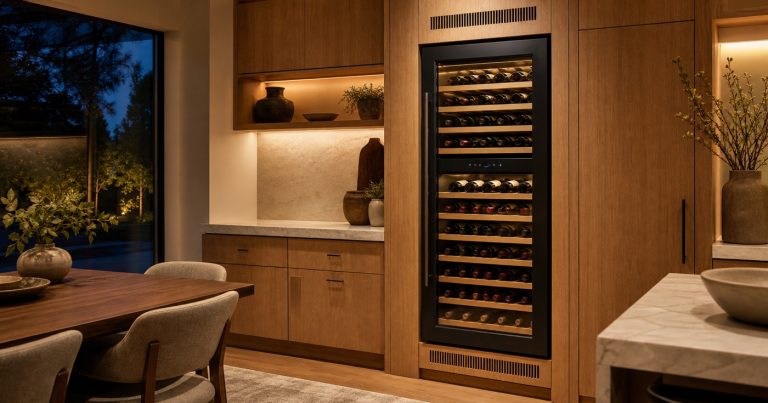
This makes the category relevant to kitchen brands, furniture retailers, appliance distributors, hospitality projects, interior contractors, and home-product buyers. The cabinet must look correct in a dining room or kitchen elevation, but it also has to maintain a controlled internal environment, reject heat, close reliably, support bottles without vibration or breakage, and remain serviceable once it is surrounded by expensive cabinetry.
The Home Industry Insights view is that a wine cabinet should be sourced as appliance-integrated furniture. A factory that can build a beautiful cabinet box is not automatically ready to manage refrigeration performance, electrical components, ventilation paths, door sealing, shelf mechanics, and service access.
The Product Brief Starts With The Storage Use Case
Wine cabinets are often marketed through broad claims such as “dual zone,” “quiet cooling,” or “smart temperature control.” For a buyer, the stronger starting point is the actual use case. Is the unit intended for a small apartment collection, a dining-room display, a kitchen renovation, a hospitality suite, a restaurant private room, or a large project built-in? Will it store standard bottles only, mixed bottle shapes, champagne formats, opened bottles, or a combination of wine and other beverages?
Those decisions affect bottle count, shelf spacing, shelf depth, temperature-zone layout, door configuration, internal lighting, cabinet width, ventilation, and packing. A nominal 46-bottle cabinet may not hold 46 bottles of every format. Buyers should ask the supplier to specify the bottle shape used for the capacity claim and to state any reduction caused by larger formats or mixed storage.
The visible furniture details also matter. A freestanding cabinet may need finished side panels and a stable top. A built-in unit needs a coordinated opening, clear ventilation path, plumb installation surface, trim strategy, and service clearance. A full-height cabinet integrated into oak joinery is not just an appliance placed in a hole; its surrounding materials and tolerances can affect heat rejection, door movement, noise, and later repair work.
Temperature Zones Need A Credible Layout
Single-zone and dual-zone wine cabinets are not interchangeable product briefs. A dual-zone model may use separated compartments, separate sensors, dampers, or different control logic. Buyers should ask the supplier to define each zone’s setpoint range, sensor position, tolerance, recovery behavior after the door opens, and what happens when one zone is lightly loaded while the other is full.
The aim is not to turn a furniture buyer into a refrigeration engineer. It is to make sure the product specification matches the sales claim. A display cabinet used for short-term serving may need a different temperature range and access pattern than a long-term collection cabinet. A retailer should not use one generic marketing statement for all models if the hardware, zones, door glass, and cooling system differ.
Temperature should also be evaluated during realistic use. A cabinet may perform well in a controlled factory test but behave differently after installation into a tight wood surround, in a warm kitchen, or when customers frequently open the door. Buyers should request a test method that defines ambient condition, cabinet loading, setpoint, door-opening sequence, stabilization time, and acceptable variation rather than relying on a single display reading.
Ventilation Is A Furniture And Appliance Decision
Every cooling system needs a way to move heat away from the cabinet. Depending on the design, that may involve a front grille, rear clearance, upper vent, lower plinth opening, side clearance, or a defined cabinet cutout. The furniture team and the refrigeration team must approve the same drawing.
Ventilation is easy to compromise during installation because a designer may prefer uninterrupted cabinetry, a cleaner plinth, or a narrower opening. Blocking the intended heat path can increase compressor run time, noise, internal temperature variation, and service risk. Buyers should treat the ventilation drawing as a non-negotiable part of the installation pack.
The supplier should state which dimensions are required at the rear, top, sides, and front. It should also state whether the cabinet can be pushed flush to a wall, whether a toe-kick grille must remain open, and whether the door needs space to clear adjacent handles or panels. These are small details until a completed kitchen has to be modified to make an appliance work.
Glass Doors, Gaskets, And Shelves Carry Daily-Use Risk
The door is a furniture face and an appliance seal at the same time. Buyers should review glass thickness, frame construction, hinge capacity, handle fixing, door alignment, gasket compression, closing force, and the way the cabinet handles repeated openings. A door that looks elegant but leaks air, sags, rattles, or rubs a nearby cabinet will undermine the premium position quickly.
The glass choice needs a disciplined conversation. Clear, tinted, mirrored, and low-visibility glass create different display effects. Buyers should ask what glass construction is used, how it is protected in transit, whether the door has a safety film or multi-pane construction where relevant, and how the manufacturer handles replacement glass. Do not turn “UV protection” into a broad claim unless the supplier can support the exact glass construction and performance statement.
Shelving is equally important. Wooden shelves, metal rails, fixed racks, and telescopic slides need to support bottle load without racking, scraping labels, or creating excessive vibration. A customer should be able to remove a bottle without disturbing the entire shelf. If the model uses slide-out shelves, the factory should test them fully loaded and define whether they have a stop, a retention feature, or a safe removal method.
Smart Controls Need To Add A Real Benefit
The useful smart layer is often modest: accurate setpoint control, door-open alert, temperature alarm, service diagnostic code, child lock, filter or maintenance reminder, or remote visibility for a project operator. An app that only repeats the front-panel display can add cost and support burden without adding value.
If a cabinet includes Wi-Fi, Bluetooth, or a remote monitoring module, buyers should lock the exact module and firmware in the bill of materials. In the United States, 47 CFR 2.803 is relevant to the marketing of radio-frequency devices. In the European Union, the European Commission’s Radio Equipment Directive overview describes the framework for radio equipment. The applicable route depends on the finished configuration and destination market.
Controls should also be usable at the cabinet. Touch panels must be readable without dominating the furniture design. Door-open alarms should be audible enough for the intended room but not create nuisance complaints. A control lock should be understandable. The product should have a clear behavior after a power interruption, including how it restores settings and how users can identify a fault.
Electrical And Refrigeration Components Need Service Access
A smart wine cabinet may contain a compressor or thermoelectric system, condenser fan, evaporator, sensor, control board, power supply, lighting driver, door switch, wiring harness, drainage arrangement, and shelf slides. The component mix varies by model, but the service requirement is consistent: the buyer needs to know how a technician reaches the parts after the cabinet is installed.
The expensive failure is often not a failed fan or sensor. It is having to dismantle custom cabinetry to reach it. A product drawing should show the service side, removable panels, ventilation grille access, power disconnect, water or drainage access if applicable, and the clearance needed to remove a shelf, door, or component.
UL’s UL 962 listing describes a standard for household and commercial furnishings that includes motor-operated furnishings. That listing does not define every compliance route for a wine cabinet, but it reinforces a practical sourcing point: when furniture and electrical systems are integrated, the finished configuration, wiring, labels, instructions, and service model need review together.
Factory Quality Control Must Cover Both Appearance And Performance
Cabinetry inspection covers finish, edge quality, gaps, handles, glass alignment, dimensions, and packing. Wine-cabinet inspection needs those controls plus cooling performance, sensor consistency, door sealing, internal lighting, shelf movement, fan noise, vibration behavior, and electrical safety checks.
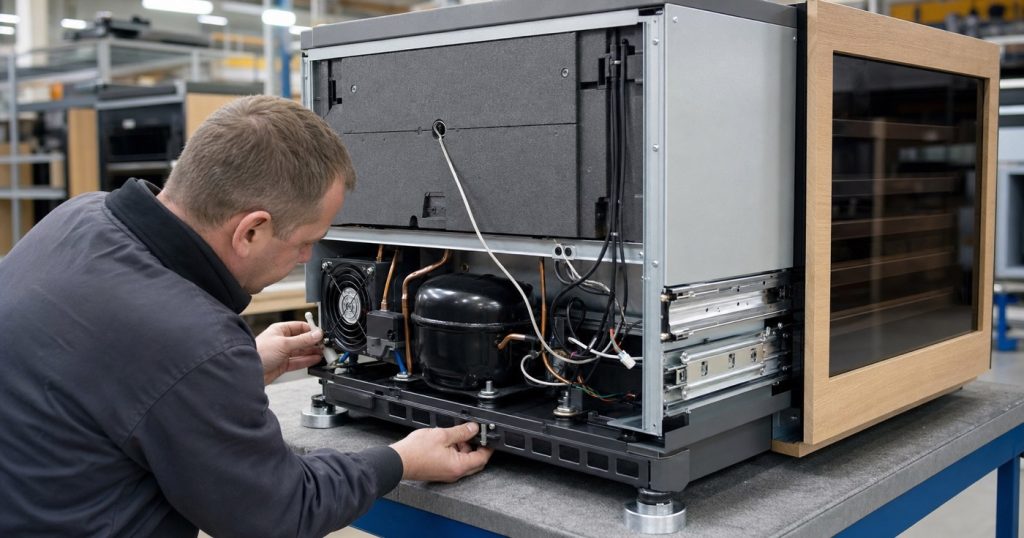
The factory should test the finished product with representative bottle loading and the final door, shelves, control panel, and ventilation configuration. Component traceability matters. A compressor, fan, controller, sensor, or door gasket changed after sample approval can alter noise, temperature behavior, electrical documentation, service parts, and customer experience.
Buyers should also check noise in the context of the intended room. A cabinet installed beside a dining table or in an open-plan living room may have a different noise expectation from a back-of-house beverage appliance. Ask how the product is tested and whether vibration isolation mounts, shelf pads, fan control, and cabinet stiffness are managed as a system.
Packaging, Installation, And After-Sales Define The Real Cost
The product combines glass, wood or metal trim, refrigeration components, rails, controls, and a heavy cabinet body. Packaging must protect the door, corners, glass edges, shelves, compressor mounts, and accessories. A cabinet can arrive without a visible scratch yet have a loosened shelf rail, shifted door, damaged fan mount, or obstructed vent.
Our earlier analysis of furniture packaging and transit damage is directly relevant. Receiving inspection should include more than carton condition. Before surrounding trim is completed, installers should check level, door swing, ventilation, initial cooling behavior, shelf movement, lighting, and controls.
The spare-parts plan should identify the door gasket, glass door, handle, hinge, shelf rail, shelf, fan, sensor, controller, power component, light, and any wireless module. Each part needs a stable code, image, compatibility rule, lead-time expectation, and replacement path. This is the same broader principle covered in our smart furniture integration analysis: product value depends on whether the hidden technical system remains controllable after launch.
What Buyers Should Approve Before Launch
A strong product brief defines the storage use case, bottle assumptions, zone layout, cabinet dimensions, door direction, glass construction, shelf type, ambient condition, ventilation opening, installation clearances, and expected room environment.
It then defines the technical layer: cooling system, sensor layout, control logic, fan behavior, wiring, light, alarm, wireless module where used, power-interruption behavior, service access, approved components, and destination-market documentation.
Finally, it defines the commercial system: finish samples, loaded performance test, noise check, carton plan, installer instructions, first-use inspection, spare parts, warranty responsibilities, and supplier change control. A wine cabinet should not be approved from a beautiful kitchen rendering and a list of bottle capacity alone.
2026 Takeaway
Smart wine cabinets show how beverage storage can become a high-value appliance-integrated furniture category. The opportunity is strongest for brands and suppliers that can deliver furniture-grade appearance without treating the cooling system as an invisible afterthought.
For buyers, the right standard is simple: the cabinet should look correct, cool predictably, ventilate properly, protect bottles and glass, install cleanly, and remain repairable after the project is finished. The suppliers that control all of those layers will be better positioned than those that only sell a dark glass door and a bottle count.