
A storage wall can do more than hold books, objects, and cabinets. A motorized rotating bookcase can pivot a full-height storage section through a controlled arc, changing access between two rooms or zones while keeping the visual language of built-in furniture. The product can suit premium residences, home libraries, hospitality apartments, private offices, and projects that need flexible separation without adding a conventional swing door to the room.

The visual effect is compelling, but the buying decision should not be driven by the effect alone. A rotating bookcase is a moving, loaded storage unit. It needs a reliable floor pivot, upper guide, cabinet structure, drive system, control method, lock or retention strategy, cable route, clearance envelope, installation plan, and service access. If any of those layers is weak, a refined storage wall can become an alignment, noise, safety, or warranty problem.
Home Industry Insights views this as controlled storage furniture, not a decorative bookcase with a motor attached. The supplier needs to manage furniture production and mechanical integration together.
The Product Is A Moving Load, Not A Standard Cabinet
A fixed bookcase transfers its load through a base, side panels, and wall fixing. A rotating bookcase carries shelf loads while moving that mass around a pivot. Books, objects, glass decor, cabinet doors, panels, and hardware all contribute to the rotating load and influence the center of gravity.
The first buyer question is not “How many shelves?” It is “What is the approved moving load and where can it sit?” A shelf full of books near the outer edge creates a different load from a balanced display of light objects. The product brief should define maximum overall load, permitted shelf load, recommended load distribution, cabinet dimensions, expected rotation angle, and whether the system is designed for decorative display, frequent daily access, or a specific project function.
The visible panel design must also work with motion. A tall bookcase can rack or twist if the carcass is not stiff enough. Doors can rub as the cabinet moves. Loose objects can shift. A unit that is quiet when empty may become noisy or unstable after a customer fills it with books. Buyers should require testing with a realistic storage load, not only an empty cabinet.
Floor And Upper Support Must Be Designed Together
The lower pivot and base carry substantial responsibility, but a tall rotating unit may also need an upper guide or ceiling-side restraint to control sway and alignment. The exact configuration depends on the size, construction, rotation angle, floor build-up, ceiling condition, and project structure.
The supplier should provide a coordinated drawing showing the lower bearing or pivot, base plate, upper guide, cabinet interface, fixing points, floor level tolerance, ceiling tolerance, and adjustment range. It should state what the installation assumes: concrete slab, engineered subfloor, wood structure, ceiling blocking, finished-floor thickness, or project-specific reinforcement.
Installers need to know when the pivot is set, when the cabinet is attached, how the unit is leveled, and how the upper guide is aligned. A beautiful bookcase cannot correct an uneven floor or a weak fixing condition by itself. Project buyers should coordinate those requirements before cabinetry is manufactured and before finishes make later adjustment difficult.
The Motion Envelope Needs A Real Room Plan
Rotating furniture occupies a changing footprint. The open and closed dimensions are not enough. Buyers need a motion envelope that shows the sweep of the outer corner, hand-clearance zones, adjacent wall gaps, furniture clearance, ceiling features, floor transitions, rugs, door swings, and any objects that could enter the path.
The product should be located where the user can see the movement and where people do not naturally stand in the swing area. Controls should be positioned to give the operator a clear view of the bookcase and both sides of its path. A remote may be convenient in some projects, but it should not invite operation without a clear view of the moving storage wall.
It is also important to keep the use case honest. A rotating bookcase is not a substitute for a required egress, fire-rated separation, or any other regulated building element. Where the product is adjacent to a corridor, exit route, or code-controlled opening, the architect, project engineer, and local authority need to determine what is permitted. Furniture suppliers should not market a rotating storage wall as solving those requirements.
Controls, Locking, And Recovery Need A Defined Strategy
Some bookcases rotate by hand with a soft-close or detent mechanism. A motorized model adds a drive, controller, control switch, and sometimes a remote, smart lock, keypad, or app. These features can make movement repeatable, but they also create new decisions: how the unit starts, where it stops, how it locks, and what happens if power is lost.
The product file should define the closed positions, stopping tolerance, speed, soft-start and soft-stop behavior, manual release, emergency recovery, and the intended lock or retention method. A heavy cabinet should not depend on a weak magnetic catch or decorative latch to stay in its intended position. If the mechanism uses a locking pin or electrically controlled lock, the service method and replacement part must be documented.
The user interface should be simple. A wired switch, key switch, access-control reader, or hold-to-run button can be appropriate depending on the project. The correct choice is not the most futuristic one. It is the one that allows the user to see the path, understand the state, and recover safely from a fault.
If a product includes radio control, Bluetooth, Wi-Fi, or smart-home integration, buyers should freeze the module identity and firmware version. In the United States, 47 CFR 2.803 addresses the marketing of radio-frequency devices. In the European Union, the European Commission’s Radio Equipment Directive overview describes the framework for radio equipment. The actual route depends on the final configuration and market.
Pinch Protection And Shelf Retention Are Part Of The Furniture Brief
The moving edges of a rotating bookcase can create pinch or impact zones at the pivot side, leading edge, upper guide, floor interface, and adjacent wall. The supplier should identify these zones on the drawing and explain the chosen protection: controlled gaps, physical guards, obstruction sensing, torque/current sensing, hold-to-run controls, speed limits, or a defined stop-and-reverse behavior.
Book and object retention also matters. A shelf that looks attractive in a room scene may not be suitable for a moving application. Buyers should consider shelf lips, retainers, adjustable shelf security, glass-door latches, anti-rattle pads, and any restrictions on objects placed near the outer edge. Open shelves may be appropriate for a low-speed decorative wall; a frequently moved unit may need a more controlled storage strategy.
Electrical Integration Should Be Reviewed As A Finished Product
The drive system may include a geared motor, actuator, controller, power supply, cable harness, limit switch, lock, and sensor. The furniture structure has to protect the wires from abrasion and allow enough controlled movement without snagging or crushing them at the pivot.
UL’s UL 962 listing describes a standard for household and commercial furnishings that includes motor-operated furnishings. It does not determine the required assessment for every rotating bookcase, but it is a practical reminder that the cabinet, motor, wiring, labels, instructions, and service approach should be considered as a finished system.
Buyers should request a wiring diagram that shows the power entry, moving cable path, strain relief, connectors, controller location, disconnect method, and any safety sensor. A clean exterior should not mean a hidden cable is inaccessible or trapped inside a pivot assembly.
Factory Quality Control Has To Combine Cabinet And Mechanism Testing
Traditional bookcase inspection focuses on panel finish, dimensions, edge banding, shelf fit, door alignment, and packing. A motorized rotating unit needs all of those controls plus pivot alignment, drive mounting, cable routing, fastener verification, travel limits, noise, stop position, and loaded motion testing.
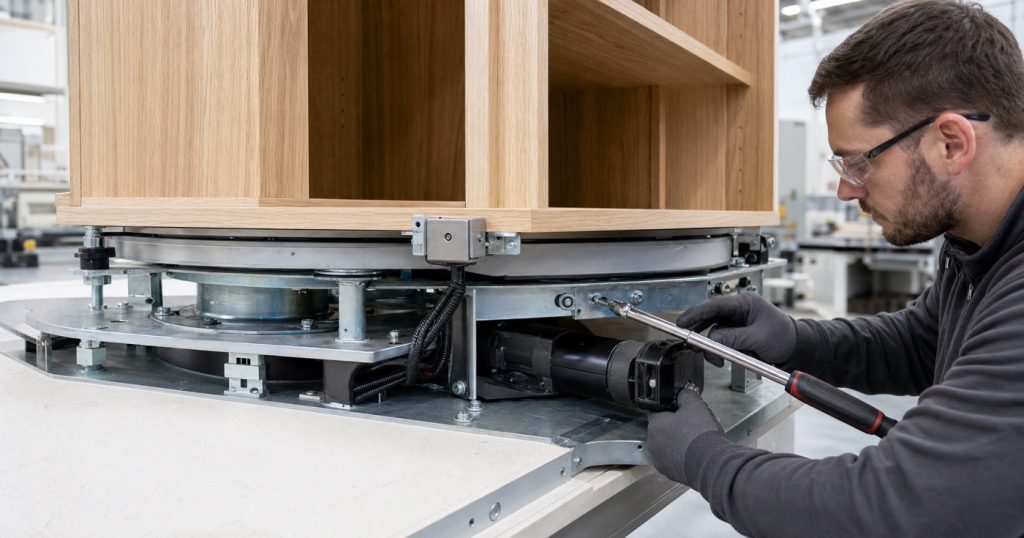
The best test is a finished-unit test with representative shelf loads. Factories should record the motor, controller, and key mechanism components used in each batch. They should also test after a transport simulation or packing check, because a bent bracket, loose base plate, or altered pivot alignment can be invisible until the bookcase moves at the installation site.
Tolerance stacking needs particular attention. A slightly uneven cabinet bottom, a small floor-level variation, a guide set a few millimeters off, and a shelf load concentrated on one side can combine into rubbing or unstable motion. Finished-product alignment is more important than passing separate component dimensions.
Packaging And Service Decide Whether A Premium Unit Stays Premium
Rotating storage walls can be difficult to ship because the moving cabinet, pivot hardware, panel finish, and electrical parts need protection at the same time. The packing plan should define the transport position, mechanism restraints, protection for finished edges, accessory boxes, and the order in which installers release and test the system.
Our analysis of furniture packaging and transit damage applies directly. Receiving inspection should include a controlled first rotation, not only a visible finish check. Test alignment, noise, lock engagement, stop position, and cable behavior before adjacent trim or cabinetry limits access.
Service access should be designed before the cabinet finish is finalized. Buyers need to know whether the motor, controller, pivot bearing, upper guide, lock, sensor, and wiring harness can be reached without dismantling the entire storage wall. Spare parts should have stable codes, compatibility rules, images, and replacement instructions. This is the same discipline discussed in our article on smart furniture integration: a visible convenience feature depends on hidden systems that must remain controllable over repeat orders.
What Buyers Should Approve Before Launch
A strong brief defines the project setting first: cabinet dimensions, storage load, rotation angle, room clearance, floor and ceiling conditions, adjacent furniture, intended user, and whether the unit is residential, hospitality, office, or project furniture.
It then defines the movement system: pivot and guide design, drive, speed, limits, locking, controls, power entry, cable route, pinch protection, manual recovery, and approved component substitutions. The finished sample should be tested with representative loads, repeated cycles, realistic clearance conditions, and post-packaging checks.
Finally, it defines the service system: installation sequence, adjustment procedure, spare parts, troubleshooting, warranty labor assumptions, change control, and project coordination responsibilities. A rotating bookcase should be treated as engineered moving furniture, not a standard cabinet with an added feature.
2026 Takeaway
Motorized rotating bookcases can give a storage wall a more flexible role in premium homes and projects. They offer a useful blend of display, separation, controlled access, and architectural interest.
The opportunity is strongest when the supplier controls the whole system: cabinet stiffness, pivot design, floor and upper support, load limits, safe movement, electrical integration, packaging, installation, and long-term service. That is where a furniture product becomes a credible smart-furniture program.