
The coffee table has traditionally been one of the least technical items in a living room. It holds a book, a drink, a tray, or a remote. A motorized lift-top coffee table changes that role. At the press of a control, the tabletop can rise from lounge height toward a usable position for a laptop, meal, hobby, or casual work session, then return to a low table when the room needs to feel open again.

This is not simply a smaller version of a height-adjustable desk. A desk is designed around office posture, a predictable chair height, and a dedicated work zone. A lift-top coffee table has to work beside a sofa, often over a rug, with a smaller footprint, more varied loads, a lower center of gravity, visible furniture finishes, and a storage cavity that can complicate the mechanism. It also needs to be safe around knees, hands, drinks, pets, children, and everyday living-room clutter.
For furniture buyers, retailers, distributors, and private-label teams, the right question is not whether the table can rise in a showroom. It is whether the finished product can rise smoothly, remain stable under a realistic load, protect the user from pinch zones, tolerate shipping and assembly, and be serviced without turning a coffee table into a costly return.
Why This Is A Distinct Smart Furniture Category
The commercial appeal comes from flexible living. Smaller apartments often ask one room to support relaxing, eating, casual work, gaming, reading, and occasional entertaining. A lift-top table can add a practical surface without permanently placing a desk or dining table in the middle of the room.
That use case also creates a different product brief. The top must be large enough for its intended task but not so large that it becomes unstable when raised. The base must fit under or in front of a sofa. The travel path must avoid a seated user’s knees. Storage below the top needs to remain useful while allowing space for lift hardware. If a table is marketed for dining, the supplier should define the intended number of place settings and load, rather than relying on an ambiguous lifestyle image.
Buyers should specify the primary scene early: laptop work from a sofa, a compact meal for one or two people, game or hobby use, assisted rising for a user who needs a higher surface, or a premium transforming-furniture collection. Those scenarios influence top dimensions, travel height, edge shape, lift speed, controls, storage layout, and packaging.
Lift Geometry Controls Stability
Motorized lift-top tables may use scissor linkages, synchronized lift columns, telescoping brackets, geared arms, or linear actuators. The visible tabletop can look simple while the hidden geometry determines whether the product feels solid or unstable.
The key test is not only vertical travel. A raised top can shift the center of gravity forward, especially when a laptop, meal, or elbows add load near the front edge. The base, linkage, pivot points, and top attachment need to resist wobble, twist, and uneven travel. A mechanism that rises evenly with an empty top may behave very differently when the customer leans on one side.
Ask the supplier for a motion drawing that shows closed height, maximum height, forward or horizontal travel, side clearance, top overhang, base footprint, and the permitted load distribution. Buyers should also ask whether the top is intended to be lifted only in its empty position or whether it can safely move with common objects in place. A product that requires users to remove every cup, laptop, and book before it moves needs very clear instructions.
Payload Needs A Real Use Model
A load rating without context is incomplete. A 10 kg load at the center of a tabletop does not behave like a person leaning on the front edge, a meal spread across the surface, or a child pulling on one corner. The product file should distinguish between static load, moving load, maximum recommended use load, and any prohibited load.
The factory should test the finished table with the actual top material, storage box, lift mechanism, and legs. Evaluate start and stop behavior, side-to-side levelness, noise, top deflection, visible gaps, fastener loosening, and stability at full height. Repeat the checks after simulated transport or carton-drop testing, because a slightly bent linkage or loosened fastener can turn into a wobble that a customer notices immediately.
This is where lift-top tables differ from ordinary coffee tables. A scratch on a conventional top is visible but normally does not stop the table from working. On a powered table, a shifted rail, bent arm, loose pivot, or damaged controller can stop the central feature of the product.
The Living Room Creates Pinch And Spill Risks
The moving zone beneath a lift top can create pinch points around scissor arms, slides, hinges, storage-box edges, and the connection between the tabletop and base. Buyers should request a mechanism drawing that marks accessible gaps and explains the protection strategy. Depending on the design, this may include controlled gaps, covers, hold-to-run controls, soft start and stop, obstruction sensing, current sensing, or a defined manual recovery method.
Controls need to work in a casual environment. A button placed where it is easily hit by a knee, remote, or toy can create an unwanted movement. A control hidden inside a storage compartment may be frustrating in daily use. A remote can be misplaced. A practical design gives the user clear feedback about direction and movement and lets them see the table while it operates.
Spills are another real-world concern. A coffee table is likely to carry drinks. The cabinet and electrical design should define how the top seam, control area, storage compartment, cable entry, and lower electronics are protected from ordinary spills and cleaning. A supplier should not imply that a walnut veneer, painted panel, touch control, and motor cavity will tolerate every cleaning product or a flooded storage box.
Electrical And Wireless Features Need Finished-Product Review
The electrical layer may include an actuator, motor, control box, power supply, switch, cable harness, charging outlet, wireless charger, remote receiver, and sometimes Bluetooth or app control. Each added feature makes the table more useful for some customers, but it also expands the component list, service plan, and destination-market review.
UL’s UL 962 listing describes a standard for household and commercial furnishings that includes motor-operated furnishings. It does not prescribe the compliance path for every lift-top table, but it is a useful sourcing reminder: the finished furniture, motor, power system, controls, cable routing, labels, instructions, and service access need to be considered together.
If the product includes a wireless remote, Bluetooth, Wi-Fi, or smart-home function, buyers should freeze the exact module and firmware in the bill of materials. In the United States, 47 CFR 2.803 is relevant to the marketing of radio-frequency devices. In the European Union, the European Commission’s Radio Equipment Directive overview describes the framework for radio equipment. The actual obligations depend on the final configuration and destination market.
Materials Must Survive Both Furniture And Mechanism Loads
The top may use veneer, solid wood, MDF, particleboard, laminate, sintered stone, glass, or a mixed material. The selection affects not only appearance but also screw holding, weight, stiffness, edge durability, and the way loads transfer into the lift brackets.
A heavy stone or thick solid-wood top can create a premium appearance but may require a different motor, linkage, base, and carton strategy. A light panel top may reduce load on the mechanism but can flex or lose fasteners if reinforcement is inadequate. Buyers should approve the exact top construction and attachment method, not only a finish sample.
The storage box also matters. A lift-top table often uses the cavity beneath the top for remotes, cables, games, books, or blankets. The interior needs enough stiffness that the moving mechanism remains aligned, and it needs enough clearance that stored items cannot foul the arms, cable harness, or controller.
Factory Quality Control Must Combine Furniture And Motion Testing
Conventional coffee-table inspection covers dimensions, finish, edge banding, drawer or lid fit, visible gaps, and packing. A motorized table needs all of those checks plus component traceability, cable routing, fastening verification, motion testing, noise checks, end-position consistency, and load testing.
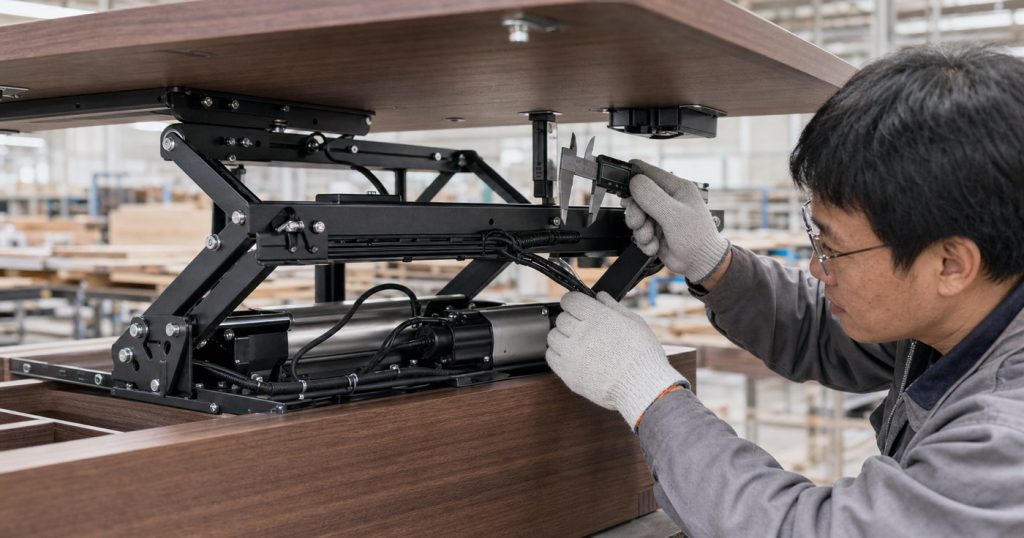
The best inspection plan tests the finished unit rather than a mechanism alone. The actual tabletop, storage cavity, legs, lift arms, electronics, and controls must work together. Factories should retain identifiers for the actuator, controller, power supply, and critical linkage so that a later warranty claim can be tied to a production batch.
Tolerance stacking should also be checked. A top that is slightly bowed, a storage box that is slightly out of square, and a linkage bracket that is slightly offset can combine into a table that rubs or rises unevenly. A fixture that tests full travel and top levelness is more useful than approving component measurements in isolation.
Packaging And Service Decide Whether The Feature Survives Delivery
Lift-top tables combine a large visible top, a moving metal mechanism, electronics, and sometimes fragile finishes. The carton must prevent abrasion and impact while also restraining the mechanism. If a lift arm moves during transit, bends against the side panel, or damages a cable, the table may arrive looking intact but fail on first use.
The packing plan should define the shipping position, any restraint or lock, protection for the tabletop edges, location of the power adapter and remote, and the sequence for removing restraints during assembly. Our earlier analysis of furniture packaging and transit damage applies directly: receiving inspection should include a controlled first lift, not only a check for scratches.
Service access is equally important. A buyer should know whether an actuator, controller, switch, cable harness, remote receiver, or lift arm can be replaced without destroying the table or requiring a full furniture return. The spare-parts matrix should include part codes, images, compatibility rules, replacement steps, and change-control requirements.
This connects to our earlier coverage of smart height-adjustable desks. In both categories, motion quality is part of the product promise. For a living-room table, however, the furniture finish, storage space, sofa relationship, and casual-use risks are just as important as the actuator.
What Buyers Should Approve Before Launch
A strong brief should define the living-room scene first: intended top height, sofa relationship, table footprint, storage use, top material, maximum use load, desired work or dining task, and clearance around the raised position.
It should then define the mechanism and electrical layer: lift geometry, actuator, control box, power supply, cable route, switch or remote, pinch-zone strategy, limits, load distribution, manual recovery, component substitutions, and destination-market documentation.
Finally, it should define the commercial system: finished-product test plan, packaging restraints, first-use inspection, installation or assembly instructions, spare parts, warranty responsibilities, and supplier change notification. A table that moves once in a showroom is not yet a reliable transforming-furniture program.
2026 Takeaway
Motorized lift-top coffee tables can give living rooms a more flexible role without making them feel like permanent offices. They are a practical answer for compact homes and a credible premium category for retailers and furniture brands.
The products that succeed will be the ones that treat the coffee table as a complete powered system. Stable geometry, realistic payloads, controlled motion, protected electronics, durable materials, clear packaging, and serviceable parts matter as much as the convenience of a rising top.