
Upper kitchen cabinets create efficient storage, but they also put everyday items above the height at which many people can comfortably see, reach, or handle a loaded shelf. A powered lift-down cabinet changes that relationship. At the press of a switch, a section of the wall cabinet moves forward and downward, bringing plates, dry goods, or small appliances closer to countertop height.

The visual idea is simple, but the product is not. A lift-down unit sits between casegoods, wall-mounting hardware, moving mechanisms, electrical components, installation practice, and after-sales service. The cabinet still needs to look like a coherent kitchen collection. It also has to move with a repeatable path, carry a defined load, stop safely, stay securely mounted, protect cables, and remain repairable after the kitchen has been installed.
The Home Industry Insights view is that lift-down wall cabinets should be sourced as powered storage systems, not as conventional upper cabinets fitted with an accessory. For retailers, project buyers, distributors, kitchen brands, and factories, that distinction affects the brief, the drawing pack, the inspection plan, the packing method, and the warranty model.
Why Lift-Down Storage Is A Distinct Smart Furniture Product
Smart furniture is often associated with charging, lighting, app controls, or motorized beds. Lift-down wall storage addresses a different use case: reducing the reach needed to use upper-cabinet space. The product can be relevant in aging-in-place projects, accessible or adaptable kitchen programs, compact apartments, premium kitchen retail, hospitality residences, and households that simply want frequently used items brought closer to the work surface.
That does not mean a moving cabinet automatically makes a kitchen compliant with any accessibility rule. A project team still has to apply the code, contract requirements, reach ranges, clear floor space, work-surface conditions, and local authority requirements that apply to the installation. The U.S. Access Board’s ADA standards resources are a useful starting point for understanding that accessibility is a whole-environment question, not an accessory claim. A buyer should not allow a supplier to market a powered cabinet as universally compliant without project-specific review.
Commercially, the category is attractive because it creates a visible reason to trade up. It can turn a standard kitchen elevation into a differentiated product story. Operationally, it creates more dependencies than a fixed cabinet: cabinet carcass stiffness, mechanism geometry, payload, mounting rail, wall substrate, actuator, controller, control position, obstruction behavior, cable routing, installation tolerance, and access for future service.
The Motion Path Must Be Defined Before Styling Is Locked
Not every lift-down mechanism moves in the same way. Some systems descend mostly vertically. Others use articulated arms that bring shelves forward and down. Some move a whole cabinet section; others carry an internal shelving frame while the outer carcass remains fixed. These choices change the usable storage volume, the depth needed above the counter, the door treatment, the apparent gap lines, and the safe clearance around a countertop, faucet, backsplash, appliance, or pendant light.
The buyer should request a fully dimensioned motion envelope, not only a closed-position rendering. It should show the highest and lowest positions, forward projection, shelf depth, maximum load, side clearances, cabinet opening geometry, counter clearance, and the clearance needed for a user or installer. The drawing should also define what happens when the shelf is loaded with real dishes, cans, jars, or small appliances instead of empty showroom props.
Motion quality has a direct effect on perceived product quality. A shelf that twists, stops unevenly, rubs against the cabinet side, or changes height under load will quickly make a premium kitchen feel unreliable. The cabinet box, shelf frame, linkage brackets, and mounting points need enough rigidity that the system remains aligned after transport and repeated cycling.
For a kitchen collection with several widths, the mechanism should be matched to each format. A linkage that is stable in a narrow 600 mm cabinet may not perform the same way in a wider cabinet with deeper shelves and more dishes. Buyers should define approved width, depth, shelf, and load combinations rather than assuming a single mechanism can be stretched across every SKU.
Payload Is Not A Catalogue Number Alone
Lift capacity is commonly presented as a clean number, but the practical load is more complex. Plates stack differently from cereal boxes. Glass jars create concentrated weight. A countertop appliance may be heavy and may slide while the shelf moves. The center of gravity may shift when customers load the front edge of a shelf more heavily than the rear.
Specify a realistic payload model: total permitted load, maximum per shelf, permissible load distribution, permitted item height, and prohibited items. The product file should define whether the stated capacity includes the moving shelf itself, the front panel, the baskets, and optional organizers. It should also say whether the rating is for a single short movement, ordinary household cycling, or a specific tested duty cycle.
The factory should test the finished cabinet at representative loads, not only a bare mechanism on a metal rig. Evaluate start and stop behavior, levelness, arm deflection, noise, screw loosening, contact with the carcass, and whether the control reliably stops at the intended positions. Repeat those checks after packaging simulation or transport testing. A mechanism that works in an assembly cell but becomes misaligned after a long shipment creates an expensive field problem.
Wall Mounting Is Part Of The Product, Not An Installer Detail
Fixed upper cabinets are already dependent on sound wall fixing. A powered lift-down cabinet adds a moving load and changing forces at the mounting points. The finished product needs an installation design that states the wall conditions it assumes and the exact mounting hardware, rail, fasteners, and reinforcement it requires.
The supplier’s instructions should separate cabinet-side hardware from building-side responsibility. Is the cabinet intended for studs, masonry, engineered backing, metal framing, or a project-specific reinforcement system? Are anchors included, and are they suitable for every wall type? What is the required fixing pattern? Can a decorative filler or crown detail interfere with a mounting rail or service access panel?
Kitchen retailers should not leave these questions to a generic installation contractor after the sale. The order pack should identify the cabinet weight, moving payload, closed and open motion envelope, wall requirements, electrical connection assumptions, and any required pre-install coordination. For project channels, those details belong in coordinated shop drawings before cabinetry is manufactured.
This is also why lift-down storage differs from a decorative pull-down basket. The mechanism changes the forces the wall and cabinet structure experience. A correct cabinet design on an unsuitable wall is still an unsuitable finished installation.
Controls Need To Be Intuitive And Protected
A lift-down cabinet may use a wired wall switch, a cabinet-mounted button, capacitive touch control, a remote, or a smart-home interface. The simplest control is not always the best control. A high-mounted switch defeats the reach benefit. A control hidden inside the cabinet may be hard to use when the cabinet is closed. A remote can be misplaced. A touch point near a splash zone or cooking area needs a realistic durability and cleaning plan.
The user should receive clear feedback about direction, motion, stop state, and any fault condition. The control should not create ambiguity about whether a loaded shelf is moving. Buyers should review where a user stands while operating it, whether hands or objects can be in the travel area, and how the system reacts when the user releases the control or when power is interrupted.
Optional wireless or app control should be justified by a real product use case, such as a coordinated smart-home scene or diagnostic support. If radio functions are included, lock the module and firmware version in the bill of materials. In the United States, 47 CFR 2.803 addresses the marketing of radio-frequency devices. In the European Union, the European Commission’s Radio Equipment Directive overview describes the framework for radio equipment. The applicable documentation route depends on the final configuration and destination market; a generic wireless module record does not replace finished-product review.
Obstruction, Pinch, And Recovery Behavior Need Real Testing
Moving shelves can create pinch, shear, and impact zones around arms, cabinet openings, side panels, and the countertop. A buyer should ask the supplier to identify those zones on a mechanism drawing and to explain the chosen protection strategy. Depending on the design, that may include hold-to-run control behavior, obstruction detection, current sensing, soft start and stop, mechanical guards, controlled gaps, warning labels, or a defined manual-release method.
The critical question is not whether a brochure says the unit is safe. It is how the unit behaves with a misplaced bowl, an open cabinet door, a hand near the linkage, a drawer left open below, or a shelf loaded beyond its intended distribution. The factory should demonstrate stopping and recovery behavior. It should also provide a clear fault process for a stalled unit, a power outage, a failed switch, or a service technician who needs to return the shelf to a safe position.
For powered furniture, the electrical layer should be reviewed as part of the finished product. UL’s listing for UL 962 describes a standard for household and commercial furnishings that includes motor-operated furnishings. That reference does not decide every product’s certification route, but it is a useful reminder that motor, power supply, wiring, controller, cabinet construction, labels, and instructions need to be considered together rather than as separate purchases.
Service Access Decides The Warranty Cost
The cost of a failed actuator is often smaller than the cost of reaching it after a fitted kitchen is complete. A lift-down cabinet can become a poor retail product if servicing one controller requires removing doors, trim, adjacent cabinets, backsplash pieces, or the whole unit from the wall.
The buyer should request a service-access drawing before approval. It should show the actuator, control box, power supply, cable harness, linkage pivots, limit settings, and any replaceable fuse or switch. Can they be accessed from inside the cabinet, from below, or through a designed service panel? Can a technician remove the shelf frame without damaging the visible cabinet finish? Is the mechanism manufacturer identifiable in the service documentation?
Spare parts need stable identifiers. A motor, controller, transformer, switch, cable, linkage arm, bracket, shelf frame, damper, and mounting rail should each have a part code, compatibility range, image, replacement sequence, and approved substitution rule. Change control is essential: a visually similar controller or actuator can have different connectors, firmware, stroke, load characteristics, or end-stop behavior.
This service discipline is consistent with our earlier analysis of smart TV lift cabinets. The visible furniture may look calm and simple, but the commercial success of a moving product depends on whether the hidden system can be diagnosed, repaired, and kept consistent over repeat orders.
Factory Quality Control Must Combine Furniture And Mechatronics
Conventional cabinet inspection covers panel finish, edge banding, drilling, dimensions, doors, drawers, hardware, and packing. A powered lift-down cabinet needs all of those controls plus a mechatronic inspection plan. The mechanism must be verified in the cabinet, with the actual shelf frame, mounting points, load, wiring path, and control configuration.
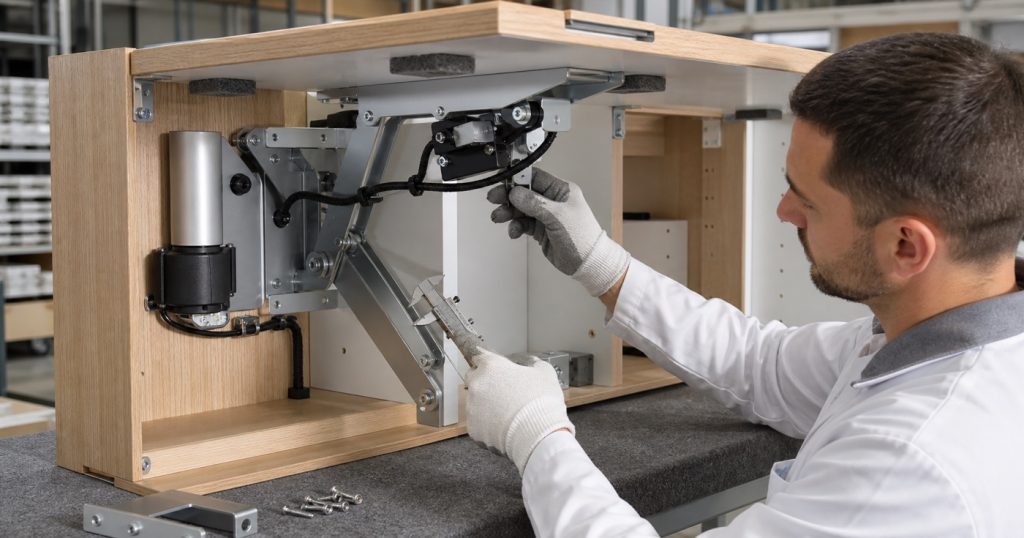
The plan should include incoming checks for critical mechanism components, traceability for motors and controllers, fastening torque or fastening verification where appropriate, cable strain-relief checks, motion and noise checks, end-position consistency, loaded-cycle testing, visible finish inspection after movement, and a final functional check after complete assembly. Suppliers should retain batch records for critical components rather than treating the lift mechanism as an anonymous purchased accessory.
Buyers should also check tolerance stacking. Cabinet width, side-panel squareness, shelf frame dimensions, hinge position, linkage brackets, and mounting rail location can each be within their individual tolerance while creating a poor motion path when combined. The best protection is a fixture or test method that checks the finished unit, not only separate component dimensions.
Packaging And Installation Packs Need More Discipline
The shipping risk is not limited to a scratched door front. Linkage arms can bend, shelf frames can rack, a control box can come loose, cables can be pinched, and a pre-set limit can change if the cabinet is dropped or compressed. Packaging needs to protect the furniture finish and keep the moving mechanism immobilized or restrained in a defined shipping position.
For knocked-down or project-delivered units, the installation pack should be visually organized. It should separate mounting rails, fasteners, spacers, electrical parts, covers, and adjustment tools. It should include a clear sequence that tells installers when to mount the carcass, connect power, remove transport restraints, test the motion, load the shelves, and fit any decorative covers. The instructions must not assume that every installer is already familiar with a particular lift mechanism.
Our earlier review of furniture packaging and transit damage is directly relevant. For this category, a receiving check should go beyond cartons and visible surfaces. It should include a controlled first movement before the installation team closes off service access or completes surrounding trim.
What Buyers Should Put In The Product Brief
A strong lift-down cabinet brief begins with the real user and kitchen context. Define the cabinet widths, depths, shelf layout, intended items, maximum payload, wall conditions, counter and appliance clearances, control location, electrical assumptions, open and closed positions, required service access, and target sales market.
Then define the system layer: mechanism model, actuator or motor, controller, power supply, switch or wireless module, cable routing, motion path, load distribution, end stops, obstruction behavior, labels, instructions, approved substitutions, and documentation needed for the target market.
Finally, define the commercial layer: finished-product test plan, sample approval condition, packaging restraint, installation pack, spare-parts matrix, warranty responsibilities, response path for a failed mechanism, and factory change-notification rules. A buyer who only approves the kitchen elevation and door color will be buying an unfinished specification.
2026 Takeaway
Smart lift-down kitchen cabinets illustrate a useful direction for powered furniture: the function is not technology for its own sake. It changes how wall storage can be used and gives kitchen brands a credible way to build reach, convenience, and differentiated functionality into a familiar product category.
For buyers, the opportunity is strongest when the cabinet, lift mechanism, wall fixing, controls, safety behavior, installation, packing, and service model are developed together. For factories, the opportunity is to move beyond a cabinet box and become an integration partner that can manage furniture production and controlled motion with equal discipline.