
An induction dining table looks simple from across a room: a clean timber, stone, or composite tabletop with a black glass cooking zone set into the center. In practice, it joins two very different products. It must work as daily dining furniture, then perform as a cooking appliance without damaging the table, confusing the user, creating a cleaning problem, or becoming impossible to repair after installation.

This makes induction dining tables a useful test case for smart furniture. The visual idea can be attractive to apartment developers, hospitality projects, premium kitchen retailers, home brands, and buyers serving compact homes. But the real sourcing question is not whether a factory can cut a hole in a tabletop. It is whether the supplier can manage heat, glass support, ventilation, electrical routing, spills, cookware behavior, installation, and service as a single finished system.
The Home Industry Insights view is that this product should be specified as appliance-integrated dining furniture. Buyers who treat it as a furniture surface with an add-on cooktop will miss the risks that appear after the sample leaves the showroom.
Why The Category Is Different From A Kitchen Island
A kitchen island cooktop is usually designed into a fixed cabinet run with planned electrical supply, appliance clearances, and a dedicated installation environment. An induction dining table may be freestanding, closer to seating, used for hotpot or tabletop cooking, moved during renovation, or positioned in a dining room that was not designed as a kitchen.
That changes the product brief. The table has to look balanced from every angle, support normal dining use when the cooktop is off, and keep the cooking module protected when chairs, plates, spills, serving dishes, and tablecloths are part of the daily scene. It also needs a credible cable and power-entry strategy. A freestanding table with a visible loose cord may suit one retail channel, while a project installation may require a concealed floor or wall connection and a clear installer plan.
The audience matters. A compact city apartment may value one or two cooking zones, a small footprint, and simple cleaning. A hotpot-focused restaurant or private dining room may need a larger working zone, higher duty-cycle confidence, easy reset access, and staff-safe controls. A furniture retailer may prefer a modest feature set with fewer field-service dependencies. These are different products even if the visible tabletop is similar.
Induction Changes The Tabletop Engineering
Induction cooking transfers energy to compatible cookware through an electromagnetic field rather than relying on a conventional exposed heating element. The U.S. Department of Energy explains that induction heats the cookware directly and that compatible cookware generally has a flat bottom that a magnet will stick to. Its overview also notes common safety behavior such as pot detection and automatic shutoff when cookware is not detected. That official explanation is useful context for furniture teams because the product experience depends on both the table and the cookware the customer brings to it.
The first design decision is the interface between the cooking surface and the furniture surface. Ceramic glass is often selected because it provides a flat, cleanable cooking area. But the glass needs correct support, edge treatment, expansion allowance, and protection from point impacts. A large serving plate dropped at the edge of an inset can create a different risk from a pan placed normally on the cooking zone.
The surrounding table material also needs a realistic heat and spill brief. Solid wood, veneer, laminate, sintered stone, engineered stone, metal, and compact surfaces behave differently around a hot vessel, an inset edge, and repeated wiping. A beautiful veneer may be unsuitable if its edge, adhesive, or finish cannot tolerate the temperature pattern and cleaning routine around the cooking zone. Buyers should ask the supplier to show the tabletop after repeated heating and cleaning trials, not only as a new sample.
A Heat Path Must Be Designed, Not Assumed
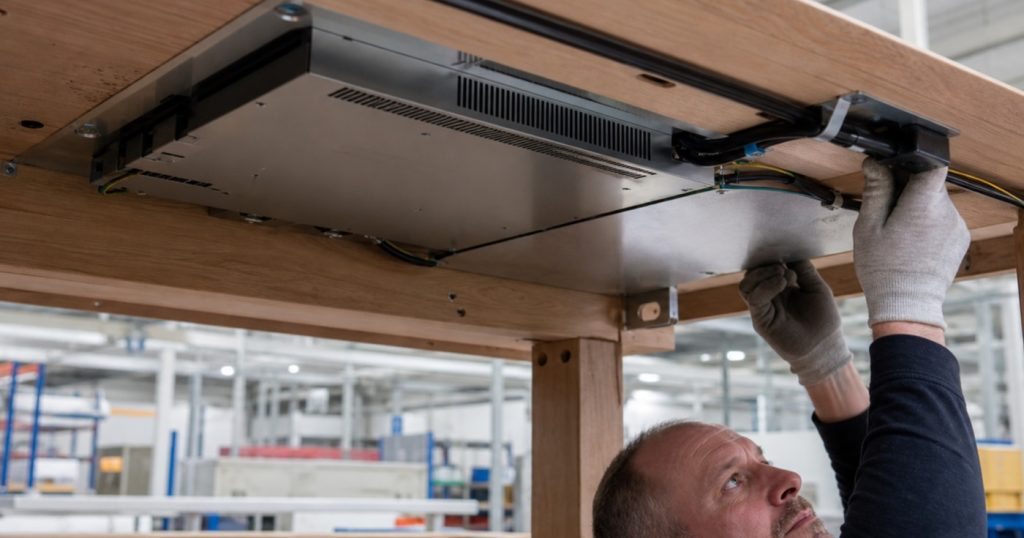
The cooking energy is directed to the cookware, but an induction module is still an electrical appliance with internal components that generate heat. Power electronics, cooling fans, coils, wiring, and control boards need an airflow path. The furniture structure can either support that path or block it.
Buyers should request a cutaway drawing that shows the ceramic glass, module housing, heat shield or insulating layer, ventilation inlets and outlets, support rails, clearance to the table frame, and power-cable route. The drawing should match the exact table size and cooking module, because changing the tabletop thickness, underframe, drawer, apron, or decorative screen can change the available space for heat and airflow.
Ventilation openings are often the least glamorous part of the design, so they are easy to hide too aggressively. That can make the table look cleaner in a lifestyle photo while creating a worse heat path in use. Conversely, large exposed grills can collect crumbs and make cleaning difficult. The best solution is usually a controlled, accessible route that is integrated into the furniture design and can be inspected during service.
The sample evaluation should include a sustained-use heat check at the intended cookware size and power setting. Buyers should inspect the underside of the tabletop, nearby joinery, control areas, cable clamps, and any surface directly above the module. The goal is not to run an informal certification test; it is to see whether the table architecture creates obvious hot spots, odor, fan obstruction, or material stress before a collection is locked.
Controls Need To Work In A Dining Environment
Touch controls may be built into the ceramic glass, mounted at the table edge, placed in a side drawer, or paired with a remote or app. Each option has a different use and cleaning risk.
A glass touch panel can keep the tabletop visually clean, but it must remain understandable when the table is partly covered by serving dishes. A side-mounted control may be easier to reach but needs protection from knees, chairs, and accidental contact. A hidden panel can preserve the furniture look but may create frustration when a user needs to reduce heat quickly. A remote can be misplaced. An app adds convenience only when it clearly improves a real use case such as lock control, timed operation, or service diagnostics.
For everyday use, buyers should favor direct feedback: a clear indication of active zones, heat level, lock state, and residual heat. The control area must also tolerate normal wiping and occasional splashes. A dining table is not a sealed appliance control panel in a protected kitchen zone; people place wet glasses, serving bowls, and sauces around it.
If a product includes Bluetooth, Wi-Fi, or an app-linked controller, buyers should lock the exact hardware module and firmware in the product file. In the United States, the FCC rules on marketing radio frequency devices are a relevant official reference. For Europe, the European Commission’s Radio Equipment Directive page describes the framework for radio equipment placed on the market. The applicable route depends on the final configuration and destination, so a generic module document should not be used as a shortcut for the finished table.
Spill Management Is A Furniture Requirement
Food and drink are inevitable around a dining table. The critical question is what happens when a pot boils over, soup reaches an inset edge, wine runs beneath a plate, or a customer wipes a wet cloth across a control zone.
The tabletop should be designed so that normal spills do not find an easy path into the module cavity. Buyers should examine the glass-to-top interface, gasket strategy, corner treatment, control seams, cable-entry points, and the way the tabletop is supported from below. A gap that looks minor on a dry showroom sample may become a warranty path after months of food residue and cleaning liquid.
Cleaning instructions should be honest. A smooth ceramic glass zone may be easy to wipe, but the table still has transitions between glass and furniture materials. If the design needs a special tool, a strict cool-down process, or a prohibited cleaning agent, the manual and retailer training need to state that clearly. A premium product can ask for care, but it cannot conceal the care burden.
The Electrical Layer Must Be Serviceable
An induction dining table needs an electrical architecture that a qualified installer and later a service partner can understand. This means the buyer should receive a wiring diagram, power specification, plug or connection type, module model number, controller part number, cable routing, strain-relief locations, ventilation guidance, and service-access instructions.
The manufacturing question is often more important than the quotation question. Can the supplier use the same module across repeat orders? Can a failed control panel be swapped without removing the entire tabletop? Is the cooling fan replaceable? Can the module be removed from below? Does a service technician need to dismantle a dining table in a customer’s home just to inspect a cable connection?
For a finished table that incorporates a cooking appliance, buyers should discuss the destination-market route with a qualified testing laboratory or compliance specialist. The UL Standards listing for UL 858, Household Electric Ranges is one useful U.S. reference point for the appliance side. It does not, by itself, tell a buyer what is required for every appliance-integrated table. The finished product, its electrical system, its installation method, and the target market determine the actual documentation and assessment needed.
Installation Decides Whether The Product Feels Premium
An induction dining table may ship as a finished table, a top with detachable legs, or a more complex project product. The installation design should be chosen early because it influences wiring, packing, glass protection, and service access.
A retail-ready freestanding product needs a practical answer for power. Does it use a wall plug, a floor outlet, a protected cable channel, or a detachable cord? Where is the power supply located when the table is moved? Can the cable be crushed by the table base or a chair? Is the cord visible from normal seating positions?
Project products add another layer. Designers, electricians, installers, and furniture teams need coordinated dimensional drawings. The product file should define clearances, floor or wall connection assumptions, access panels, ventilation requirements, tabletop lifting points, and what happens if the module needs replacement. A table that only works when the electrical and furniture installer improvise around each other will create delays and service disputes.
Packaging Has To Protect Glass, Furniture, And Electronics
The product combines several freight-sensitive components: a large tabletop, ceramic glass, electronics, cooking module, cable harness, and potentially a heavy wood or metal base. The carton and internal packing need to control impact at the glass edge, abrasion on the furniture surface, vibration around the appliance module, and damage to connectors.
Our earlier analysis of furniture packaging and transit damage applies strongly here. A tabletop can arrive without a visible scratch yet still have a cracked glass edge, bent support bracket, loose connector, or blocked vent. Buyers should ask how the factory protects the cooking zone, how a delivery team identifies hidden damage before installation, and whether the module is tested again after final assembly and before packing.
The best packaging plan may include a dedicated glass protector, separate accessory box, connector restraint, table-edge guards, orientation marks, pallet strategy, and a simple receiving inspection. The receiving inspection should be designed for the real customer or installer, not only for the factory’s quality team.
Smart Kitchen Furniture Needs A Service-Parts Plan
This category is not finished when the table leaves the factory. The buyer should receive a spare-parts matrix covering the ceramic glass, induction module, controller, cooling fan, power cable, connector, gasket, heat shield, support bracket, touch panel, and hardware. Each part should have a stable code, photograph, compatibility rule, expected lead time, and replacement method.
Change control is particularly important. A substitute module might look identical but use a different controller, connector, fan profile, firmware, or glass cutout. Those differences can make a later repair impossible. Buyers should require approval before the supplier changes any critical electrical, control, ventilation, or support component.
This is the same broader lesson covered in our article on smart furniture integration: connected or powered functionality only creates value when the parts, documentation, and after-sales model are as dependable as the furniture itself.
What Buyers Should Review Before Launch
Before approving an induction dining table, buyers should request a finished-product specification rather than a lifestyle rendering and a cooktop data sheet. The file should include tabletop materials, glass details, module configuration, cookware assumptions, power requirements, ventilation drawing, heat-management design, controls, lock and shutoff behavior, wiring diagram, installation method, cleaning instructions, packaging drawing, test plan, service-parts list, and change-control rules.
The sample review should cover normal dining use, cookware detection, control visibility, heat behavior, spill paths, table stability, edge protection, cleaning, cable routing, ventilation, noise, module access, carton recovery, and installation sequence. The commercial review should include destination-market documentation, installer support, parts stock, warranty labor assumptions, replacement policy, and whether the supplier can keep the same configuration stable over repeat orders.
2026 Takeaway
Smart induction dining tables show how furniture categories can expand when a clear home-use scenario meets a technically credible system. The opportunity is not simply to make a table look more futuristic. It is to create a practical dining and cooking surface for compact homes, social cooking, hospitality settings, and premium project spaces.
For buyers, the disciplined approach is to separate the visible idea from the finished-product reality. The table must be attractive, but it also has to manage cookware, heat, spills, wiring, ventilation, installation, packaging, compliance, and service. Suppliers that can control all of those layers will be better placed than those that merely fit an appliance into a tabletop.