
Smart furniture is often discussed through beds, desks, recliners, and charging tables. But wardrobes and closet systems are quietly becoming one of the more interesting smart-furniture categories, especially for premium apartments, hotels, custom homes, compact urban housing, and whole-house storage projects.
A smart wardrobe is not only a cabinet with lights. It may combine LED shelf lighting, door-open sensors, motion sensors, humidity monitoring, ventilation, dehumidification modules, sliding-door systems, soft-close drawers, mirrors, access control, app settings, modular panels, and project installation requirements. That makes the category different from ordinary bedroom furniture.
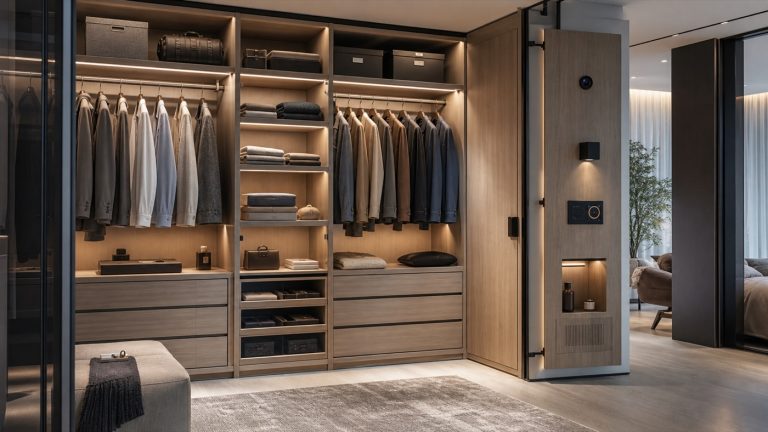
The Home Industry Insights editorial view is that smart wardrobes should be sourced as storage systems, not only as case goods. Buyers who only approve the exterior finish, panel color, and drawer layout may miss the real risks: lighting heat, sensor placement, cable routing, installation tolerance, ventilation noise, sliding-door durability, tall-furniture stability, and service access.
Why Wardrobes Are A Different Smart-Furniture Category
Beds and recliners are centered on motion. Charging furniture is centered on power access. Smart wardrobes are centered on the daily use of storage space: visibility, organization, garment care, access, and room integration.
The customer wants to open a door and see every shelf clearly. They want drawers that glide smoothly, lights that turn on at the right time, mirrors that are useful, ventilation that does not feel noisy, and hardware that does not sag after a season of use. In hotels and serviced apartments, the product must also survive repeated guest use and housekeeping routines.
For buyers, this means a smart wardrobe should be evaluated across three layers. The first layer is furniture construction: panels, edges, shelves, drawers, rails, hinges, doors, anchors, packaging, and installation. The second layer is electronics: lighting, sensors, drivers, cables, control boards, low-voltage power supply, and optional wireless modules. The third layer is service: parts, access, troubleshooting, and version records.
If those layers are not designed together, the product may look impressive in a showroom and still create claims after installation.
Lighting Is The Core Feature, But Not A Simple Add-On
Integrated lighting is usually the first smart feature in wardrobes. LED strips under shelves, vertical light channels, drawer lights, mirror lights, and garment-area lighting improve the user’s experience immediately. They also create engineering questions.
Where is the LED strip installed? Can the user see exposed dots or glare? Is the color temperature suitable for clothing and accessories? Does the driver fit safely inside the cabinet? Is the light channel replaceable? Does the heat affect veneer, laminate, adhesive, fabric inserts, or stored items? Does the lighting turn on only when needed, or does it stay on because the sensor is poorly placed?
UL’s page for UL 2108 identifies the standard as covering low voltage lighting systems and components, including power units and low-voltage luminaires and lighting systems. For wardrobe buyers, the practical point is that integrated cabinet lighting should not be treated as a decorative strip added after furniture approval. It is part of the product system.
The right question is not only whether the light works. The right question is whether the lighting system remains safe, replaceable, visually consistent, and durable when installed inside the actual wardrobe structure.
Sensors Need Furniture Context
Door-open sensors and motion sensors are common in smart wardrobe proposals. They can improve convenience and reduce unnecessary lighting time, but they must be placed with the furniture design in mind.
A door sensor may work on a hinged door but behave differently on a sliding door. A motion sensor may detect movement outside the wardrobe and trigger unwanted lighting. A drawer sensor may be difficult to protect from dust, fabric fibers, and accidental impact. A sensor placed near a reflective mirror or glossy panel may behave differently from one installed inside a matte cabinet.
This is where the furniture factory and electronics supplier must work together. The sensor position, wiring path, panel drilling, magnetic alignment, door gap, hinge adjustment, and installation tolerance all affect performance. A small change in door alignment can create intermittent behavior that is hard for a customer to explain and hard for a service team to diagnose.
For project buyers, the sample should be tested after installation adjustment, not only on a clean bench. Open and close doors repeatedly. Load shelves and hanging rails. Change ambient light. Test the product in day and night conditions. Check whether sensors still behave correctly after the doors are adjusted on site.
Ventilation And Humidity Features Need Discipline
Some smart wardrobe concepts include ventilation, humidity sensing, drying, deodorizing, or garment-care positioning. These can be useful in humid regions, luxury closets, hotels, and compact apartments. They can also become risky if claims are unclear.
Buyers should separate three ideas. First, passive ventilation helps air move through the cabinet. Second, active ventilation uses a fan or module. Third, humidity or garment-care claims may imply performance expectations that need evidence.
If a wardrobe claims to protect garments, reduce moisture, remove odor, or improve storage hygiene, the buyer should ask how that claim is supported. What sensor is used? Where is it located? Is the fan accessible for cleaning? How loud is it? What happens when dust collects? Is there a filter? Does the user need maintenance instructions? Are replacement parts available?
Without that discipline, a useful feature can become a vague marketing claim. For an export product, vague claims can create disappointment, support cost, or compliance questions in destination markets.
Wireless Control Brings Documentation Needs
Many smart wardrobe functions can work locally. Door-open lighting, motion-triggered lighting, and basic ventilation do not always need a mobile app. But some products add Bluetooth, Wi-Fi, or remote control for scene settings, lighting modes, occupancy data, or smart-home integration.
When wireless modules are included, buyers should ask for model numbers, authorization documents, labeling, firmware records, and module-change controls. For the United States, 47 CFR § 2.803 says a radio-frequency device may not be marketed unless it is authorized under a valid FCC equipment authorization, with marketing defined broadly to include sale, lease, advertising, importation, shipment, or distribution for sale or lease.
For the European Union, the European Commission’s Radio Equipment Directive page explains that Directive 2014/53/EU sets a framework for radio equipment and includes essential requirements covering safety and health, electromagnetic compatibility, and efficient use of radio spectrum.
The sourcing lesson is direct: if the wardrobe uses wireless control, the electronics cannot be undocumented. The buyer needs stable module identity and market-entry documentation before mass production.
Cable Routing Must Survive Installation
Wardrobes are often larger and more installation-sensitive than loose furniture. A smart wardrobe may be delivered as panels, carcasses, hardware packs, rails, lighting kits, drivers, sensors, and wiring harnesses. The final product may be assembled by installers, dealers, contractors, or the customer’s own team.
This makes cable routing a major risk area. Wires may be pinched behind panels, pulled during installation, drilled through by mistake, routed too close to sliding hardware, or left where drawers can rub against them. Connectors may be mixed up. A lighting driver may be placed where it overheats or cannot be reached later.
The product should therefore include a cable-routing map. It should define wire length, connector color or shape, grommet position, strain relief, cable clips, service access, and no-drill zones. The assembly instructions should show the wiring as clearly as the furniture hardware.
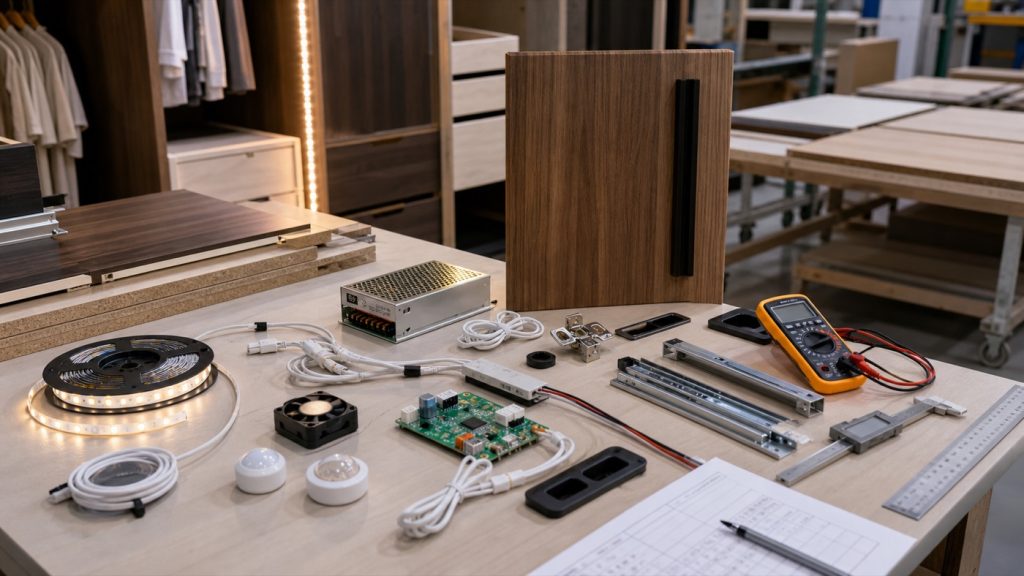
A factory that does not control cable routing may still ship a beautiful wardrobe. But after installation, the claims may look like electronics failures, when the real cause is assembly or routing.
Hardware Still Decides Daily Performance
Smart features do not replace basic furniture performance. In a wardrobe, hinges, drawer slides, sliding-door rails, hanging rods, shelf pins, handles, connectors, and wall anchors still decide whether the product feels reliable.
This links directly to our earlier analysis of cabinet hardware durability. A smart wardrobe with poor sliding rails or weak drawer slides will not be saved by lighting or sensors. The user’s daily experience is still physical.
Smart features can even increase stress on hardware. A door sensor may need consistent door alignment. A light channel may make a shelf harder to replace. A sliding system may need tighter clearance to protect wiring. A tall wardrobe may need better anchoring because it contains heavier modules, mirrors, or integrated accessories.
Buyers should test the complete wardrobe under realistic load: clothing, drawers, accessories, repeated opening, door adjustment, lighting operation, and installation movement. The test should include both mechanical and electrical functions.
Tall Storage Furniture Needs Stability Thinking
Wardrobes and closet systems are tall storage products. Even when the article’s focus is smart features, stability cannot be ignored. Tall furniture can face uneven floors, heavy loading, sliding doors, mirrors, pull-out accessories, and installation variation.
Our previous article on furniture tip-over safety covered why stability should be addressed during product development rather than treated as an accessory at the end. Smart wardrobes make that lesson more important because added modules, lighting channels, mirrors, or pull-out systems can change weight distribution and user behavior.
For buyers, the stability plan should include product geometry, wall anchoring, installation instructions, hardware packs, warning labels, and project-site responsibility. For factories, it should be part of the engineering file, not a late-stage packaging insert.
Surface Materials And Lighting Must Match
Wardrobe interiors often use decorative panels, veneers, melamine, high-pressure laminate, glass, mirror, metal profiles, fabric inserts, leather-like surfaces, and painted finishes. Lighting changes how those materials appear.
Warm lighting may flatter wood tones but distort garment color. Cool lighting may make white interiors look clean but feel harsh in bedrooms. Glossy surfaces may reflect LED dots. Dark panels may need stronger lighting. Mirror sections may create glare if the strip location is wrong.
This is not only a design issue. It affects sampling and quality control. Buyers should approve lighting color temperature, diffuser design, strip position, and interior finish together. A finish board approved under office lighting may look different inside an illuminated wardrobe.
For premium closets and hospitality projects, consistency matters across rooms. If replacement LED strips or drivers change color temperature after six months, the product can look inconsistent even if it still functions.
Packaging And Logistics Are Harder Than They Look
Smart wardrobe components are vulnerable in transport. LED channels can bend. sensors can shift. mirrors can crack. aluminum profiles can scratch. drivers and harnesses can be misplaced. small connectors can disappear inside hardware packs. Long panels can warp or get damaged at edges.
A normal furniture packaging plan may not be enough. The packaging should protect electronics and hardware as controlled components. Each module should have a stable SKU, packing position, label, and inspection checklist. The carton should protect long profiles and fragile lighting diffusers. The hardware pack should separate electrical parts from screws and sharp metal pieces.
For online sales or dealer networks, missing components are especially damaging. If a single sensor, driver, or connector is missing, the installer may not be able to finish the wardrobe. That turns a small packing error into a costly service visit.
After-Sales Depends On Replaceable Systems
The best smart wardrobe design is not the one with the most functions. It is the one that can be maintained. A failed LED driver, sensor, fan, or control board should not require removing the whole wardrobe from the wall.
Buyers should ask whether the lighting strip can be replaced, whether the driver is accessible, whether sensors are modular, whether the fan can be cleaned, whether parts have stable numbers, and whether troubleshooting can be done by a dealer or installer.
Version control also matters. If a factory changes the LED strip, sensor, connector, or driver in the second batch, the buyer needs a record. Otherwise, spare parts and warranty analysis become guesswork.
Factories that want to build smart wardrobe programs should prepare a service kit: wiring diagram, module list, spare-part table, installation photos, troubleshooting flow, and replacement instructions. This is not extra paperwork. It is what allows a smart furniture program to scale beyond a showroom sample.
What Buyers Should Ask Before Approval
A strong smart wardrobe brief should answer several questions before mass production.
What are the core smart functions: lighting, sensors, ventilation, wireless control, mirror lighting, access control, or something else?
Which functions work locally without an app?
Which modules are certified or documented for the target market?
Where are the driver, control board, sensors, and service access points?
How are cables protected during installation and daily use?
How is the wardrobe anchored, adjusted, and tested after installation?
Which parts are replaceable, and who can replace them?
How will the factory control module version changes?
These questions help the buyer move beyond a showroom impression. They also help factories avoid vague promises that cannot survive project installation or export after-sales.
The 2026 Takeaway
Smart wardrobes and closet systems show where smart furniture is heading. The market is not only adding electronics to loose furniture. It is turning storage furniture into a system category that combines panel manufacturing, lighting design, sensors, airflow, hardware, installation, documentation, and service.
For buyers, the opportunity is a more useful and premium storage experience. But the risk is hidden complexity. Lighting, sensors, ventilation, sliding systems, and tall-furniture stability must be approved together.
For factories, the opportunity is to move from cabinet maker to system supplier. The factories that can manage panels, hardware, electronics, installation files, and spare parts will be better positioned for smart wardrobe projects.
Smart wardrobes can make storage feel more organized, visible, and premium. But the intelligence only matters if the furniture remains stable, serviceable, and reliable after it leaves the showroom.