
Smart furniture is moving beyond novelty features. Adjustable desks, motorized recliners, smart beds, charging nightstands, LED wardrobes, sensor cabinets, heated seating, app-connected massage chairs, and storage products with integrated power modules are all changing what buyers need to evaluate before placing an order.
The product is still furniture, but the sourcing problem is no longer only furniture. A smart bedside table is not just a wood cabinet with a charging pad. A lift desk is not just a tabletop with legs. A smart bed base is not only a frame with a motor. Each product combines structure, electrics, electronics, firmware, user interface, cables, certification, packaging, warranty, and after-sales service.
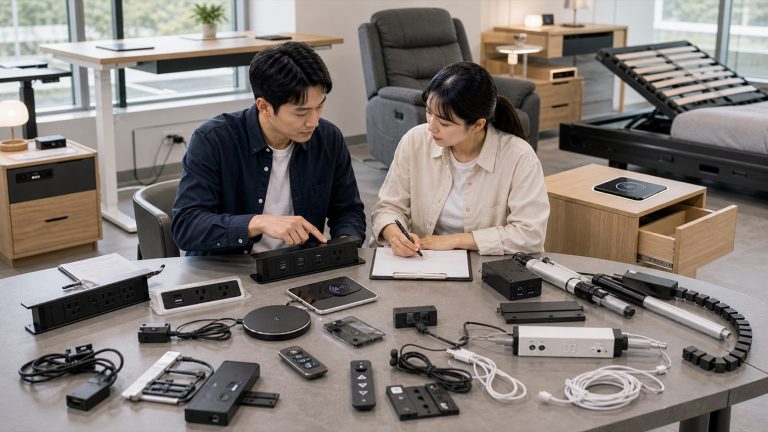
The Home Industry Insights editorial view is that smart furniture should be sourced as an integrated product system. Buyers who treat the electronics as an add-on may approve a product that looks attractive in the sample room but becomes difficult to certify, ship, repair, update, or support in the market.
Why Smart Furniture Raises The Sourcing Bar
Traditional furniture sourcing is already complex. Buyers need to manage materials, construction, dimensions, finish, packaging, quality control, compliance, and logistics. Smart furniture adds another layer: power, control, connectivity, motion, data, and service.
A smart furniture SKU may include USB-A ports, USB-C PD charging, wireless charging, LED lighting, motion actuators, lift columns, massage motors, heating pads, sensors, Bluetooth, Wi-Fi, remote controls, app control, embedded control boards, low-voltage adapters, AC outlets, cable harnesses, strain relief, software, and user manuals. Each component creates its own risk.
For a sourcing team, this means the product brief must become more specific. It is not enough to say “add wireless charging” or “make it app controlled.” The buyer needs to know which module is used, what market it is designed for, what certification path is required, how cables are protected, how firmware is maintained, how customers reset the product, and what happens when a component fails after delivery.
The Furniture Factory May Not Own The Whole System
One of the biggest risks in smart furniture is fragmented responsibility. The furniture factory may build the frame, panels, upholstery, and packaging. A motor supplier may provide actuators. A power-module supplier may provide USB and AC outlets. A separate electronics supplier may provide wireless charging or control boards. An app developer may handle software. A certification lab may test only part of the system.
If the buyer does not define system ownership, problems can fall between suppliers. The furniture factory may say the electronics module caused the issue. The electronics supplier may say the installation environment caused the issue. The motor supplier may say the load or frame geometry exceeded assumptions. The app developer may say the firmware version changed after sample approval.
This is why buyers should ask who owns the integrated product. A serious smart furniture supplier should be able to provide a system bill of materials, approved electronics suppliers, wiring diagram, assembly SOP, test plan, firmware version record, spare-part list, and failure-response process. Without that, the buyer is not sourcing a system. It is sourcing a collection of parts.
Electrical Safety Cannot Be Treated As A Late Check
Electrical safety should be part of product development from the start. It affects component selection, wire routing, enclosure design, grounding, insulation, heat dissipation, strain relief, user access, labels, instructions, and packaging.
UL’s page for UL 962 identifies the standard as covering household and commercial furnishings. The page also notes that electrical components of certain furnishings are required to comply with applicable UL 962 requirements. For furniture buyers, the practical point is that electrified furniture should not be treated like an ordinary cabinet or desk with a last-minute power strip added inside.
The same logic applies outside the United States. Destination markets may require different electrical safety, EMC, plug, voltage, labeling, and documentation expectations. A product designed around a U.S. outlet module may not be suitable for the EU, U.K., Australia, Middle East, or Southeast Asia without redesign.
Buyers should ask early: which markets is the product designed for, which plug and voltage versions are planned, which standards or certifications apply, whether the finished furniture or only the module was tested, and whether the test sample matches the production configuration.
Wireless Features Create Regulatory And Service Risk
Many smart furniture features use wireless components: Bluetooth remotes, Wi-Fi app control, occupancy sensors, wireless charging, connected lighting, or control modules that communicate with a phone. These features make the product more attractive, but they also bring radio-frequency and software questions.
The FCC’s Equipment Authorization page states that RF devices must be properly authorized under 47 CFR Part 2 before being marketed or imported into the United States. In smart furniture, that means the buyer should understand whether a wireless module, control board, charger, or finished product needs authorization, labeling, user information, or specific documentation before launch.
For the European Union, the European Commission’s Radio Equipment Directive page explains that Directive 2014/53/EU establishes a framework for radio equipment on the market, including essential requirements for safety and health, electromagnetic compatibility, and efficient use of radio spectrum. It also discusses additional aspects such as privacy, personal data, fraud protection, interoperability, emergency service access, and software-combination compliance.
The sourcing lesson is clear: wireless features are not only user-experience features. They create market-entry, documentation, testing, and after-sales obligations.
Power Modules Need A Product-Level Brief
Power modules are often treated as purchased accessories, but in smart furniture they become part of the product promise. A nightstand with USB-C charging, a desk with AC outlets, a bed base with control power, or a cabinet with integrated lighting must be designed around realistic use.
Buyers should ask:
What output does the USB-C port actually support?
Is the wireless charging pad aligned with common phone positions?
Does the AC outlet or power strip meet the destination market’s requirements?
Is there protection against overheating, overload, short circuit, and poor cable routing?
Can the module be replaced without destroying the furniture?
Is the module certified alone, and has the finished furniture been evaluated as an integrated product?
The last question is especially important. A certified module installed incorrectly can still create a problem. If the module is placed inside a drawer with poor ventilation, routed through a sharp edge, exposed to spilled drinks, or packed under compression, the risk changes.
Motion Systems Need Load And Life-Cycle Thinking
Motorized furniture is another major smart furniture lane. Lift desks, recliners, adjustable beds, height-adjustable side tables, TV lift cabinets, and motorized storage solutions depend on actuators, lift columns, control boxes, limit switches, gears, brackets, and frame geometry.
A motor system should be approved under realistic load. A lift desk should be tested with expected monitors, accessories, and cable management. A smart bed base should be tested with mattress weight, user weight assumptions, repeated movement, and emergency lowering or reset logic. A recliner should be tested for motion smoothness, pinch points, cable protection, and customer recovery after power interruption.
Motion also changes packaging and logistics. Motors, brackets, and control boxes must survive vibration, compression, moisture, and handling. If a connector becomes loose during transport, the customer may receive a product that appears dead on arrival. If a cable is routed poorly, repeated movement can create wear or intermittent failure.
This connects with our earlier analysis of cabinet hardware durability in furniture sourcing. Movement systems are not minor accessories. They define daily product performance.
Software And Firmware Are Part Of The Product
When a smart furniture product includes app control, firmware, Bluetooth pairing, Wi-Fi setup, OTA updates, or user accounts, the sourcing brief must include software responsibilities.
Buyers should ask who owns the app, who maintains it, which phone operating systems are supported, whether the app is white-label or supplier-owned, how updates are released, what happens if the supplier stops supporting the software, and whether the product can still function without the app.
This is not only a technology question. It is a warranty and brand question. A smart bed that cannot pair with a new phone, a desk app that disappears from an app store, or a connected nightstand that requires confusing permissions can damage the buyer’s brand even if the furniture itself is well made.
Data collection also needs attention. Does the product collect user behavior, sleep data, room data, location data, or account information? Does the buyer understand privacy obligations in target markets? Does the supplier have a data-processing policy? Does the product work locally if the cloud service is unavailable?
For many furniture buyers, the safest starting point is to keep the first generation simple: reliable local controls, clear manual override, replaceable modules, and limited data dependency. Advanced connected features can be added only when the support model is mature.
Cable Routing Is A Quality-Control Detail
Smart furniture failures often begin with cables. A cable can be pinched by a moving frame, pulled during assembly, bent too sharply, abraded against a metal edge, disconnected during transport, or routed where the customer can damage it.
Cable routing should be designed, not improvised. A factory should specify harness length, connector type, strain relief, clips, grommets, protective sleeves, bend radius, movement clearance, and inspection points. If the product is assembled by consumers, the instructions should make cable routing difficult to get wrong.
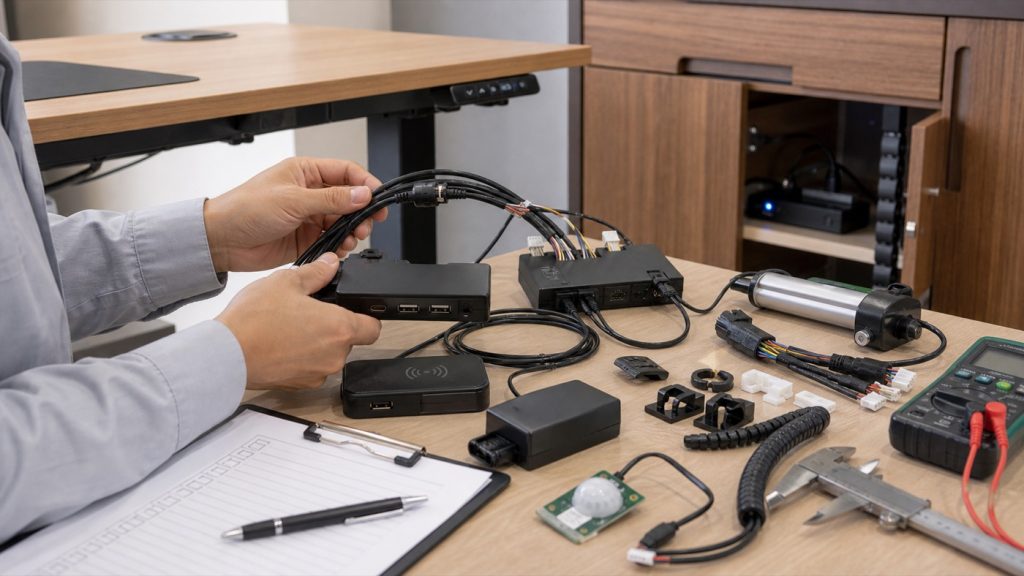
The quality team should test the product after packaging simulation and movement cycles, not only when it is fresh on the assembly table. A product that works before packing but fails after shipping is not ready for ecommerce or export.
Spare Parts And Service Decide The Real Cost
Smart furniture after-sales cost can be higher than ordinary furniture because a small electronic failure may make the whole product unusable. A failed adapter, remote, control box, cable, motor, sensor, or charging module can turn a bulky item into an expensive support case.
Buyers should ask whether key modules are replaceable, whether spare parts have stable SKUs, whether parts are shared across product lines, whether repair can be done by the customer, retailer, installer, or service technician, and whether diagnostic steps are clear.
For ecommerce furniture, replacement strategy is especially important. Sending a new control box may be far cheaper than replacing a whole desk or bed base. But that only works if the module is accessible, labeled, and easy to identify.
Factories should provide fault trees, photos, troubleshooting instructions, and spare-part packaging. A smart furniture supplier that cannot support parts is selling a product with hidden after-sales risk.
What Buyers Should Put Into The Smart Furniture Brief
A serious smart furniture brief should include several layers.
The furniture layer should define structure, materials, dimensions, finish, stability, load, packaging, and normal furniture quality requirements.
The electrical layer should define power input, plug type, voltage, adapter, wire rating, power module, outlet location, cable routing, insulation, heat, labels, and destination-market certification assumptions.
The electronics layer should define control box, sensors, motors, wireless modules, charging modules, remote controls, PCBs, firmware version, approved suppliers, and allowed substitutes.
The user layer should define how the customer powers, pairs, controls, resets, moves, cleans, and maintains the product. If the product has an app, the brief should define app ownership, support, update policy, and offline fallback.
The service layer should define spare parts, diagnostic flow, warranty process, component replacement, supplier response time, and how claims will be analyzed by failure type.
This may sound heavy, but smart furniture requires it. A buyer who does not write these details into the brief is relying on the supplier’s hidden assumptions.
What Factories Can Do Better
Factories that want to win smart furniture accounts need to become system integrators, not only furniture makers.
First, build approved module libraries. Power modules, actuators, control boxes, cables, sensors, remotes, chargers, lighting modules, and adapters should each have supplier identity, specification, market limits, certification status, and substitution rules.
Second, create integrated test plans. Test the finished product, not only loose components. Check motion, charging, wireless control, heat, cable routing, packaging recovery, user reset, and spare-part replacement.
Third, keep version control. Smart furniture needs records for hardware version, firmware version, app version, wiring diagram, instruction version, and production batch. Without version control, after-sales support becomes guesswork.
Fourth, design for service. A product that cannot be repaired economically may be attractive at launch but expensive later. Replaceable modules, accessible cables, clear labels, and common spare parts make smart furniture more scalable.
The 2026 Sourcing Takeaway
Smart furniture is becoming a serious sourcing category because it combines furniture, electrical products, wireless equipment, software, and service. The buyer is no longer purchasing only a shape, finish, and carton. The buyer is purchasing an operating system inside a piece of furniture.
For buyers, the practical response is to approve the system, not only the sample. Ask who owns the electronics, which standards apply, how wireless modules are authorized, how cables are protected, how software is supported, and how parts are replaced.
For factories, the opportunity is to make integration capability visible. The supplier that can control furniture construction, electronics, certification, version records, and after-sales parts will be easier for overseas buyers to trust.
Smart furniture can create real value, but only when the intelligence is supported by reliable sourcing discipline. Otherwise, a smart feature becomes a smarter way to create returns.