
Cabinet furniture is often sold through visible surfaces: the door style, finish color, wood grain, handle shape, storage layout, and the way a room scene looks in a product photo. But the parts that decide long-term satisfaction are frequently hidden or half-hidden. Drawer slides, concealed hinges, soft-close dampers, shelf pins, screws, brackets, connector holes, and drawer-box construction can determine whether the customer sees the product as reliable or frustrating.
That is why cabinet hardware durability is becoming a sourcing filter. For importers, retailers, distributors, project buyers, and furniture factories, hardware is no longer a small line item at the end of the bill of materials. It is a performance system that affects installation, daily use, warranty cost, replacement parts, online reviews, and repeat orders.
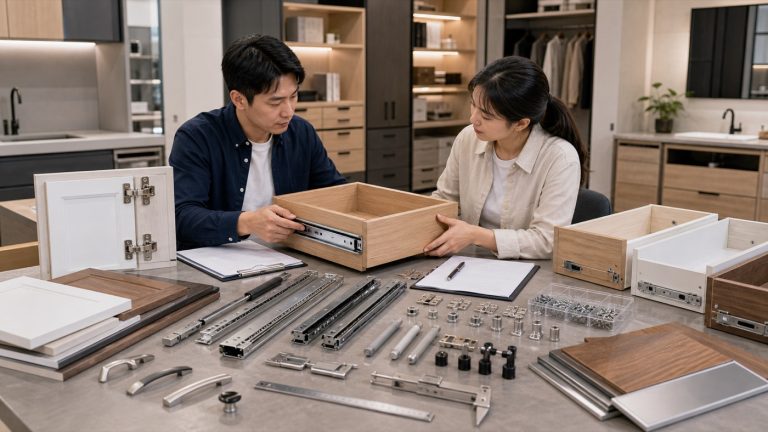
The Home Industry Insights editorial view is that cabinet hardware should be evaluated as part of product engineering, not only as accessory sourcing. A cabinet can have a beautiful panel finish and still fail commercially if the drawer binds, the hinge loosens, the soft-close mechanism stops working, or the handle screws strip after normal use.
Why Hardware Is A Buyer-Level Issue
Hardware problems usually appear after the product has moved through several expensive steps: factory production, inspection, packing, export transport, warehousing, delivery, installation, and customer use. Once the problem appears, the cost of a cheap hardware decision is no longer cheap.
A drawer slide that does not run smoothly can create a return. A hinge that cannot hold door alignment can make the entire cabinet look low grade. A soft-close unit that fails early can damage the product’s premium positioning. A missing or wrong screw can stop consumer assembly. A weak shelf support can create a safety and claim issue. A misdrilled mounting hole can turn a good component into a bad product.
This matters across kitchen cabinets, bathroom vanities, wardrobes, dressers, sideboards, TV cabinets, shoe cabinets, storage units, office cabinets, and modular systems. The exact use case differs, but the commercial pattern is similar: hardware controls movement, fit, adjustment, and user confidence.
For buyers, the key point is simple. Hardware should not be approved only by appearance or sample-room operation. It should be specified, tested, matched to the cabinet structure, and controlled through mass production.
Drawer Slides Carry The Daily Load
Drawer slides are one of the most important components in cabinet furniture because they turn storage into a repeated movement. A drawer may be opened and closed thousands of times. It may be loaded with cookware, tools, cosmetics, clothing, documents, toys, accessories, or heavy pantry items. If the slide is under-specified, the customer will feel it.
The first sourcing question is the slide type. Common options include side-mount ball-bearing slides, undermount concealed slides, roller slides, soft-close slides, push-open slides, and heavy-duty slides. Each type creates a different cost, feel, installation tolerance, load capacity, visible appearance, and maintenance profile.
Side-mount ball-bearing slides are common and economical, but they require enough side clearance and consistent drawer-box dimensions. Undermount slides create a cleaner look and are often associated with higher-end cabinets, but they are more sensitive to drawer-box construction and installation accuracy. Soft-close slides improve perceived quality, but they add damping components that can fail if the mechanism is weak, contaminated, misaligned, or overloaded.
Buyers should ask for more than the phrase “soft-close slide.” They should ask for rated load, cycle testing, extension type, material thickness, corrosion resistance, installation tolerance, brand or supplier identity, approved substitute, and whether the slide was tested in the actual drawer size and load condition.
Hinges Decide Door Alignment
Concealed hinges look small, but they control the daily impression of quality. A cabinet door that sits unevenly, drops over time, rubs against another door, or will not stay aligned can make an entire cabinet program feel unreliable.
Hinge sourcing should consider opening angle, overlay type, cup diameter, drilling pattern, hinge arm type, mounting plate, adjustability, soft-close function, corrosion resistance, and compatibility with the door material. Heavy doors need more careful hinge selection than small lightweight doors. Tall wardrobe doors and thick vanity doors should not be treated like small wall-cabinet doors.
The cabinet panel also matters. A good hinge installed into weak material can still loosen. Screws need adequate holding strength, and the hinge cup should not split or weaken the door. If the product uses MDF, particleboard, plywood, solid wood, or a laminated panel, the screw-holding behavior and drilling quality can vary. This connects with broader material documentation. In our earlier article on composite wood compliance in furniture sourcing, we discussed how hidden panel choices can carry sourcing and documentation risk. For cabinet hardware, hidden panel quality also affects mechanical performance.
For buyers, hinge approval should include adjustment after shipment and after repeated operation. A hinge that works on a fresh sample may still become a complaint if it loosens after transport vibration, consumer assembly, or normal use.
Hardware Standards Help, But The Product Context Still Matters
Industry standards and certification programs can help buyers structure the conversation. The Kitchen Cabinet Manufacturers Association’s KCMA A161.1 Quality Certification page describes cabinet quality certification as a benchmark for cabinet durability and performance, including structural, shelf, drawer, door, and finish-related testing. KCMA also describes door and drawer operation as part of its cabinet performance focus.
The Builders Hardware Manufacturers Association’s ANSI/BHMA standards page explains that BHMA is accredited by ANSI to develop and maintain performance standards for builders hardware, and that its product directory includes performance-oriented standards with cycle, operational, strength, security, and finish test requirements.
These references are useful because they remind buyers that hardware is about performance, not only appearance. However, standards should not be used as vague marketing language. A buyer should ask which component was tested, under what method, in which configuration, with what load, for how many cycles, and against what pass/fail criteria.
In furniture sourcing, the real issue is always the complete product context. A high-quality slide can perform poorly if the drawer box is out of square. A good hinge can loosen if the door material has weak screw holding. A soft-close damper can fail if dust, paint, or poor assembly affects movement. A test report for a hardware component is helpful, but it does not replace checking the finished cabinet.
The Weak Point Is Often Installation Tolerance
Cabinet hardware failures are not always caused by the hardware itself. Many are caused by tolerance mismatch.
Drawer slides need side gaps, parallelism, and consistent drawer-box dimensions. Hinges need accurate cup drilling, mounting plate position, screw depth, and door overlay control. Handles need hole spacing and back-side reinforcement. Shelf pins need clean, consistent holes. Knock-down connectors need proper drilling depth and panel alignment.
If the factory controls these details well, even a mid-range hardware set can feel reliable. If the factory controls them poorly, expensive hardware may not save the product.
This is especially important for flat-pack and ready-to-assemble furniture. The end user becomes part of the assembly process. If holes are slightly off, screws are mixed, instructions are unclear, or hardware bags are poorly labeled, the customer may blame the brand even when the component supplier did nothing wrong.
Buyers should therefore inspect not only hardware samples, but also drilling jigs, assembly SOPs, pilot-run photos, hardware bag control, torque guidance, and final functional checks. The question is not only “Which slide did you use?” It is “Can the factory install this slide consistently across thousands of units?”
Soft-Close Is A Promise, Not A Decoration
Soft-close hardware has become common in kitchen cabinets, vanities, wardrobes, and higher-end storage furniture. It can make a product feel quieter, more refined, and more expensive. But soft-close is also a promise. If the mechanism becomes weak, inconsistent, noisy, or misaligned, the customer notices quickly.
Soft-close performance depends on damping quality, load, movement speed, drawer or door weight, alignment, installation position, and long-term contamination. A soft-close drawer with light sample load may work beautifully. The same slide under real cookware or bathroom-storage load may close too slowly, fail to pull in, or lose the smooth feeling.
For buyers, soft-close approval should be done with realistic load. A vanity drawer should be tested with expected bathroom items. A kitchen drawer should be tested with cookware or simulated load. A wardrobe drawer should be tested with clothing weight. If the product is sold online, the test should also consider consumer assembly variation.
The buyer should also confirm whether soft-close hardware is standard across all drawers or only some drawers. Inconsistent hardware can create customer confusion, especially when the listing or sales material implies a premium feature across the whole product.
Hardware Packs Are A Customer Experience Issue
For assembled cabinets, hardware is mainly a factory and installer issue. For RTA and ecommerce furniture, hardware packs become part of the customer experience.
A hardware pack should be accurate, clean, labeled, protected from rust, separated by step when needed, and matched to the latest instruction revision. Small errors create large frustration. One missing cam lock, one wrong screw length, one unlabeled hinge plate, or one poor-quality Allen key can create a return, a bad review, or a customer service ticket.
Buyers should ask how the factory counts hardware. Manual counting, weight checking, vision inspection, pre-packed kits, and barcode-controlled hardware bags all create different risk levels. For high-volume ecommerce furniture, a simple “workers count it” answer may not be enough.
Instruction consistency also matters. If the hardware pack changes but the instruction drawing does not, customers may install parts incorrectly. If the same product uses alternate hardware suppliers, the instruction sheet should still match the actual delivered kit.
This links directly with packaging discipline. In our article on furniture packaging and transit damage, we argued that packaging is part of the product system. Hardware packs are one of the clearest examples. The product may be undamaged, but the customer still cannot use it if the hardware system is wrong.
Finish And Corrosion Are Not Only Outdoor Problems
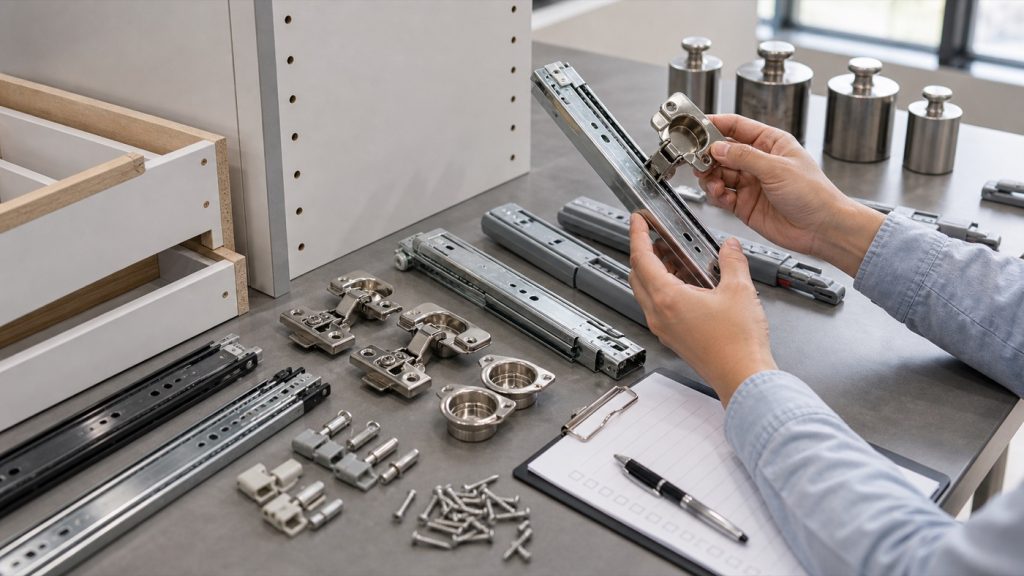
Hardware finish matters indoors too. Bathrooms, kitchens, laundry rooms, coastal apartments, rental units, and hospitality spaces all expose hardware to humidity, cleaning chemicals, hand oils, and repeated wiping.
Rusting screws, stained hinge cups, discolored handles, and rough drawer-slide movement can all damage perceived quality. Even when the hardware still functions, visible corrosion or finish wear makes a product look cheap.
Buyers should ask about hardware finish, corrosion screening, salt spray or humidity expectations where relevant, and packaging moisture control. If a product ships in humid containers or sits in warehouse storage, poor hardware protection may show up before the customer has used the product.
Mixed metals should also be reviewed. A cabinet may use metal slides, screws, brackets, hinge cups, handles, and decorative caps from different suppliers. If finishes do not match, the product may look inconsistent. If materials interact poorly, corrosion risk can increase in humid environments.
Claims Reveal The Real Hardware Risk
A supplier may say its hardware is good. Claim data tells a better story.
Buyers should ask what hardware-related claims occur most often. Do drawers bind? Do slides bend? Do soft-close units fail? Do hinges loosen? Do handles pull out? Do screws strip? Do shelf pins break? Do customers report missing hardware? Do installers complain about hole alignment?
The answer should be specific by product type. A bathroom vanity may have different hardware risk than a wardrobe. A large kitchen drawer may have different load issues than a small nightstand drawer. A cheap shoe cabinet may fail through connector loosening, while a premium storage unit may fail through soft-close inconsistency.
Good factories use claim data to improve hardware selection, drilling control, hardware packaging, instruction design, and inspection. Weak factories treat each complaint as an isolated after-sales issue.
What Buyers Should Put Into The Hardware Brief
A strong cabinet hardware brief should include more than item names.
For drawer slides, specify type, extension, load rating, finish, soft-close or push-open requirement, cycle expectation, installation gap, drawer size range, approved supplier, and allowed substitute process.
For hinges, specify opening angle, overlay, cup size, mounting plate, adjustment range, soft-close requirement, door weight limit, drilling pattern, and screw type.
For handles and pulls, specify material, finish, hole spacing, screw length, thread quality, finish tolerance, and back-side reinforcement where needed.
For shelf supports and connectors, specify load expectation, hole diameter, hole spacing, panel thickness, insertion fit, and packaging method.
For hardware packs, specify counting method, bag labeling, spare-parts policy, instruction revision control, corrosion protection, and random audit procedure.
For finished cabinets, specify functional checks: drawer run, door alignment, soft-close consistency, handle tightness, shelf stability, visible finish, and noise during operation.
This may sound detailed, but it prevents a common sourcing mistake: approving a cabinet by finish and price while leaving the moving parts to supplier habit.
What Factories Can Do Better
Factories that want stronger export accounts should treat hardware capability as part of their selling proposition.
First, build an approved hardware library. Each slide, hinge, handle, shelf support, screw, connector, and damper should have a supplier, specification, approved use, cost level, and substitute rule. The library should distinguish between entry-level, mid-range, premium, hospitality, project, and ecommerce uses.
Second, link hardware to product families. A slide that works for a light bedside drawer may not be suitable for a wide kitchen drawer. A hinge that works for a small door may not support a tall wardrobe door. A handle screw that works for solid wood may not work for a thin composite panel without reinforcement.
Third, control drilling and assembly. Jigs, CNC programs, hole-depth checks, torque control, and pilot assembly are as important as the purchased hardware. The factory should prove that the hardware works in the product, not only that the component is acceptable on its own.
Fourth, make replacement easy. Buyers need spare slides, hinge plates, screws, shelf supports, and handles for after-sales service. A supplier that can provide clear spare-part codes and stable availability reduces the buyer’s support cost.
The 2026 Sourcing Takeaway
Cabinet hardware durability is becoming a sourcing filter because customers interact with hardware every day. They open drawers, adjust shelves, close doors, pull handles, and judge smoothness without thinking about the component list behind the product.
For buyers, the practical step is to move from hardware appearance to hardware performance. Ask what hardware is used, how it was tested, how it is installed, how substitutions are controlled, and how claims are tracked.
For factories, the opportunity is to make hardware reliability visible. Strong hardware selection, accurate drilling, consistent assembly, well-managed hardware packs, and useful claim feedback can separate a serious cabinet supplier from a sample-only supplier.
In cabinet furniture, the best hardware is often the hardware customers do not notice. It simply works, quietly and repeatedly, long after the product photo has done its job.