
Upholstered furniture is often sold through emotion: comfort, softness, silhouette, fabric handfeel, color, and how a sofa or lounge chair fits into a room. For buyers and suppliers, however, the product is also a layered materials system. Fabric, foam, batting, decking, barrier textiles, labels, and production records all matter.
That is why flammability is becoming a sourcing issue, not only a laboratory issue. A sofa program can look attractive in the showroom, but still create risk if the buyer cannot connect the fabric, filling, barrier material, label, and test basis to the final shipped product. For importers, distributors, retailers, and private-label brands, this topic now belongs inside product development and supplier qualification.
The point is not to make every furniture buyer a fire-safety engineer. The point is to avoid treating upholstery compliance as a last-minute label. The stronger operating model is to build material selection, sample approval, component testing, label control, and production version control into the sourcing process from the beginning.
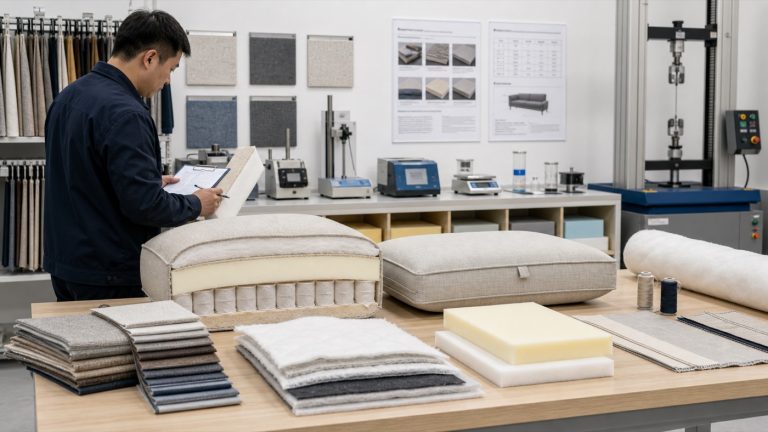
The Standard Is About A Product System
The U.S. Consumer Product Safety Commission’s upholstered furniture FAQ explains that 16 C.F.R. part 1640 is intended to reduce deaths and injuries associated with upholstered furniture fires. The standard provides methods for smolder resistance of cover fabrics, barrier materials, resilient filling materials, and decking materials used in upholstered furniture.
That component language is important. Buyers sometimes talk about a sofa as one finished item, but the compliance path depends on how the components work together. A cover fabric, foam, barrier material, and decking material may each have a role. A product can use a passing barrier material around filling material, or use passing cover fabric and passing filling material, while decking material must pass if present. CPSC notes that the relevant test methods evaluate components against performance criteria for char length, smoldering, and transition to open flaming.
This makes upholstery sourcing different from buying a simple visible shell. Two sofas can look nearly identical, but have different compliance logic because the fabric, foam, or barrier construction is different. A fabric substitution, foam supplier change, cushion redesign, or decking material change can therefore create a documentation problem, even if the visual product remains similar.
For factories, this means upholstery engineering and purchasing need to be aligned. For buyers, it means material approval must go deeper than color and texture.
TB 117-2013 Became A National Reference Point
California Technical Bulletin 117-2013 reshaped the way many suppliers and buyers discuss upholstered furniture flammability. The California Bureau of Household Goods and Services’ TB 117-2013 FAQ states that the standard became effective January 1, 2014 and was fully implemented January 1, 2015. The same FAQ says the standard applies to upholstered furniture sold in California and does not apply to bedding products such as mattresses, comforters, mattress pads, and bed pillows.
CPSC later codified federal upholstered furniture flammability requirements at 16 C.F.R. part 1640. CPSC states that the requirement went into effect on June 25, 2022 and applies to upholstered furniture manufactured, imported, or reupholstered on or after that date.
For global furniture suppliers, the practical lesson is that U.S.-bound upholstered furniture cannot be managed as a generic sofa category. The product team needs to know which items are in scope, which are out of scope, and how the construction supports the required labeling and compliance position. Sofa beds, futons, detachable cushions, separately sold pillows, outdoor cushions, and reupholstered goods may need more careful review because scope can depend on product design and use.
Flame-Retardant Chemistry Is Not The Same As Flammability Compliance
One of the most common buyer misunderstandings is to treat “flammability compliant” and “contains flame retardants” as the same thing. They are not the same.
CPSC’s FAQ states that 16 C.F.R. part 1640 does not specify or prohibit flame-retardant chemicals. California’s TB 117-2013 FAQ similarly says the Bureau’s flammability standards are performance standards and do not prescribe or prohibit the use of flame-retardant chemicals. That distinction matters commercially because many retailers, brands, and consumers pay attention to chemical claims, while regulators focus on the applicable product requirements and labeling.
For buyers, the question should be separated into two tracks. First: does the product meet the required upholstered furniture flammability standard for the intended market? Second: what chemical, material, and retailer-specific claims are being made, and can the supplier support those claims with documentation?
If a brand wants to market a sofa as made without added flame-retardant chemicals, that statement needs a separate documentation discipline. It is not enough for the supplier to say the product passed a flammability requirement. It is also not enough to assume that all TB 117-2013 compliant constructions are chemically identical. The buyer needs clear component records.
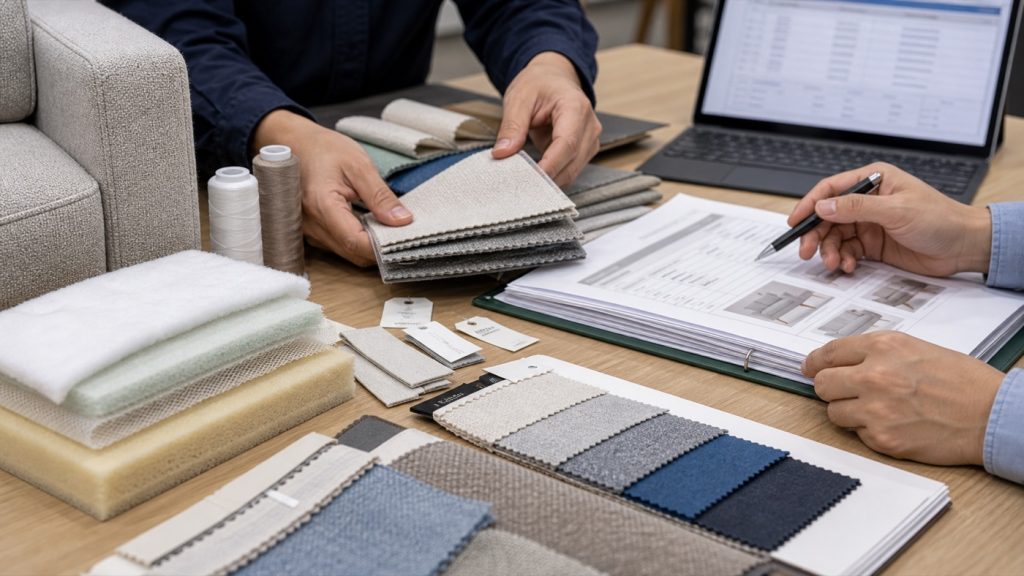
Labels Are Small, But They Carry Commercial Risk
Labels are easy to underestimate. They are physically small, often placed under a cushion or on a hidden panel, and may be treated as a factory routine. In upholstered furniture, they are part of the product’s market readiness.
CPSC says upholstered furniture subject to the federal standard must have a permanent label with the statement that it complies with U.S. CPSC requirements for upholstered furniture flammability. CPSC staff recommends the statement be conspicuous and legible, and that hangtags and zip ties are not considered permanent labels.
For buyers, label control should be part of pre-shipment inspection. The label should match the right SKU, production version, destination market, and factory. It should be attached securely and placed in a practical location. If the buyer also needs a California law label or retailer-specific chemical disclosure, those requirements should not be confused with the federal flammability statement.
Factories should avoid treating labels as interchangeable. A sofa collection may include multiple fabrics, foam densities, cushion constructions, and destination markets. A label template that works for one SKU may not be correct for another. Version control matters.
Material Changes Can Break The Documentation Chain
Upholstery sourcing involves frequent changes. A buyer may request a new fabric color. A factory may change foam density to meet cost. A cushion may be redesigned to improve comfort. A decking material may be substituted because of lead time. A barrier layer may be removed to reduce cost. Each change may look operationally small, but it can change the compliance basis.
This is where serious sourcing teams separate themselves. They do not ask only whether the sample passed. They ask whether mass production is still using the same approved construction. They ask whether the test report or supplier declaration covers the exact fabric, foam, barrier material, and decking combination. They ask whether the factory can show records for the component lot and finished SKU.
The issue is similar to the document chain we discussed in composite wood compliance. The visible product is only part of the story. The buyer also needs material traceability and production-change control. In upholstery, the traceability challenge is often more complex because the product contains multiple soft components from different suppliers.
What Buyers Should Ask Before Approving A Sofa Program
A practical buyer review should begin with scope. Is the product upholstered furniture under the intended market’s rules? Is it a mattress, detachable mattress, decorative pillow, seating cushion, outdoor cushion, or reupholstered item? Is it manufactured, imported, or reupholstered after the relevant effective date? If the answer is unclear, the buyer should not rely on the product name alone.
The next layer is construction. What are the cover fabric, foam, batting, barrier material, and decking material? Which components are responsible for compliance? Does the product rely on a passing cover fabric and filling material, or a passing barrier system? If decking material is present, how is it controlled?
The third layer is documentation. What test evidence or supplier documentation supports the material set? Does it match the final production construction? What happens if the buyer changes fabric, color, cushion style, or foam density? How are component substitutions approved?
The fourth layer is labeling. Does the permanent label include the required flammability statement when applicable? Is the label securely attached? Does the product also need California law-label content or other market-specific labeling? Is the label checked during final inspection?
The final layer is claim control. If marketing copy says “no added flame retardants,” “chemical-conscious,” “low emission,” or similar language, what evidence supports that claim? Which component suppliers are responsible for the declaration? How long are records retained?
What Factories Should Build Into Their Workflow
Factories serving serious upholstered furniture buyers should make this process routine. The strongest suppliers maintain an upholstery bill of materials by SKU, approved fabric and foam lists, barrier-material records, decking specifications, label templates, sample approval history, production-change procedures, and inspection points for permanent labels.
Sales teams should avoid promising broad compliance language without confirming the actual construction. Purchasing teams should not substitute foam, fabric, or barrier layers without checking whether buyer approval is required. Quality teams should not inspect only appearance, dimensions, and stitching while ignoring labels and component identity.
This capability can become a competitive advantage. Many suppliers can show a sofa photo and quote a price. Fewer can explain the construction logic, documentation basis, label control, and change-management process. For importers and retailers, that difference matters because the cost of a documentation failure can exceed the savings from a cheaper fabric or foam substitution.
It also connects to packaging and delivery. Upholstered furniture is bulky, soft, and vulnerable to compression, stains, and abrasion. A compliance-ready product still has to survive transport. The packaging discussion in our article on furniture packaging and transit damage applies here as well: material quality, documentation, and delivery performance need to be managed together.
The Home Industry Insights View
Upholstered furniture flammability is becoming a broader sourcing issue because it touches multiple teams at once: design, materials, purchasing, compliance, quality, labeling, packaging, and sales.
For buyers, the main lesson is to approve the product system, not just the sofa appearance. For factories, the lesson is to keep fabric, foam, barrier, decking, label, and production records aligned. The product that reaches the market is not just a beautiful sofa; it is a documented materials package with a clear compliance path.
In a competitive upholstery market, comfort and style still sell the product. But reliable material control and documentation are what make the product scalable across serious retail, distribution, and cross-border channels.