
Furniture tip-over safety used to be treated by some suppliers as a packaging insert or warning-label issue. That view is no longer enough. For bedroom storage furniture, stability is now connected to product design, drawer construction, hardware selection, assembly instructions, compliance documentation, and buyer risk.
The change is especially important for companies that source dressers, chests of drawers, armoires, fabric drawer units, and other clothing storage products for the U.S. market. A storage unit is not judged only by its finish, carton size, price, or visual style. Buyers also need to understand whether the product falls within a mandatory safety rule, how it performs when drawers are opened or loaded, whether anti-tip hardware is properly supplied, and whether the documentation can support the finished goods being shipped.
For factories, this means stability can no longer be left until the end of development. For importers, distributors, and retailers, it means supplier qualification must include the product’s stability logic, not just its cost, appearance, and delivery schedule.
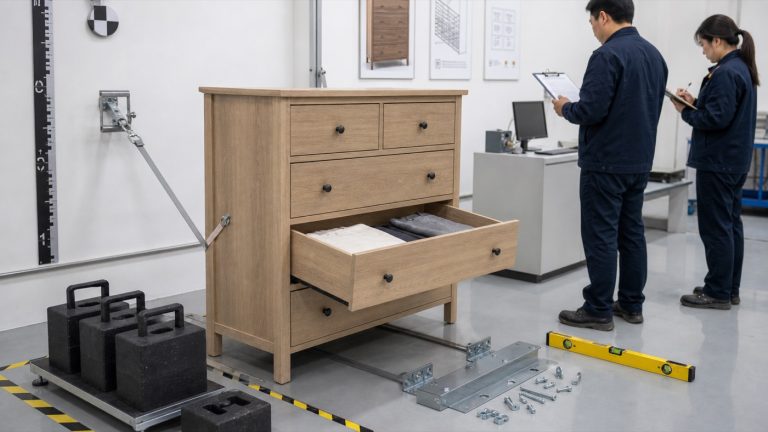
The Rule Has Changed The Buyer Conversation
The U.S. Consumer Product Safety Commission’s business guidance on clothing storage units states that the STURDY law directed CPSC rulemaking for these products, and that the requirements are codified at 16 CFR part 1261. CPSC says the requirements apply to clothing storage units manufactured after September 1, 2023.
The rule is not a general rule for every piece of furniture. CPSC’s guidance describes a clothing storage unit as a furniture item with drawers and/or hinged doors intended for storing clothing typical with bedroom furniture, and it lists criteria such as being free-standing, at least 27 inches tall, weighing at least 30 pounds, and having enclosed storage volume of at least 3.2 cubic feet. Examples include chests, chests of drawers, drawer chests, armoires, bureaus, door chests, and dressers.
That distinction matters. A buyer should not treat every bookcase, TV stand, accent table, or dining cabinet as if it falls into the same category. But a buyer also should not assume a product is outside scope simply because it is lightweight, fabric-based, flat-packed, sold online, or positioned as budget furniture. CPSC specifically notes in its guidance that fabric dressers with drawers can be clothing storage units if they meet the criteria outlined in ASTM F2057-23.
For overseas suppliers, the commercial meaning is clear: product naming and category presentation are not enough. The product’s actual structure, dimensions, weight, storage volume, intended use, and market destination need to be reviewed before quotation and production.
Stability Starts Before Testing
Testing is important, but the stability result is shaped much earlier in development. The product’s height, depth, footprint, center of gravity, drawer size, drawer extension, leg design, back panel, material weight, and hardware choice all influence risk.
This is why tip-over safety should be reviewed at the sketch, sample, and engineering stages. A dresser can look balanced in a product photo but become risky when multiple drawers are opened, when the floor is not perfectly level, when a consumer loads heavier items into upper drawers, or when the unit is placed on carpet. A fabric drawer unit can feel light and convenient, yet its low mass and tall profile may create a different stability profile from a heavier wooden chest.
Factories sometimes respond to stability concerns by adding an anti-tip kit at the end. That may be necessary, but it should not replace design review. A better approach asks whether the unit’s proportions are appropriate, whether the drawer system limits risky extension, whether drawer interlocks are relevant, whether the wall-anchor system is practical, and whether instructions make correct installation realistic for the final user.
For buyers, the practical question is not only “Does the product include anti-tip hardware?” It is “How was stability considered in the product design, test setup, hardware specification, warning material, packaging, and final documentation?”
Anti-Tip Hardware Is A System, Not A Loose Accessory
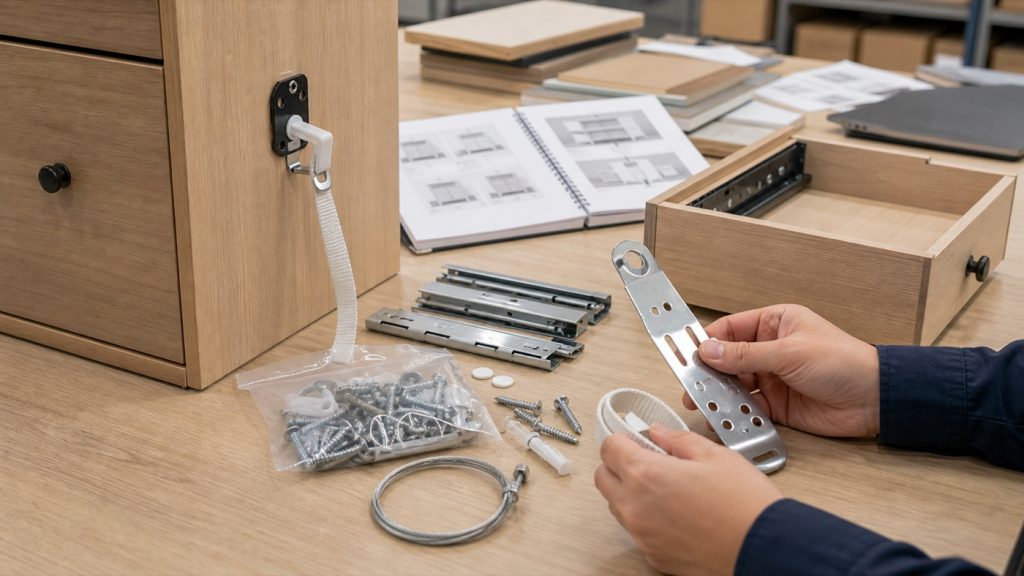
Anti-tip hardware is often physically small: a bracket, strap, cable, screw set, wall anchor, or instruction sheet. Commercially, it is not small. If the kit is missing, mismatched, poorly described, or packed separately in a way that consumers overlook, the product can create compliance and reputational problems.
The hardware system should be reviewed like any other critical component. Buyers should confirm the exact components, material strength, screw type, wall-anchor assumptions, attachment point on the product, installation steps, packaging location, and version control. A product shipped assembled may need different control from a product shipped flat-packed. A wooden dresser may require different attachment logic from a fabric drawer unit with a metal frame.
Instructions matter as much as the kit. A clear kit that is buried in the carton, paired with vague instructions, or drawn incorrectly can fail in practice. For cross-border products, the instruction sheet also needs to align with the destination language, warning format, and product revision. If a factory changes the back panel, frame, drawer structure, or hardware hole location, the anti-tip instruction may also need revision.
Documentation Is Part Of The Finished Product
CPSC’s guidance also notes that manufacturers and importers of consumer products subject to a CPSC-enforced rule must certify compliance, and that for clothing storage units the citation to use in the certificate is “16 CFR part 1261 – Clothing storage units.” For sourcing teams, that makes documentation a finished-product requirement, not a back-office formality.
A buyer should be able to connect the finished SKU to the test record, product configuration, component version, production batch, warning material, instruction sheet, and certificate. This is especially important when one factory produces similar-looking storage units for multiple buyers or multiple markets.
Version control is often the weak point. A sample may pass in one configuration, but production may later change drawer slides, panel thickness, frame material, leg height, packaging sequence, or hardware kit. These changes may appear minor to a factory trying to control cost or lead time. For the buyer, they can change the stability profile or the documentation trail.
That is why product approval should define which changes require buyer approval. It should not be left to the factory’s internal purchasing team to decide whether a different bracket, strap, drawer slide, or back panel is “basically the same.”
Why This Matters For Different Channel Models
The risk is not identical across channels. A retail buyer, marketplace seller, distributor, private-label brand, and DTC operator may all face the same product rule, but the operational pressure is different.
Retailers and major importers tend to require more formal documentation, repeated supplier audits, and stricter approval processes. Marketplace and ecommerce sellers may move faster, but they still face product safety exposure, consumer complaints, platform scrutiny, and potential recall risk. Smaller brands may be tempted to rely on the factory’s verbal assurance because they lack internal compliance teams. That is precisely where a structured checklist becomes important.
For factories, the channel also changes the commercial expectation. A supplier trying to sell a low-cost fabric dresser into ecommerce cannot assume that price alone will win the program. The product must be stable, documented, correctly labeled, and packed with installation hardware and instructions that make sense for the final consumer.
This connects to our earlier discussion of composite wood compliance in furniture sourcing. In both cases, the stronger buyer is not just purchasing a physical item. The buyer is purchasing a product system with materials, documentation, configuration control, and destination-market readiness.
What Buyers Should Ask Before Approving A Storage Furniture SKU
A practical buyer review should begin with scope. Is the product intended to store clothing? Is it free-standing? What are its height, weight, and enclosed storage volume? Does it have drawers, hinged doors, or extendible elements? Which destination market is being served? Has the supplier reviewed whether 16 CFR part 1261 applies?
The next layer is design. What is the unit’s footprint and center of gravity? How do drawers extend? Are interlocks used? What is the back-panel structure? How are legs, feet, or frame components attached? Does the product behave differently on carpet? Are there meaningful differences between the sample and mass-production version?
The third layer is documentation. What test evidence is available? Which SKU and version does it match? Is the anti-tip hardware kit identified in the BOM? Are the instructions and warnings current? Does the certificate cite the correct rule when applicable? How are production changes controlled?
The final layer is packaging and inspection. Where is the anti-tip kit placed in the carton? Is it easy for the consumer to find? Are hardware bags labeled clearly? Does the pre-shipment inspection verify the presence of the kit and instruction sheet? Are carton photos and assembly documents retained?
These questions are not only legal questions. They are commercial risk questions. A product that passes visual inspection but fails the documentation review is not ready for a serious market launch.
What Factories Should Build Into Their Workflow
Factories that want to sell bedroom storage furniture into regulated markets should build stability review into their normal development process. That means product design, engineering, purchasing, quality, packaging, and sales need to work from the same version-controlled specification.
At a minimum, the factory should maintain a stability-related bill of materials, anti-tip hardware specification, approved instruction sheet, warning material, sample approval history, test record, production-change procedure, and pre-shipment inspection checklist. The team should know which products are in scope, which are outside scope, and why.
Factories should also avoid vague language. Saying “we include the wall strap” or “this is export quality” is not a compliance system. A stronger answer explains the product’s scope review, applicable rule, test basis, hardware kit, instruction control, and certificate support.
This capability can become a selling point. Many buyers already expect low price and acceptable appearance. Fewer suppliers can clearly explain product safety, configuration control, and documentation. For storage furniture, that difference can determine whether a buyer trusts the factory with repeat programs.
The Home Industry Insights View
Furniture tip-over safety is no longer a narrow technical issue. It is becoming a product development issue, a sourcing issue, and a supplier-capability issue.
For buyers, the lesson is to review storage furniture earlier and more structurally: scope, design, testing, hardware, instructions, documents, and packaging must connect. For factories, the lesson is to stop treating anti-tip parts as a loose accessory and start treating stability as part of the product itself.
The home industry is moving toward a model where visible design and hidden control matter together. A dresser that looks good in a listing photo is only half a product. The other half is whether it is engineered, documented, packed, and supported in a way that protects the buyer, the channel, and the end user.