
Small kitchen appliances create a familiar trade-off. A stand mixer, espresso machine, food processor, or air fryer may be used often enough to deserve an accessible position, yet leaving every appliance on the countertop consumes preparation space and makes the room feel crowded. Putting a heavy machine in a low cabinet clears the surface but shifts the burden to the user, who must lift, carry, and reconnect it.
A motorized kitchen appliance lift changes that sequence. The appliance stays on a powered shelf inside a base or tall cabinet, then moves upward and outward toward working height. The idea is appealing for premium kitchens, accessible homes, senior living, and compact apartments. But it is not merely an electric shelf. Cabinet geometry, the appliance envelope, power-cord routing, ventilation, movement clearances, controls, and service access all become one product system.
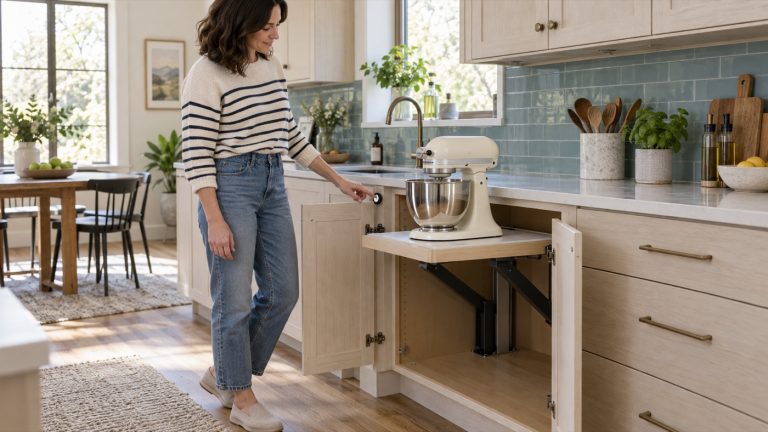
The product is a movement path, not just a load rating
Buyers naturally start with maximum load. That number matters, but it answers only one question: how much weight the mechanism is designed to move under stated conditions. It does not confirm that a particular appliance will fit inside the cabinet, pass through the opening, clear the countertop, or remain stable when used.
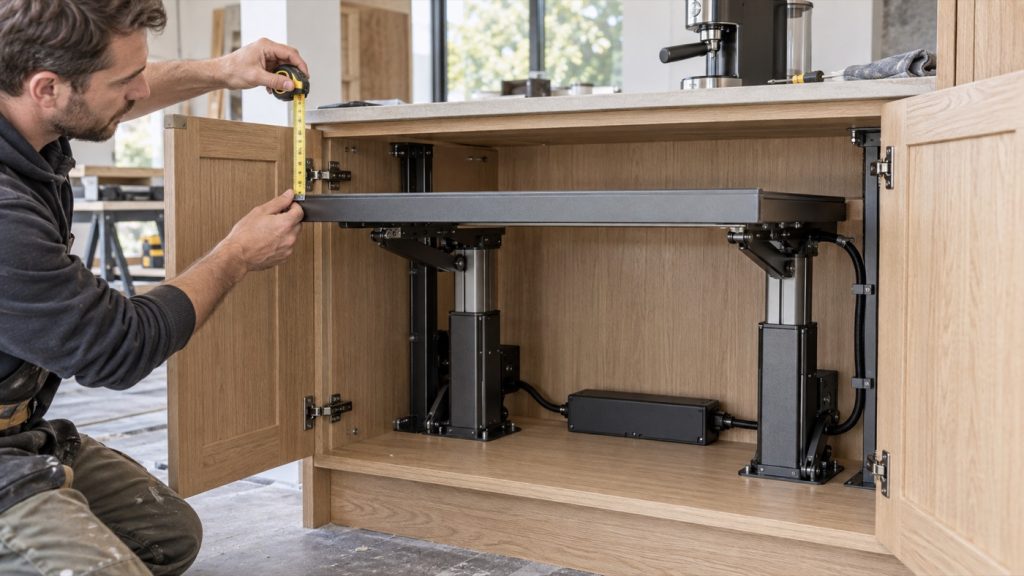
Map the complete three-dimensional envelope. Record the appliance width, depth, height, weight, control locations, lid or head-opening movement, handle projection, and cord exit. Then add the shelf dimensions, lift hardware, cabinet hinges, door thickness, and the manufacturer’s required clearances. A stand mixer may fit while stored but become unusable if its head cannot tilt back at the delivered height. An air fryer may fit physically yet require more open space around its exhaust than the cabinet arrangement provides.
The shelf also travels through space that people may treat as ordinary kitchen space. The doors must be fully clear, adjacent drawers should not enter the path, and a stool, waste bin, or user’s knee must not become an obstruction. That operating zone belongs in the kitchen drawing and the handover instructions.
A useful 2026 product example
Granberg introduced its UNILIFT 880 electric kitchen appliance lift for 2026. The published product information describes a shelf that moves upward and outward from a base or tall cabinet, with a maximum load of 25 kg. It lists versions for 50, 60, and 80 cm cabinet widths, a 475 mm upward movement, a 656 mm outward movement, and an included Bluetooth control button. The company also says the model is prepared for a future Granberg Connect platform, with the app planned for autumn 2026.
These figures are useful because they show how specific the selection process must be. They are manufacturer claims for one product family, not general specifications for all appliance lifts. In particular, a future app should not be treated as an available feature until it has actually launched in the relevant market, and a stated cabinet width is not the same thing as the usable shelf width.
Granberg’s earlier UNILIFT 870 illustrates a related but different configuration. Its published description uses a movable manual control and says the movement can stop at different heights. Comparing product generations helps buyers separate the core function—bringing an appliance forward and upward—from optional control and connectivity features.
Decide which appliances are truly compatible
A category name such as “appliance lift” does not make every countertop appliance suitable. Start with the appliance manufacturer’s own instructions. Check whether the product is intended to operate on a movable shelf, what surrounding clearance it needs, whether its feet require a particular surface, and whether steam, heat, vibration, or liquid spillage could affect the lift or cabinet.
A stand mixer creates dynamic loads and vibration. An espresso machine combines weight, water, heat, and frequent access to tanks or bean hoppers. An air fryer moves hot air and greasy vapor. A microwave adds door swing and appliance-specific installation requirements. These are different use cases, even when their weights are similar.
For that reason, a buyer should define an approved appliance list or an appliance envelope rather than market the lift as universally compatible. Where the final appliance is selected later, the documentation should state the maximum dimensions, mass, center-of-gravity assumptions, ventilation constraints, and prohibited uses. This protects the distributor, installer, and end user from a fit decision being made from cabinet width alone.
The cabinet is structural equipment
The lift transfers its own weight, the appliance load, and movement forces into the cabinet. A decorative base unit should not be assumed adequate without checking the installation requirements. Panel thickness, material, fasteners, bottom construction, back fixing, cabinet level, and anchoring can all affect the result.
Granberg’s installation instructions for the related UNILIFT 870 state that installation should be performed by competent personnel and discuss the cabinet dimensions, load envelope, and fixing points. Those instructions must not be substituted for the current manual of a different model, but they make the broader point clear: the furniture is part of the lifting installation.
Buyers should request a cabinet-interface drawing before production. It should show the internal opening, lift attachment points, door and hinge positions, control-unit location, cable route, ventilation provisions, service access, and the appliance envelope in both stored and working positions. A rendered kitchen elevation is not enough.
Power routing must work in every position
A powered appliance on a moving shelf creates two separate electrical questions: how the lift itself is supplied and how the appliance is supplied. The answer should come from the selected lift and appliance instructions plus the destination’s electrical requirements, not from an improvised extension lead hidden in the cabinet.
If the appliance remains plugged in while moving, its cord must have adequate movement allowance and must stay away from hinges, lift arms, hot surfaces, and pinch zones throughout the cycle. If it is unplugged for storage, the working position still needs a conveniently placed outlet that does not encourage a cord to cross a sink, hob, or walkway. Cable clips and service loops should be designed and inspected, not added casually at final installation.
The control also needs a sensible position. It should be reachable without leaning into the movement path and should not be confused with appliance controls. Wireless controls reduce one cable, but they introduce pairing, battery, replacement, and handover questions. Buyers should confirm whether a wired fallback exists and what happens after power loss or a control failure.
Heat, steam, and liquids change the furniture specification
An appliance should not automatically operate inside the closed cabinet just because the lift can carry it. Hot-air exhaust, steam, condensation, and splashes can damage panels, edges, wiring, or mechanisms. They can also make cleaning difficult in places the consumer cannot easily see.
For steam-producing appliances, assess where vapor travels in the full working position. The 2026 UNILIFT 880 description says its shelf swivels out in front of the work surface and presents this as helping protect wall cabinets from rising steam. That is a model-specific design claim. The final kitchen still needs appliance clearances and a layout that does not direct heat or vapor toward vulnerable surfaces.
Material specifications should cover the shelf surface and exposed cabinet edges. Look for cleanable finishes, sealed edges, corrosion-resistant hardware where appropriate, and a way to remove crumbs or liquid without reaching into an unsafe mechanism. A drip tray may help in some applications, but it must not block ventilation or interfere with the lift.
Safety claims need an acceptance procedure
Powered furniture is often described with broad words such as smooth, stable, or safe. A procurement specification should turn those words into observable checks. The test should cover the complete movement with the agreed appliance, cabinet doors, hardware, cord routing, and surrounding furniture installed.
Check that the lift starts and stops as intended, holds its position, does not contact the cabinet, and does not expose an obvious trapping point during normal use. Verify the manufacturer’s prescribed response to an obstruction and the recovery method after interruption. Do not use a hand or body part to test a safety function; follow the product’s stated procedure and use appropriate test methods.
Controls should not allow accidental operation from an adjacent room or by a child without the safeguards required for the intended household. Connected control is especially sensitive because it may separate the operator from the product’s line of sight. A buyer should ask what operations the app permits, whether continuous user input is required, and what local control remains available. Our broader analysis of smart furniture integration explains why control behavior has to be evaluated at system level.
Connectivity should remain optional to the core job
Bluetooth or app control can improve placement flexibility and help a family manage several compatible products. It can also create support obligations that conventional cabinet hardware never had. Pairing instructions, operating-system compatibility, app availability by region, permissions, update policy, account requirements, and replacement phones all become part of the customer experience.
For buyers, the strongest specification keeps the essential movement usable through a clear local control even if a service, account, router, or phone is unavailable. Confirm this for the actual product. Also define who handles first-line support: the furniture retailer, lift-system supplier, kitchen installer, or app provider.
Connected features should not be used to disguise weak cabinet planning. A perfectly paired control cannot solve an appliance that hits the countertop or a cord that enters the mechanism. The priority order is physical fit, safe movement, usable control, maintainability, and then optional digital convenience.
Compare the complete delivered solution
Quotations become comparable only when they include the same scope. Ask whether the price covers the lift, shelf, control, power supply, cabinet reinforcement, doors and hinges, cable management, installation, commissioning, user instruction, and any appliance-specific accessories. Clarify whether the appliance is included or merely shown for demonstration.
Warranty language also needs a scope check. Does it cover only the lifting mechanism, or labor and travel as well? Is registration required? Are control buttons and batteries treated differently? How long will motors, controls, and model-specific parts remain available? A premium cabinet that cannot be repaired without removing a stone countertop is not a serviceable system.
For distributors, maintain a commissioning record with the lift model and serial number, installed appliance, measured appliance weight, cabinet reference, control type, safety checks, photographs of cable routing, and the manuals given to the customer. That record makes later support much more efficient.
Where this category fits in a smart kitchen
A motorized appliance lift solves a narrower problem than an electric height-adjustable worktop. It moves one appliance from storage to a working position; it does not change the height of the main preparation surface. It also differs from a lift-down wall cabinet, which brings stored contents downward from above.
That narrower scope can be an advantage. A carefully selected lift can free counter space and reduce manual handling without rebuilding an entire kitchen. The value comes from treating the appliance, lift, cabinet, power, controls, and service plan as one specified product—not from adding a motor after the cabinetry has already been designed.