
A personal locker in a shared workspace has a different job from a wardrobe at home. The same compartment may serve one employee for a year, a visitor for an afternoon, or a resident using a communal work lounge. Once access is assigned electronically, the cabinet becomes part of the building’s daily operations: someone must issue access, recover forgotten belongings, replace batteries, and decide when a compartment is ready for another user.
For furniture retailers and contract suppliers, smart locker furniture offers a product category with a clear practical purpose. Its value depends on how comfortably the cabinetry, locks, credentials, and operating procedures work together. This article focuses on personal-storage cabinets for shared interiors, rather than parcel-delivery systems or safes.
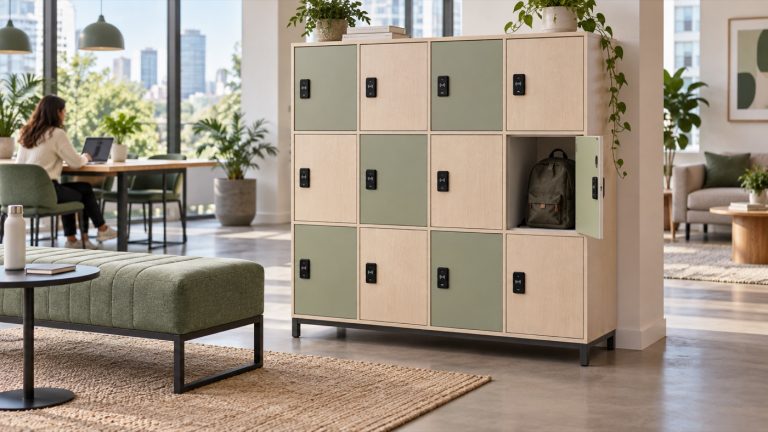
Three Purchasing Decisions Before Choosing a Lock
Start with the access model. Assigned storage gives a named person continuing use of a compartment. Shared-use storage lets someone claim an available compartment temporarily. Managed visitor storage adds an operator who issues and expires access. These modes create different expectations about clearing lockers, retaining records, and resolving disputes over belongings.
Next, define the stored items. A laptop bag, bicycle helmet, coat, and small suitcase need different clear openings and internal depths. Measure the usable opening after installing hinges and lock bodies. A nominal compartment width can be misleading when hardware reduces the space through which a bag must pass.
Finally, identify the administrator. A staffed coworking reception can handle exceptions differently from a residential lounge with no attendant. That decision influences the need for remote support, local recovery tools, user instructions, and replacement parts. A technically capable lock can still be a poor fit if nobody on site can support it.
What Existing Products Establish
Gantner describes battery-powered locker systems with RFID or PIN operation and optional wireless management. Its documentation also distinguishes those products from centrally powered systems. This supports an important purchasing distinction: battery power, connectivity, and management software are separate specification choices. They should not be treated as interchangeable meanings of “smart.”
Hafele’s digital furniture-lock range illustrates another choice: different products use fingerprint, RFID, PIN, or Bluetooth access. Buyers should verify the selected model’s actual functions. A feature advertised for a product family is not evidence that every lock in a quotation includes it.
These are manufacturer descriptions of their own systems, not independent performance comparisons. The purchasing recommendations below are editorial analysis; acceptance limits should be agreed for the actual cabinet and lock combination.
Battery Power or Central Power?
Battery locks can simplify an installation where running cables through multiple cabinets is inconvenient. They also create a maintenance task at each lock. Ask how low-battery warnings reach the operator, whether the battery can be accessed when a compartment is occupied, and what authorized recovery procedure applies after the battery is exhausted. Do not assume all locks behave the same way.
Compare battery estimates using the stated operating conditions: daily opening cycles, radio activity, battery type, and temperature. A long headline lifetime may describe a different usage pattern from a busy shared office. Include replacement labor and the supply of approved batteries in the operating budget.
Central power moves some maintenance away from individual doors, but introduces shared dependencies. A failed power supply, controller, or cable can affect several compartments. Ask which doors remain operational, what any backup supply supports, and how a technician isolates and replaces a failed section. The appropriate choice depends on the site layout and service arrangement.
A Good Lock Still Needs an Accurate Cabinet
The latch and strike plate must meet reliably after assembly, delivery, installation, and repeated use. Door sag, uneven floors, loose hinges, or panel movement can turn a working electronic lock into a cabinet that users have to push or lift to close.
Approve the lock mounting pattern, supported door thickness, strike adjustment, hinge specification, and clearances against the manufacturer’s installation requirements. Test the finished cabinet on its intended base. If cabinets are joined into a bank, repeat the checks after joining and leveling them.
Our coverage of cabinet hardware durability explains why door mass and repeated movement matter. Here, the additional requirement is consistent engagement of the locking hardware. A successful electronic command does not necessarily prove a door is physically closed; whether the system detects that condition depends on the installed sensors.
Keep the security claim proportional to the whole assembly. An electronic credential controls access, but does not by itself establish resistance to forced entry through a panel, hinge, or cabinet back. Buyers needing a rated level of protection should request applicable evidence for the complete product.
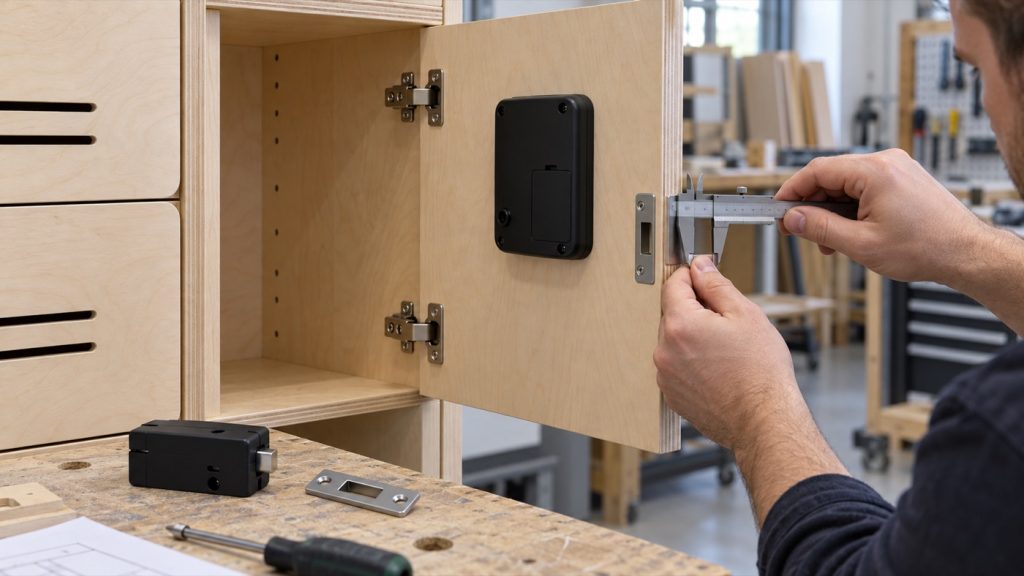
Test the Exceptions Before the Installation Is Accepted
An acceptance session should include ordinary users and the staff who will handle problems. Demonstrate the following scenarios on the specified configuration and record the result for each.
Lost credential: an authorized administrator removes the lost credential’s access and restores access for the legitimate user. Confirm what identity checks the operator requires.
Low battery or power interruption: the operator receives the expected warning, follows the documented recovery procedure, and checks whether assignments survive the interruption.
Network outage: test which previously issued credentials continue working, whether new assignments can be made, and what happens when connectivity returns. Avoid promising offline operation until it has been demonstrated.
Door left ajar: establish whether the system can detect the condition, how it reports it, and whether it could otherwise show the compartment as occupied or locked.
End of a reservation: define the operator’s process for belongings left inside. A software expiration must not be confused with confirmation that a compartment is empty.
These checks turn an abstract feature list into a usable handover record. They also show where the owner needs a written operating procedure rather than another hardware feature.
Compatibility Means More Than “RFID Supported”
If a project expects staff to use an existing badge, test a representative credential with the actual lock, reader, and management configuration. A generic RFID label does not establish compatibility with a building’s existing credential technology or permissions.
For mobile access, demonstrate enrollment, normal entry, phone replacement, account removal, and recovery when the phone is unavailable. Establish who maintains the application and how long software support is included. Check whether an optional subscription is necessary for the functions shown in the demonstration.
The supplier should distinguish local lock features from functions requiring gateways, controllers, a server, or a cloud service. Request an itemized quotation that identifies these dependencies. Otherwise, a low cabinet price may omit the equipment needed to operate the proposed system.
Personal Data and Administrator Access
A connected locker can associate a person with a compartment and access events. Before deployment, the site owner should decide which records are needed, who can see them, how long they are retained, and how departing users are removed.
Ask for separate administrator roles where supported and a record of administrative openings where available. Handover should include ownership of the management account, recovery contacts, and a process for revoking installer access. These are operational recommendations, not a claim that all systems implement the same controls.
Biometric access adds another purchasing decision. It should be selected for a demonstrated need, with a clear understanding of enrollment, template storage, deletion, and an alternative access method. For many shared interiors, a familiar card or PIN may already meet the operator’s requirements.
Cost the Cabinet Over Its Service Life
Compare quotes on a common basis: cabinetry, locks, credentials, gateways, power equipment, commissioning, software charges, training, spare parts, and service response. Include the cost of changing assignments and recovering access, not just replacement hardware.
A useful spare-parts package might include compatible locks, strike plates, hinges, battery covers, and the approved tools needed by trained staff. Require revision identifiers so a replacement ordered later fits the original machining and management system. This is closely related to smart furniture integration, where small component changes can affect the entire product.
Agree who handles a fault that crosses suppliers: for example, a door that fails to latch because the cabinet is out of alignment while the lock electronics pass their own check. One coordinated support route saves the building operator from diagnosing ownership disputes.
Shipping, Commissioning, and the First Week
Protect readers, protruding handles, and internal lock bodies in transit. Secure adjustable shelves and package commissioning credentials separately under the agreed handover process. Inspect door alignment again after delivery; a factory test cannot account for every transport or installation change.
Our article on furniture packaging and transit damage covers the physical delivery risks. For connected lockers, add a compartment-by-compartment commissioning record linking each physical door to its software identity.
During the first week, track failed closures, recovery requests, confusing instructions, and unclaimed compartments. Those observations help distinguish installation defects from training or policy gaps. They are more useful than judging success solely by whether every reader lights up.
The Furniture Opportunity
Smart locker furniture gives contract suppliers a way to combine interior design with practical shared-space services. Different finishes, accessible compartment positions, replaceable fronts, and well-integrated readers can make storage fit a lounge or workplace without sacrificing maintainability.
The strongest offer is a cabinet with a clear operating model, proven hardware fit, documented exception handling, and a costed support plan. Those details determine whether the system remains useful after the opening-day demonstration.